In a new collaboration, Porschenet and one of our newer members, Niket Anjaria, and his company, VR Motion Labs, have teamed up to help us all understand the latest on the topic of full-motion simulators. We hope you will enjoy it.
Top-tier simulation technology has long been an exclusive, ‘members-only’ experience that is reserved for very high-end applications such as Formula 1 racing (also, interestingly, for aviation training, urban planning or disaster management!). Cost and complexity have kept this from us mere mortals, historically. Sadly, urban planners don’t seem to have as active a club of enthusiasts as we do around our Porsches. At least, not yet?
What we have had for some time are homemade racing sims. Like the one you may have in the basement with a used car seat, gaming wheel, and a set of pedals all hooked up to an Xbox. Luckily, the options are becoming a bit more sophisticated as of late. Simulators have been blessed by the same technological adoption curve that turned room-sized supercomputers into PCs. The expensive, sophisticated racing simulation tech is now far more accessible to the discerning enthusiast. Winter is coming. Admit it. You’re thinking about it.
How Real Can It Feel?
Software companies like iRacing are investing heavily in laser-scanning tracks and vehicles, modeling tire physics, and generating real-time telemetry data that would typically be accessible only to race engineers. For example, here’s an excerpt from a partnership press release with McLaren:
“ATLAS Express provides iRacing subscribers with detailed data such as real time tire surface temperatures, lateral acceleration data, steering wheel angle and damper/spring deflection.
Furthermore, the telemetry system comes with a powerful API that allows the data to be used for several purposes such as real-time data overlay for race broadcasts and a broad support for hardware devices such as motion platforms.”
Most even have VR support, which adds an entirely new dimension of realism to the experience.
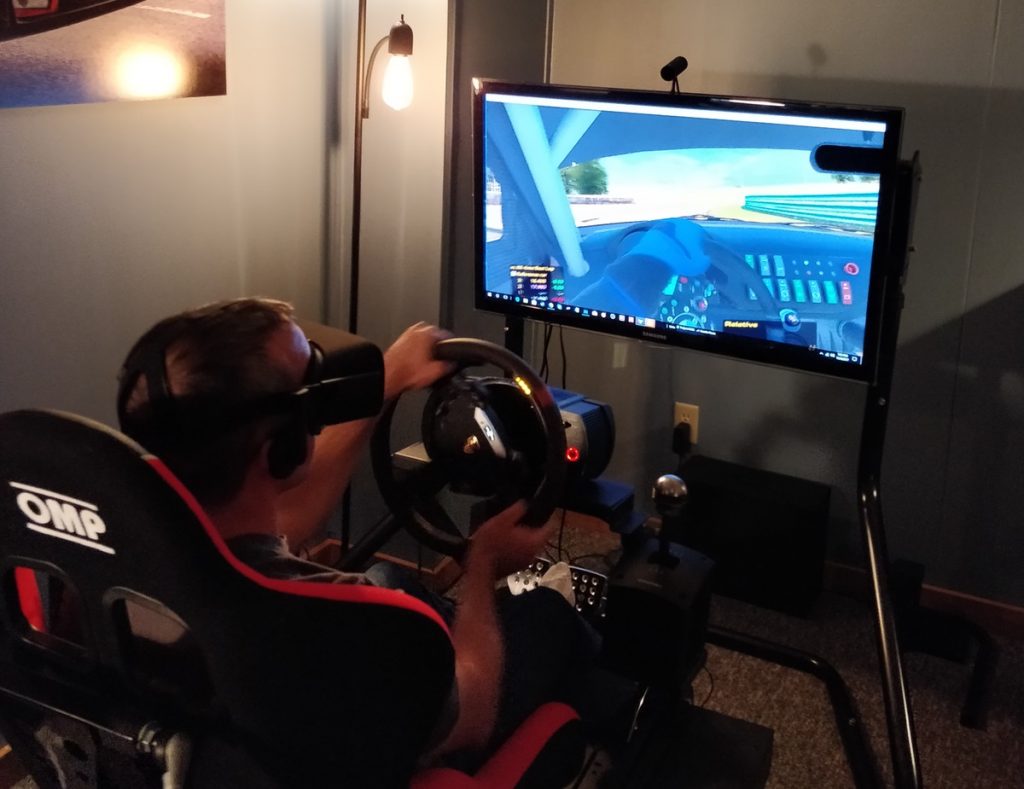
On the hardware side, VR headsets such as the Oculus Rift are not a novelty anymore, thankfully, and a talented team of engineers can synchronize the VR headset graphics with high speed motion actuators. A well-engineered setup can come very close to the real thing, and even simulate the experiences of oversteer and traction loss.
What has all of this achieved so far, you ask?
It Feels Like You Are There
You’re on the back straight at Watkins Glen, rapidly approaching the braking zone while the 911 RSR screams its beautiful flat-six song. The VR headset lets you quickly check your mirrors to see a Corvette C7.R on your tail, but you heard it before that on your high-fidelity headphones. You begin braking, squeezing the hydraulic brake pedal, and modulating pressure as you go. You downshift using the paddles mounted on your wheel that looks just like the one in a Porsche 918 and hear the blip as your PDK downshifts. The motion-actuated racing seat rocks forward under braking, letting you know just when to turn in, and rocks you sideways under cornering as you take the bus stop in a single, precise arc. You feel the weight of the “car” shift as you turn into the carousel. Can you see this in your head yet?
Ten minutes in, and your body forgets that it’s in your living room. Your brain knows you’re not at WGI but it struggles to stay grounded in your physical location because the VR and motion have it fooled into believing you are on track in New York!
Don’t believe it? Run a few laps with a VR headset on and then drive into an Armco barrier at speed. You’ll brace yourself for the impact and then finally remember that you are actually sitting still! Try not to have someone filming you do this as it’s going to end up on Facebook or YouTube…
The Pros Are Way Ahead Of Us. And Not Just On The Track
Simulators have long been recommended by some of the best drivers and coaches in the world. A capable sim setup can help you progress more quickly because it opens you up to more practice time. This is true especially for beginner and intermediate level drivers who benefit by practicing techniques such as heel-toe, trail-braking, squeezing throttle, finding apexes, etc.
Your can read more about it in a post by Ross Bentley, a renowned driving coach who came to instruct our NER instructors this past Spring, on using simulators to improve your driving (through the eyes of a PhD engineer and instructor named Chris Ruckman). It’s a great assessment of both the strengths and inherent challenges, depending on the style of simulator and setup in use. With the intervening two years of progress since this article was written, some of the ‘cons’ have already been improved. In an article by Road & Track columnist Sam Smith, we see that “virtual reality” has greatly improved the overall experience.
Can There Be Cheap Racing?
The cost to benefit ratio of simulators is hard to beat. You can drive nearly any car type – from antique Fiat 500’s to exotics, street cars, race cars, vintage cars, classics…. You can even experiment with suspension setups (camber, toe, caster) or tire pressures, and comparison test your own car setups at different tracks. You can learn new tracks before actually driving there, and then go home and continue to practice and improve what you learned driving the track in person.
It’s also easier on your time – you can go from “dinner at 6 to winner at turn 6” (Niket is working on a copyright for that phrase, by the way) in a matter of minutes, and in the comfort of your home or garage. You could be battling the Corkscrew at Laguna Seca in the middle of a blizzard, or working with your coach who is halfway across the world. With winter coming soon to visit us yet again in the Northeast, this might be almost as good as the summer house in Florida near PBIR. And no baggage check.
What’s the Catch?
Sounds great, right? But keep in mind some cautions from Niket – “It’s a serious undertaking. While a VR Motion Simulator is not the full racing experience – it comes very, very close to the real thing. To do this, it uses some pretty slick components and a lot of engineering goes behind getting them all to work together. As with your own cars, there’s no upper limit to how much you can spend on these components and setups.” I think we’re all probably familiar with our automotive shops giving us this same warning. If you’re like me, you do all you can to ignore it.
We thank Niket for being a great part of our membership community and hope you’ll take a moment to learn a little more about his company, based locally in Plymouth, MA.
About Niket’s company – VR Motion Labs
VR Motion Labs builds custom simulators to order, and can incorporate a wide range of preferences. They can tailor the rig to your weight and height, and even use components that match those in your track car. Customizable parts include seats, harnesses, wheels, shifters, and headsets – each with their own range of options.
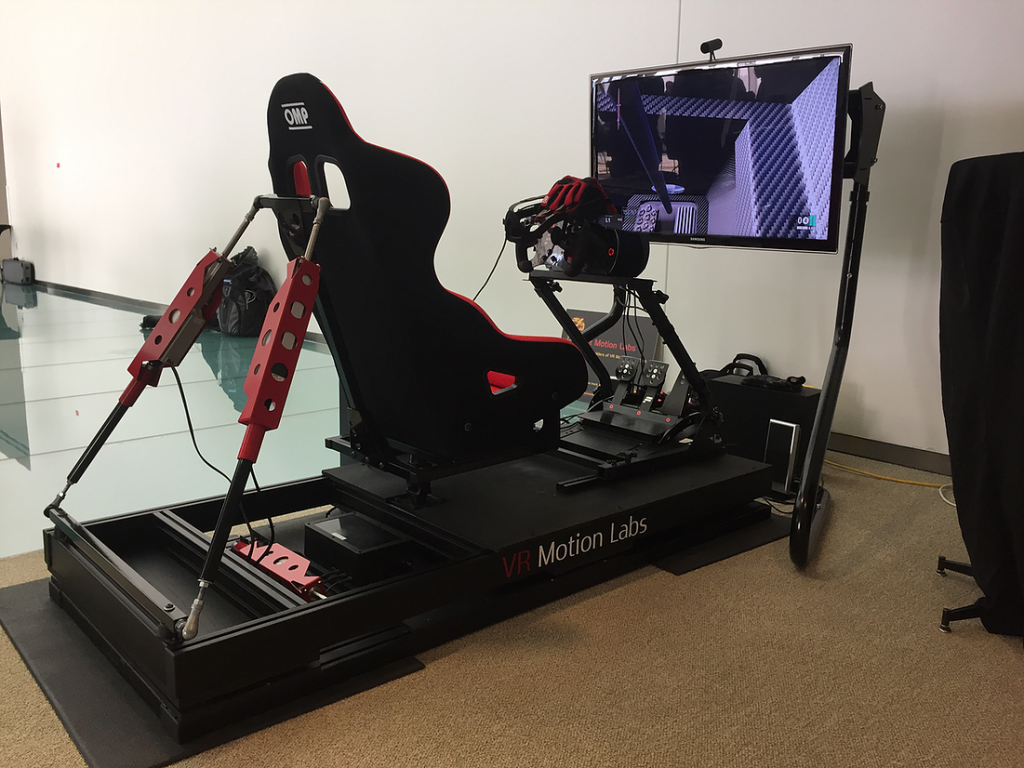
Their simulators come with software licenses and maintenance plans, and you are welcome to drop in for a test drive by appointment. Visit them at https://www.vrmotionlabs.com/