Sim Racing may look really daunting from the outside looking in, but I definitely think it’s worth a try. You’re finally able to drive the cars you watch on tv and read about online. The only difference is you’re racing from the comfort of your own home and you don’t need to worry about the expense of crashing your GT3R 25 times in a row whenever Jeremy Mazzariello comes near you. For people who have never done sim racing, the investment of time, equipment, and the steep learning curve are hurdles to consider before taking the leap into sim racing.
Before I get into what I believe the key to improving is, I’ll tell you a little about myself. I’m a 16 year old boy from Andover Massachusetts, and a competitive swimmer. I train with my club team 20-30 hours a week, while attending high school. In a mere 3 hours or so a week of practice in the sim I’ve been able to improve vastly.
This past June I started off by borrowing Anker’s extra sim rig, consisting of an Oculus Rift and g29 wheels and pedals. I invested in the software and started buzzing around Lime Rock Park in my little Miata.
I sucked completely. I found new ways to crash that no one else has managed to recreate. But with time and practice I came third overall in my class for the Zone Group Challenge Championship earlier this month. And yes, I achieved this before even having my actual drivers license.
My family and I were all enthralled with how lifelike Lime Rock Park was, or I’d assume it’s lifelike since I’ve never been. (working on that) It was so realistic it even had the Harpoon sign!
Overall I think that the biggest thing for newcomers to understand is that there will be a steep learning curve. You need to adjust to the goggles/monitors, get used to the wheel and pedal setup you have, and in my case I had to learn how to drive a car. It took a week of struggle before I could finish 2 laps in a row on Lime Rock. Controlling your level of frustration is half the path to improving.
Once you can finish laps, go to every PCA session you have time for. In these sessions you need to ask one of the coaches to help you either through ride alongs or you hopping into their car. They are super helpful and will not judge you at all. For me I was very fortunate that I knew Anker from going to autocrosses with my dad. Anker got me right into the car with Chris Braun (one of our NER coaches) who helped me right away on my first practice. My first session was at Bathurst, which is a very hard track since there’s a lot of hills, hence the official name Mount Panorama.
That first lesson I had with Coach Braun was really difficult, he was using a lot of terms and concepts I was not familiar with yet. By the end of the session I could finish laps on Mount Panorama, and if he can stay calm with a 16 year old who couldn’t even get out of the pits without binning the car 4 times, he can stay calm dealing with anyone.
After those first few sessions you will improve like I did. After my first session I was about 15 seconds slower than the fastest people, second session I was about 10, then 7 and so on. Today, about 8 months later, I am about 2 or 3 seconds off on most tracks. So far in my sim racing journey the key to improvement has been to ask the coaches for help, it will pay off.
I hope that you reading this has helped influence your decision on whether or not to start sim racing. Sim racing has helped me immensely to learn car handling skills, which will be tested at Autocross next month. It also provides an awesome learning environment where you have nothing to lose. Iracing has allowed me to drive cars I likely will never be able to drive in real life, all on a lifeguard’s salary.
Do you remember the fable of the tortoise and the hare where the hare mocks the tortoise who challenges him to a race that the tortoise ultimately wins when the hare falls asleep when he takes a break!
This fable is very relevant to Sim racing. As a novice, most of us, including me, find it very hard to slow down in corners, and we tend to be overly anxious to pass slower drivers in spots where there is a high risk of messing up. What we haven’t realized is that a simple mistake like missing an apex can have a relatively huge cost. Spinning costs a lot more, and just one spin can set you more back than you can possibly recover. Hitting a wall and having to pit for repairs typically regulates you to being lapped at least once.
Grasping that you become faster by going slower is counterintuitive, and even when you understand that it is the case, It is insanely hard to do when someone is on your rear bumper, or you have just been given the green flag or light at the start. It took me two years of sim racing to do it.
Another thing that fascinates me is the differences in driving styles, brake points, and lines even pro-level drivers exhibit. What they do share is incredible consistency. They can hit exactly the same line plus throttle and brake application lap after lap. The lesson for me is that it doesn’t work to try to emulate your hero’s line, brake, and application inputs. What you need to do is figure out what works best for you and your current skill level and stick with it.
The Difference and Similarities Between Reality and Simulation in Racing
A common question regards how realistic Sim racing is. The short answer is that in some aspects, it isn’t and never will be, and in others, it is amazingly realistic.
Starting with where it is different, the sensory inputs that you use are something you have to learn. In a real car, you primarily use forces to tell you what is going on. You can feel your car rotate when you lose traction, your pedal pulses when ABS kicks in, and so on. In a simulator, it is impossible to replicate the forces that you experience in a real car. Not even a motion rig can come anywhere close. Brake and turning forces in a real race car can exceed one G. To replicate one G, a motion rig would have to be able to tilt you 90 degrees, and for more Gs than that, you would need to put the rig in a centrifuge. Even you did that, you can’t replicate the force transitions without having the simulator perform the exact same motions as the race car, which would require a track-sized simulator!
A motion rig does, however, help by adding physical forces to your body that can be extremely useful in spite of being unrealistic. I find exaggerated nose-diving helps me modulate my braking, especially when trail braking. Because my motion rig has a yaw actuator, I can feel a loss of rear traction in my butt.
So how do sim racers know what the car is doing? Force feedback steering wheels and pedals can replicate the motions and forces of the real race car.
Moving to the similarities, hearing, and vision can be replicated to the extent where they are totally immersive. A single monitor is too restrictive, but triple monitors or a Virtual Reality (VR) headset can be fully immersive. Auditory inputs benefit from being unrealistic. Tire noise is the most important, and it helps to dial down engine noise to make it easier to hear subtle changes.
To enhance realism, sim racing software takes great care to replicate the tracks as accurately as possible. The track and its surrounding are laser scanned and also videoed, so they look exactly the same. The physical properties of the race track are also replicated accurately down to traction, patches, grooves, and bumps.
I have driven Lime Rock Park both in a real race car and in the simulator, and I can testify that the track feels exactly the same in the two modalities.
The last area I will cover is the interaction between cars—turbulence, wind, and drafting work exactly the same. The one difference that can’t be replicated exactly is contact. Because of network delays, the simulation software uses a predictive algorithm to guess where cars will be relative to one another in spite of the delays, which usually are in the order of 9 to 10 milliseconds. What the software can’t predict is what the driver is going to do, so on occasion, the simulator will flag a car contact that actually didn’t happen. This is called a netcode in sim racing speak. Netcodes can be identified after the fact by looking at logs taken by the central server that runs the race.
I almost forgot pit crew simulation. The sim racing services and third parties provide simulated pit crews both for fueling and repairs but also for crew chief spotting for the racer plus lap and sector timing announcements. A particularly useful simulation is fuel calculations.
The final difference is in driver attitude. A crash in real life can cost you life, limb and serious damage to your wallet . A crash in the simulator has no financial cost, no risk to your and your co-racer’s health and at most causes a relatively brief pit stop in your race. This has a real effect on race attitude in sim racing drivers towards driving at 10/10ths or even 11/10ths. It makes races unfold differently. League races tend to have fewer incidents and crashes because the league organizers discourage aggressive racing; but in some uncontrolled sim racing environments there are an inordinate number of incidents and crashes.
To give you a feel for much of I have written here, including the tortoise and hare section, you can watch this broadcast video from a recent race in the PCA National league. In that race, I was able to successfully be the tortoise!
Bang!
At the very last Autocross of the season on October 3rd, it was pretty cool, in the 50s. In spite of the cool temperatures, I did mount the Toyo race tires on the Caterham. Not surprisingly, I had wheel spin every time I put down the throttle. I did manage to avoid any spins, but in the afternoon, I was going through the sweeper from the runway to the main runway pushing the car hard when I heard a loud bang from the rear, followed by a lot of ugly sounding clanking. I was able to coast to a position where I wouldn’t interfere with the course, and only Lev did a slowdown, mainly to hear whether I was OK. When I came to a stop, I tried to see if the car would move under its own power. No go, just the clanking noise. When the round was over the course workers around me helped push the car towards the pits, and Rob MxAlpine came out with his truck and a tow strap to get me the last part of the way.
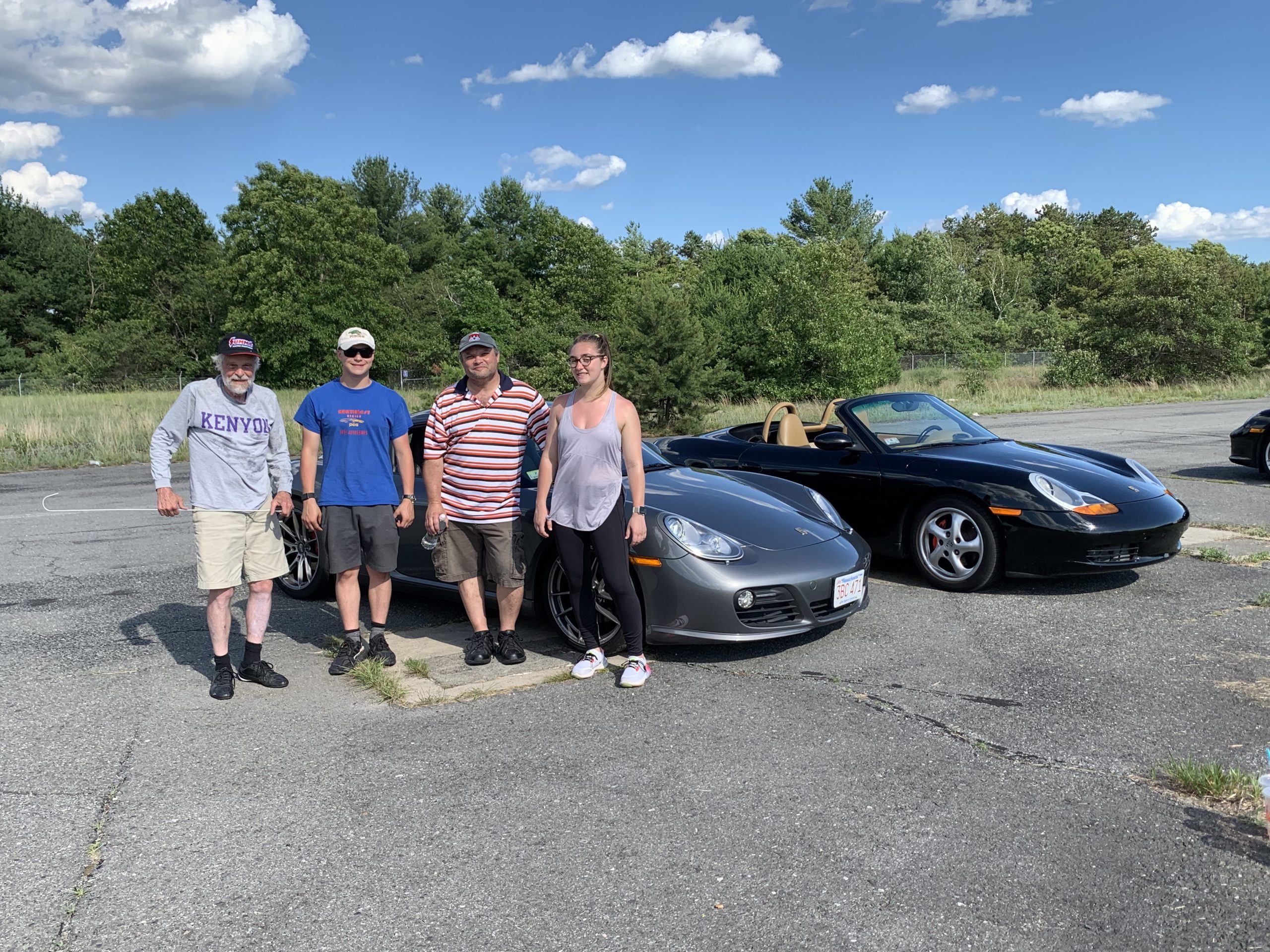
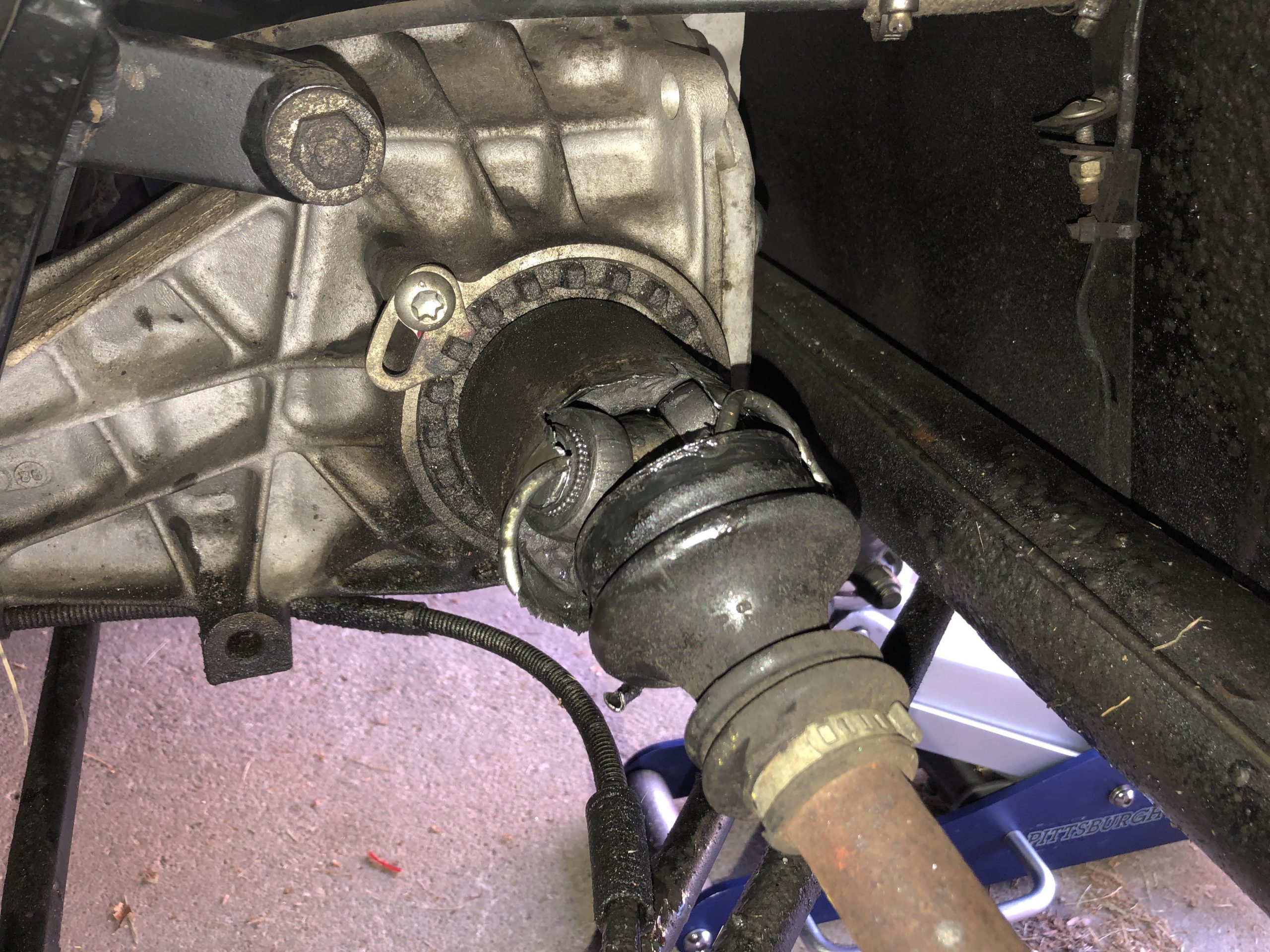
When I jacked the rear up it became very clear what had happened: the universal joint on the left half shaft at the differential end had shredded itself—lots of bent sheet metal. Ollie was extremely helpful by allowing me to load my car into his trailer and take it to my home while I led the way in his Boxster.
The next day I did some more investigating but was limited by my inability to find a 41 mm socket locally to remove the hub nut. Fortunately, I have all winter to get the car back into shape. I have ordered two half shafts, which only can be sourced from Caterham, plus two hub nuts. I will also have to send the left front damper back to Spax in the UK for a warranty repair, so the poor Caterham will spend the winter on jack stands in the garage.
The learning process
I have subscribed for a couple of years to Ross Bentley’s Speed Secrets emails and really enjoyed them. Several times I have replied to them, and he has always responded, which is unusual. For quite a while, I have kept suggesting that he set up a training service for sim racing, and a few weeks ago, he asked me to beta test exactly that. He was also looking for a few bodies to help him run the service, and I immediately stuck up my hand and yelled, “Me! Me!”. He took me up on the offer, and I am managing and moderating the Discord server. There are a couple of other team members that fill other roles, and it has been and looks to be a fun thing to do. Take a look at https://simraceracademy.com/
Ross is also really great at responding to musings. One I haven’t shared with him, but will very soon is about how people learn. Here it is:
Learning to drive a race car is like any other learning process. You start by having a goal, like learning to threshold braking and transitioning to trail braking. So you know what you want to. It sounds simple, but braking performance depends on a huge number of factors, some of which are track temperature, road surface, tire wear, corner shape, camber, slope, car weight distribution, brake bias, and more! If you don’t take all factors into consideration, bad things happen!
You can take two approaches. 1. Emulate precisely what the better drivers do on every corner of the track. The trouble is that you have to find an expert to emulate every time you get to a new track or car and that what you emulate only works if the conditions are exactly the same as when the expert ran it. 2. Learn what the expert learned to be able to figure out how to brake optimally in every condition. I call 1. the what and 2. the why or how. To become really good, I believe you have to take approach 2. But there is a lot more to it. Even if you know the theory, it is a different matter to put it into practice, so you have to also learn that. Initially, and possibly for a long time, you will have to focus your mind on doing that, but that may distract you from performing other tasks well, so eventually, you will have to apply the task unconsciously, just like you automatically hit the brake pedal when a kid runs out in front of you. You don’t think, “kid on the road, I may hit it, need to stop the car, do that by moving my foot from the accelerator to the brake pedal, push really hard.” No, your foot is hard on the brake pedal without any thought process. You may feel that you are plateauing as you go through the process of moving the application of theory from conscious to automatic, but in reality, you are progressing all the time, getting ready to go into the next phase of learning.
https://porschenet.com/wp-content/uploads/2021/11/PCA_NER_SIM_Racing.png10801920Luishttps://porschenet.com/wp-content/uploads/2017/03/NERegionVectorLogo-siteicon.pngLuis2021-11-08 21:22:392021-11-09 07:43:46Behind the Wheel with Anker
This month’s column is about membership communications and more Sim Racing.
With our website and social media being our primary communications vehicles to the membership, you will see much more content than you used to find in the NOR’EASTER appearing on porschenet.com. To ensure that there is a steady and interesting flow of content there we have established a formal submission and publication process. In addition to the regular contributors, we would love to hear more from any members that have something interesting to share, like a trip report, or your experience from your first DE, Autocross or Rally, the new or old Porsche that you just bought, or anything else that you would like to share with the rest of us.
Submissions should preferably be in Microsoft Word format and emailed to [email protected] with any pictures attached. The pictures should be in the highest possible resolution you can provide. Once we receive the email, we run the text through Grammarly to fix any punctuation, spelling, or grammatical errors, but we do make sure that your writing style is preserved. It is also categorized and tagged in order to make it easy to locate in the future. After that is done, it is sent to our web team, who add the content to the website and schedule it for publication. New content is summarized on the front page. Then, on a weekly basis, we send an email to all members summarizing and linking to all new content published after the previous email and a calendar for the current and following month to ensure that you don’t miss anything interesting. Any questions or comments you may have for us should also be emailed to [email protected]. We look forward to hearing from you.
The summer Sim Racing race series and both the regional and national levels are wrapping up, and the fall race series are about to start. This is a good time to jump in and join the fray. We have loaner equipment that we let members take home to get a taste of Sim Racing with minimal investment. If you are interested, send an email to [email protected].
At the regional level, the next series will be racing Porsches on a weekly basis. Race evening is Tuesdays at 8 PM and lasts about two hours with practice, qualification and races. We have a friendly, welcoming, and fun group and work hard to keep it this way. We also invest a lot of effort in bringing new racers up to speed with advice and practice races. To learn more, join our Facebook group at https://www.facebook.com/groups/810156892838722
At the National level, we will be racing the Porsche GT3 R, a sweet car, in an 8-week series. National also works hard to be accommodating to newcomers and has programs targeted towards bringing them up to speed and into the races. They have divided the races into four classes, Challenge, Sport, Club, and Pro, according to the driver’s abilities, so you will race against drivers with similar skills. The next series, number 7, will be published soon on the National Sim Racing League’s website pcasimracing.com. The website has a wealth of information about what Sim Racing is, how to join, and much more, so head over there and take a look.
At the National level, December, January, and February are dedicated to races between the PCA Zones. They have been organized into five groups that each will run their own races in December and January to select the top 8 drivers in each class for each Zone Group. These 32 drivers will participate in a series of three races in January that will crown the Zone group and individual winners within each class.
While we wait for Series 7 to begin, there will be an exciting two-race series between International Porsche club teams. The races will be broadcasted on YouTube and will take place (virtually) at Road Atlanta on September 11th and Spa Francorchamps (no rain!) on September 18th. It will feature the best Sim Racers in the PCA and is guaranteed to be exciting. When I know the exact times and have the URLs to connect to, I will let you know.
Finally, a few comments about myself and Sim Racing: the series that just completed was organized by the West Coast Zones in PCA and featured the Porsche GT3 R in 8 venues. 7 were road races, and one was an oval race at Indianapolis Speedway. To do well in these races, requirement one was to participate. To increase your chances of placing well, you also had to finish well in at least 7 of the eight races. To do that, you had to avoid incidents (crashing, getting penalized for violating racing rules, spinning or running off the track), and finally, you had to have a decent pace. Good pace with incidents leads to worse results than slower pace and fewer incidents. It also requires a huge amount of self-control. It is easy to increase speed when you are anxious to pass a slower driver or when a faster driver is on your rear bumper, but increased speed also increases the risk of incidents, so the best strategy is not to let the adrenalin surge take control and lead you into trouble. I have worked on this for two years now, and it finally came together in this series, and I placed much higher in the rankings than I expected.
It was a good thing that only 8 out of 7 races counted. My performance on the oval was embarrassing. I was involved in multiple crashes (but didn’t cause any) and was black-flagged multiple times for infracting rules that I didn’t quite understand. It was fun but very much a learning experience. If you are interested in seeing a 10 minute summary of the race, check out https://youtu.be/cU1VilIrWsU for a 10-minute video or https://youtu.be/lmr3GXoHO08 for a 30 minute video.
I have owned a sim racing sim rig for two years now and raced actively for a year and a half. It takes a while to learn stuff at my advanced age, and I am deeply envious of the teenagers who join the leagues and outrace me in no time flat.
Several beginners I have observed, including me, tend to start with a relatively simplistic view of what it takes to win a race: Drive as fast as you dare! That is not only a simplistic view but also wrong! To win a race, the sum of your lap times must be less than the sum of your competitor’s lap times, and there is a lot to that.
So, let’s dive into how to have short lap times!
The single biggest issue is making mistakes and losing control. The typical lap time for road racetracks is more or less two minutes, and the usual number of laps for a race in the PCA league is around 20. If you spin, you will typically lose 15 seconds in the lap. It can be much longer if you have to wait for a gap in the other racers to re-enter the track. I have had to wait more than 20 seconds to get back on track, and then I have to accelerate to get up to race speed, which also costs time. So, what is the impact of that spin? Take the scenario that your error-free lap times are 1 second faster than your buddy Joe’s. If neither of you makes a mistake, you will be 20 seconds ahead of him at the end of the race. That is huge! But if you spin once and take more than 20 seconds in the lap you spun in, and that is very likely, then you will finish behind Joe! Spins are not the only mistakes and not the most common.
The worst mistakes are the ones that damage your car. Best case, you can recover and only lose a few seconds. But a lot of damage will affect your lap times. Losing a wing or a splitter may cost you 5 seconds a lap. So do the arithmetic again. If you scape a wall and damage your aero four laps before the end of the race, you will most likely lose the race to Joe. If you hurt the car so badly that you get the meatball flag requiring you to pit and repair, you are guaranteed to end up at the back. Even if the kind race organizer has allowed instant repairs, a pit stop typically takes between 20 and 30 seconds, and you probably had to drive at reduced speed to get to the pits. If your car is undrivable, you also have to be towed, which takes a relative eternity.
So how do you avoid mistakes? Experience is, of course, a factor, but the most significant issue to keep in mind is that the slower you drive, the better your control and the better the margins of error. The temptation is to go at ten 10ths of your ability. No margin of error, and every time something unexpected happens, you lose control. That gets even worse when other racers are on track, and it is not a race if there is only one driver!
Adrenaline is also pumping, and self-control is difficult when your adrenaline levels are high. They peak at the start of the race and when you are in a battle with another driver. You also have to remember that the other racer’s adrenaline also is high, and they are as likely to make mistakes precisely as you are. So, you have to leave some margin of error to minimize the impact of your mistakes and your competitors’ mistakes.
The start of the race is where more races are lost than any other time, and the first corner is where the most incidents happen. Everybody is bunched up, tires are cold, adrenaline is pumping, and drivers who had trouble qualifying are anxious to make up positions—a recipe for disaster. Even in Formula 1, you will see massive pileups, and those are the best drivers in the world! I am in the lowest class, and there if you survive the first five laps, you are likely to finish at least in the middle of the pack! So, these laps are all about survival.
If you survive the first laps without incidents, drivers will space out, and they will focus on advancing their position, passing other drivers. Passing and getting passed is a learned skill. The best strategy when someone catches up with you is to keep your cool and stay on pace. A better driver will get by, and if you try to increase your pace, you are more likely to make a mistake, making it even easier to get by you. If you are the faster driver, the best strategy is most likely to hang out close behind the slower car and wait for it to make a mistake. Feinting a passing maneuver puts more pressure on the driver and makes it more likely to make a mistake.
If you are fast enough to make sense to pass to avoid having my other competitors catch up with you, you need to do it in a safe place and observe the racing rules, written and unwritten.
You may have noticed that I have not talked about technique yet! Racing the racing line, optimizing speed out of corners before straights, braking early, and so on is what improves your pace, but it only wins races if you have learned the previous lessons!
So, if you have just joined the league and have no previous racing experience, my advice is to work on technique and always strive to avoid making mistakes. In both our local league and in the PCA National league, we emphasize welcoming and supporting new racers, so even if you have no experience, join the leagues, and start racing. It is OK to be a beginner, and we will treat you well!
https://porschenet.com/wp-content/uploads/2021/07/Anker-Article.png739875Anker Berg-Sonnehttps://porschenet.com/wp-content/uploads/2017/03/NERegionVectorLogo-siteicon.pngAnker Berg-Sonne2021-07-18 22:00:172021-07-18 22:00:24What I have learned from sim racing – so far!