It’s a painful and difficult time and car care isn’t a driving priority for me right now, but one of my cars did need a regular service done and I was curious to know how local dealer service centers were dealing with the new challenges of COVID 19. So I decided to take a trip down to see how they were handling service at this time. I was expecting to be impressed, but I was pleasantly surprised to learn of a new service offering – deep cleaning your car interior with a new process in ways we can’t do at home, even if you are a home-car-detailer extraordinaire. They can sanitize the interior workings of your climate control system! They demonstrated for me how they have a steam cleaning machine running an isopropyl alcohol and water mix that can actually go through the vents of your car and sanitize the fans and tubing down deep in your dashboard. I hadn’t even thought enough about that challenge to know to ask for it. As expected, they are a step ahead.
In these difficult times, it’s great to know how much Porsche and their dealerships are thinking ahead and how committed they are to our safety. If you need service, Porsche Warwick and others, I’m sure, will pick up your vehicle from your home, service it, and return it to you. The deep steam cleaning service can be added to other procedures or done on it’s own for your peace of mind. Check out the video above to see the new processes they are using for keeping your car and their loaner fleet cars sanitized and safe. We thank them for their proactive thinking.
Please be sure to support those businesses and people who support our club. They give to us in our time of need and now is our time to give back to help these companies and especially their employees. Let’s all come out on the other side of this together!
https://porschenet.com/wp-content/uploads/2020/03/Deep-Clean-Porsche-Warwick-notext.png7201280Sterling Vernonhttps://porschenet.com/wp-content/uploads/2017/03/NERegionVectorLogo-siteicon.pngSterling Vernon2020-03-28 15:50:582020-03-28 15:50:59Deep Cleaning Service For Your Porsche
( author: Sterling Vernon ) Porsche has finally shown their hand, as foreshadowed by the Mission E concept, in the new Taycan. Hearing Calvin Kim, a mechanical engineer and Porsche spokesperson, describe it on a recent episode of Jay Leno’s garage, you are reminded that this car does have some roots in the 918 hypercar, and we like that. But the sedan, four-door, body-style is decidedly non-918-like. It’s “practical”….but in only one way – size/format. The pricing is very high, even compared to a Tesla Model S. The Taycan 4S may close that gap a bit, but it’s still a six-figure automobile. The Tesla Model 3 is often heralded as the democratization of the electric car with it’s comparatively modest price point. Porsche doesn’t aim for that mark. But it’s also not Rolls Royce.
So it’s not inexpensive, sure, but is it too limited dynamically to be a “true Porsche”? Porsche makes it a strong point to be the pointy, sporting end of each segment. The Macan GTS, with a new one recently unveiled, proves that point precisely. Dynamically, it’s make a silk purse of the sow’s ears that constitute the vast majority of cross-over, small SUV, “cute-ute” type cars. With a slam dunk vehicle like that in your lineup…why would you be bending over backwards to telegraph that the next one will be fully electric? It’s all a bit baffling. I’ve had the pleasure of being able to drive the Taycan Turbo model recently. The power – ridiculous. Seriously. So fast. The handling? Well, I’m used to Porsche’s new tendency to defy physics. I’ve had a slew of Cayenne vehicles – my wife forces us, literally, to always have one on hand. They are phenomenally comfortable and reasonably utilitarian. And not slow. They raise your eyebrows with their performance. But they are not Porsche race cars, obviously. They are amazing for what they are, but is that the target? Is that enough for the Taycan and all electric Porsches?
I’ve been scratching my head over this for a while now. Watching a new Top Gear video with Chris Harris explaining his Taycan experience, a new thought dawned on me. The Taycan is really an embodiment of technology and thinking that has to be at least three to four years behind the state-of-the-art. And that may be generous. It took Porsche quite a while to decide the concept was worth pursuing, funding and staffing it all, designing the product, prototyping, pushing and testing new technology and batteries, refitting an entire factory (!!) and supply chain, educating the workforce and sales staff, marketing the product, producing the product, and finally getting it under my right foot. None of this happened overnight. So what has happened in the industry while Porsche was working so hard to bring it’s four-ish-year-old-tech to market? That’s the question we must contemplate – and it’s a bit fascinating.
Chris Harris remarked that he saw “a glint in the eye” of the engineer from Porsche who accompanied the Taycan he tested. That glint – that’s what where we need to be focused.
What are the limitations now you might ask? Some are obvious: the aforementioned cost, the vehicle weight, the need to have a place to charge it reliably, the lack of electric infrastructure outside of residential locations in America (even LA is lacking), the time it takes to recharge… Important parts of owning a car. And then the intangibles. I’m admittedly lucky enough to consider these points to be very important. What does that extra weight do to the experience? Can electric cars have the same “soul”? Without the noise and the smell and the (actual) turbos and the gearboxes…can they still connect to us as humans? I recently heard Alex Roy on a podcast (The Smoking Tire) talking about how humans are basically hydraulic machines with a little electricity involved to control our functions – exactly like traditional cars. Think of how quickly you can fuel yourself! In five minutes, I can intake enough fuel for another eight or more hours! I hadn’t thought about how traditional cars and our own human physiognomy may be somewhat fortuitously aligned! Chew on that thought a bit. Electric cars don’t seem to create that same personal connection – and until Alex Roy explained his hypothesis, I struggled to articulate a defined, possible reason for it. Even Mr. Roy admits that he’s been working to articulate it for years now! Electric cars feel as alien to our bodies as robots and unfeeling machines. That’s an issue that needs to be solved. No amount of marketing hand-waving makes that go away.
Has the Taycan got enough “soul” now to get over these hurdles? I have to be honest and say that I don’t think so. It’s so much better on the intangibles than anything that has come before it that I really, really want to love it. I shock myself to say that. But then the tangible issues pop up and demand attention, cementing the mental barrier for now. It’s so close…so close…but not yet close enough.
So can Porsche close that final gap? Will the clear car-making-art that we love them for finally win this battle for our hearts with an electric model? What changes need to happen?
I’ve long postulated that battery technology is the main obstacle. The great YouTuber behind Engineering Explained summed it up well with a master-class on energy density and how it relates to function. When batteries need to take up ~80% more space to provide ~20% of the energy density, anything that needs to move those batteries around will suffer. In a home, a battery just sits there. No problem. But an airplane illustrates this problem perfectly – using batteries is antithetical to the entire goal of moving fluidly through space (with current battery tech). I’m cooking up a theory that capacitors, with their ability to charge and discharge energy incredibly quickly, have a strong place in electric mobility design. If you could create a large array of them and control the order in which they release energy linearly…but I’m not deep enough in that world, currently, to offer any specific solution. The idea being that we need to get back to or better the energy density in both volume and mass of fossil fuels to be relevant for mobility.
Tires. Tires are the other item that I’ve long tried to impress upon the human populace as being of much greater importance than most people actually consider. They are the only things connecting you to the road! And yet, most folks try to buy they cheapest ones they can find and get more life from them than they were designed to provide. Often at the cost of their own safety. In the case of electric cars now, the load on the tires is huge – equivalent to at least my Cayenne if not a larger SUV. But the contact patch is often smaller – for “efficient” rolling resistance. If you watch the linked Chris Harris video above, he explains that his standard (admittedly somewhat egregious) hooning resulted in the tires being completely unusable within three short bursts. A 911 probably would have lasted at least the day. Extrapolate that to reasonable “spirited” driving….and I see a potential issue here that will need to be watched carefully as these cars age.
And don’t get me started on “autopilot” and self-driving. Most reports I see now indicate that full self-driving may actually be impossible. It’s just too complicated. I’ve been saying this for quite a while now. I’m not sure how many more Teslerati organ-donors we need to go through before we accept this and look for better ways to move people through space without them having to pay attention.
But I’m curious what Porsche engineers have up their sleeves, even now, waiting to work their magical powers of wowing us into opening our minds and wallets to their next innovations. If any company is going to doggedly pursue a viable answer of how to make an electric vehicle stir the soul, I’d have to put my money on Porsche.
It’s too bad we’re not there yet with Electric Porsche #1 (the Taycan model)…but we’re not still all driving Gmünd’s either, are we?
https://porschenet.com/wp-content/uploads/2020/02/L1040382-jpg.webp8001200Sterling Vernonhttps://porschenet.com/wp-content/uploads/2017/03/NERegionVectorLogo-siteicon.pngSterling Vernon2020-02-12 10:42:082020-02-12 13:01:03What’s Next For Electric Cars?
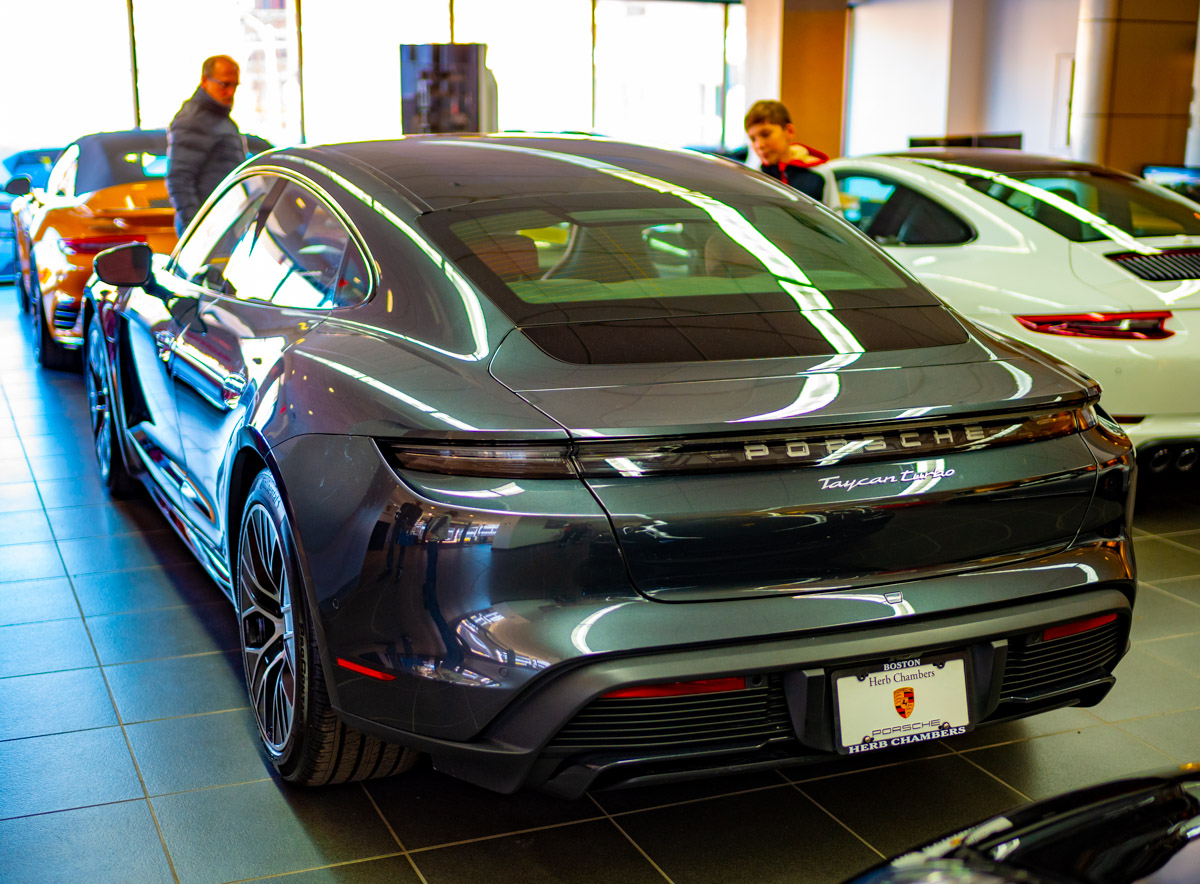
We had a great time at the Winter Warmer event today. Thanks to our friends, Rick Scourtas and John Andrade, and the staff at Herb Chambers Porsche in Boston, we were able to get out and enjoy some great company.
Porsche has grabbed pole position for two classes – GTLM and GTD – for the 2020 Rolex 24h of Daytona! This should be a spectacular race with Aston Martin entering some of their cars at the 11th hour, the new C8.R Corvette’s making their maiden voyage, BMW M8’s, Lamborghini Huracan GT3’s – all kinds of machinery to watch battle it out.
Nick Tandy in the 911 car got a new track record for the class and GTLM pole position with his time of 1:42.207, besting the record he set at Daytona in 2019. Laurens Vanthoor was just 0.049 seconds behind in the 912 car.
Zach Robichon topped the time sheets for GTD in his 911 GT3 R (#9) with a time of 1:45.237 minutes, record setting time as well – the fastest time ever in a GTD-class qualifying at Daytona.
Porsche does not run cars in the DPi or LMP2 classes. Mazda Team Joest will start first in the DPi class. PR1 Mathiasen Motorsports will lead the LMP2 class from the start.
The 24 Hours of Daytona gets underway on Saturday, 25 January, at 1.35pm EST and will be initially viewable on NBCSN.
https://porschenet.com/wp-content/uploads/2020/01/pfaff-911-GT3R-jpg.webp506900Sterling Vernonhttps://porschenet.com/wp-content/uploads/2017/03/NERegionVectorLogo-siteicon.pngSterling Vernon2020-01-24 18:24:372020-01-24 18:24:40Front Row Is The Place To Be
Get out from under that blanket! Don’t throw another log on the fire! Hold off on that next glass of mulled cider! And join us at Herb Chambers Porsche in Boston for our annual Winter Warmer event. You’ll get a preview of what the club has in store for us this year. You’ll be among friends and see lots of folks you haven’t seen since the flakes started flying. And you’ll be able to win some amazing prizes (“Racktrack Rick” Scourtas always over-delivers!) to take home. You can ogle a Taycan and get a glimpse into the electrified back-to-the-future Porsche. Come on out and join us!
https://porschenet.com/wp-content/uploads/2018/01/2014-Ground-School-DSC_0003-sm-2-jpg.webp4291000Stan Corbetthttps://porschenet.com/wp-content/uploads/2017/03/NERegionVectorLogo-siteicon.pngStan Corbett2020-01-05 16:13:122021-03-12 18:45:26DE Ground School Registration is Open
April 24 – April 26, 2020 Otesaga Resort Hotel in Cooperstown, NY
Registration Opens Wednesday January 22, 2020
2020 marks the 35th year for NER’s Annual Spring Ramble, typically the region’s largest event of the year. At the Chatham Bars Inn last year, we welcomed 195 cars and 371 people to a weekend of good friends, good food, top-notch accommodations, and of course, lots of Porsche- worthy roads to travel. This year we’re looking forward to having both veteran Ramblers and first-timers join us at The Otesaga Resort Hotel in Cooperstown, NY.
You’ll arrive Friday (or earlier at our attractive rate) for our evening Welcome Reception, and begin your social and partying activities before the serious driving commences on Saturday morning. My wife and I just returned from a route planning visit, and you’ll traverse many memorable 2-lane country roads thru the Catskill Mountains, and along the creeks and rivers that honeycomb the area.
After registration and breakfast Saturday morning, drivers will head out on a navigational, directions-based tour for about 3 hours before reaching our lunch destination. Following the buffet lunch, there will be another roughly 3-hour route back to The Otesaga, or a more direct route for those wishing to avail themselves of that option.
We’ll meet Saturday evening for cocktails and hors d’oeuvres before enjoying our plated dinner dressed in festive attire. Sunday morning’s buffet breakfast will mark the official end of the 2020 Ramble, after which you’re on your own again to head home, or stay longer and enjoy the charms of Cooperstown.
Mark your calendar for registration opening on January 22, 2020 as this one sells out within two weeks, typically. More info to come!
As a good New Englander, you probably own a car that is “good in the winter.” That may mean simply fitting snow tires, driving more carefully in the snow, or adding some mechanical advantage – such as front wheel drive or all wheel drive (or four wheel drive – yes, it’s technically different, I know). Whatever your solution to the problem of slippery surfaces, how much do you think about how your vehicle does what it does?
Porsche recently introduced their latest Carrera 4 and 4S models with, beyond the standard 992 changes, new tech: a liquid-cooled front differential for the all wheel drive system. As an owner of a 2007 Targa 4 with AWD (not to mention a string of Cayenne’s), I was curious why they would bother investing time in a system that most of us won’t ever really think about. Liquid cooling implies that the goal is to disperse heat, right? Why is there heat here to worry about? I was curious so I did what anyone does these days and Googled it.
If You Can’t Take The Heat
As I’m sure you know, when a car turns, the wheels on one side go faster than on the other. This is because the wheels on each side are suddenly following two different arcs with two different radii. All that high school geometry is coming back to you, right? But why clear those cobwebs? Well, if you solidly connect all those wheels together, they literally get themselves into a bind. The binding pressure builds up and has to go somewhere. To get out of this bind (known as torque-wind), the parts might deflect and bend or they will break. This, of course, is bad. We need to add something with a bit more give – a “differential” – a brilliant little bit of engineering that allows a wheel on one side to temporarily “slip” a bit and go a different speed. The price you pay for this controlled slippage without breaking? Usually that energy from the “slip” is dissipated as heat, often through a clutch pack or viscous coupling device of some sort. There is always a price to pay.
It was a great story arc that went from an origin of concerns about the fuel economy of four-wheel-drive systems born in the 1970’s and how saving every drop of fuel became a primary design goal – sound familiar? The Borg Warner chaps decided that being able to disengage a four wheel drive system’s front wheels manually at the hubs just would not do. Would you want to have to hop out in the snow and mess with turning some big dials on the front of your car? How plebeian. Our computer overlords could surely do a better job of doing this for us.
Gone are the inconveniences associated with part-time-four-wheel drive. Drivers don’t have to ruminate over their choices; they don’t have to wonder whether they’re in four-wheel drive; they don’t need to possess a shred of knowledge about the technology.
In the 1980’s they set to work fitting a dodgy station wagon with a prototyped computer-controlled torque sensing/splitting central transfer case that did away with the center differential completely – by using sensors to react to wheel spin by sending more torque to the front wheels via an electronically-controlled clutch (clutches are basically two spinning discs that rub together to different degrees to vary the rotational speed differences between them – but they get hot with all that friction). The computer to control the new transfer device took up the whole back seat.
Eventually they found that constant measurements of the change in RPM between various bits told them what they needed to know about slip to tell the central clutch pack to engage and grab some power for the front wheels. They packaged it up and sold it to Ford. And shrunk it so it didn’t take up the whole back seat anymore. As a side note – the clutch material was paper-based – odd choice for a heat-dependent system, no? But they tested it and raced it and it worked – after they made it bigger…to handle the heat.
Porsche’s Brand Of AWD
About the same time Borg was getting Ford on board, Porsche was putting an all-wheel-drive system into their 959. Interesting case study in economics right there if you consider the cost of an ’80’s Explorer versus a 959… Porsche’s system was similar, though, in that it used lots of computer-controlled sensors and a computer-controlled clutch pack to go from a pretty even front/rear torque split to as much as 20/80. As far ahead as Porsche was in some ways, the 911 had to make do with a passive viscous-coupling system for all wheel drive up until the computer-controlled clutch pack system went into the 911 Turbo in 2006. The fancy computers didn’t go into the base Carrera 4 until 997 gen 2 in 2008, after the Cayenne helped push the technology along a bit. [ed: some great member feedback – Nick D. pointed out that the 964 C4 had a fully mechanical AWD system with electronic controls that were very similar to the technology in the 959. The 993 went to a more simple and lightweight viscous-coupling system that was much more rear biased but slower to correct for wheelspin. Thanks, Nick!]
Once the technology was in place, what has changed since is…power! (In Jeremy Clarkson voice, of course) The latest base 992 is up to 379bhp and 331lb-ft of torque. My 2007 only had 325bhp and about 270lb-ft. These new turbo base cars are really bringing the torques! I’m betting that this new power, along with ever better and grippier tires, is the reason Porsche is adding some extra cooling to the package. More power means more slip means more heat.
So where did we wind up? All that torque wind-up wound up getting me all wound up. And all this so you won’t wind up in a ditch. It truly is all about where you wind up.
https://porschenet.com/wp-content/uploads/2019/09/911_carrera_4_2019_porsche_ag_1-sm-jpg.webp6751200Sterling Vernonhttps://porschenet.com/wp-content/uploads/2017/03/NERegionVectorLogo-siteicon.pngSterling Vernon2019-09-11 09:34:442019-09-11 14:18:59It’s Where You Wind Up That Matters – Porsche All Wheel Drive