Archive for category: For Enthusiasts

My loyal supporters will recall that I have lost a few readers upon discussing my position on noise, specifically engine noise. To set the stage for this latest discussion, let me remind everyone how this started, and then a decision can be made as to whether or not reading any further will be time well spent.

My first motor vehicle was a Lambretta motor scooter with a 125 cc two-cycle engine. Think, Putt, Putt, Putt. The year purchased, it had been used at Sebring as a communication link between corner stations at the track that we still race on. Since it burned a mixture of gas and oil (one Coke Bottle full of oil for every tank of gas) and had a muffler bigger than the gas tank, it was very quiet. The perfect vehicle for delivering the Orlando Sentinel early in the morning.  Not so perfect trying to be part of the biker crowd in rural Kissimmee, FL. In short order, I had two short pieces of plumbers pipe welded into the side of the muffler and plugged them with a screw-in metal cap. The first cutout on the street. Once the paper route was done and everyone was awake, the plugs came out, and the little scooter spoke with some authority. Not a lot, but some.

Next up was a ’58 VW beetle with a stock muffler. The second day I had it, another VW owner showed me how to take off the two chrome exhaust pipes, remove the fiberglass (probably asbestos) packing inside the pipe and make the 36hp engine sound like it had a lot more muscle. Like maybe 40hp. This was before any kind of nonstock exhaust was available. Extractor exhausts were still ten years away from the speed shops on the left coast. A couple of years into beetle ownership, the weld broke on the #4 exhaust pipe, and the one after the clamp had been loosened on the #3 pipe, the muffler could be pulled out just a little and it sounded like another ten hp appeared. Of course, it didn’t, but it sounded better

A  Porsche 356 was the next car I owned, and it came to me with an Abarth exhaust with four small chrome pipes coming out from under the rear bumper. That was perfect; no modification needed, nice deep exhaust tone, and very long-lasting.

 The 356 was getting expensive to service, and I needed a reliable ride for the last two years of college, so a Volvo 544 was the replacement. It had two mufflers, actually, one resonator in the center sitting longways and one muffler in the rear sitting crossways. Once the rear piece was removed and a straight pipe installed, it wasn’t that much louder, but it had a terrific growl to it when it was downshifted to a lower gear to slow down, just like a ’49 Flathead Ford coming down a grade in second gear.

There were lots of others. Once extractor exhausts were available, I had them on 356’s, 914’s, and even early 911s. Audis, like that old Volvo, always had more mufflers than I thought they needed, so more straight pipes were used. A  later Volvo 142 even got its system shortened to a side exhaust that dumped out in front of the rear wheel. On the driver’s side, of course.  Are we starting to see a pattern here?

There is only one car sitting in the garage with a stock exhaust system, and that is a Macan that I don’t drive and am not allowed to fool with.

 The Speedster has a Sebring exhaust                
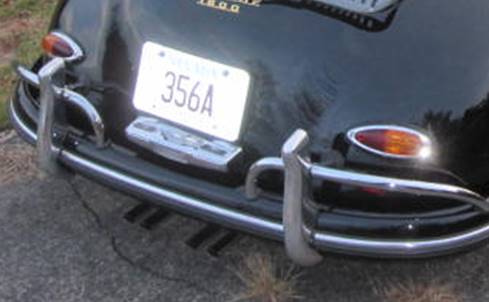
                                      

 The Puddle Jumper has an original Abarth muffler                                                

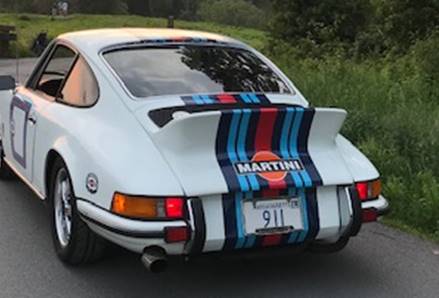
 The 72 911 has an Extractor Exhaust
The ’85 BMW has a stainless steel exhaust that Rick’s Custom built for me years ago that makes great noises, and Pearl, the Audi RS4, also benefited from Ricks’s handiwork before he retired with the installation of an electric cutout that can be opened at the touch of a button.  Even without the cutout, it is short a resonator that says it’s not your Grandfather’s Audi.

As the years rolled along, even the Porsche Factory got into the act. The current Big Dog in the garage (2015 991 Turbo S) has a system that changes tone with the touch of a switch, and it’s not quieter. The C4S that my son, Rob, loaned me for a while to inspire the Turbo S purchase has a Factory loud button as an option. Looking at the system, it is an electric cutout that redirects the exhaust to bypass two of the three mufflers. We both agreed that was a good start, but we have replaced the rear muffler on both cars to provide a little more character.

 Once the Turbo S and the C4S were tested at the track, and both passed the noise limit, that prompted me to take a look at what was on the books in the US that limited the noise on streetcars.

Of the 50 states, only 12 have an ordinance with an actual sound level number written into the regulations. It does make me wonder if Law Enforcement has a dB meter in each police car to actually measure the sound level in those states where an actual sound level applies. The states are :

CA – 95db                                   
CT- 82db                                       
HI-86db                          
MI-95db                       
MT-95db                         
NY-
82db                                 
OH-82db                                      
OR-92db                                       
RI-82db                           
WA-78db                          
DC-90db  

These are actually some pretty big numbers when you consider that the race noise limit at Lime Rock Park is 86db, and those are some loud cars. Of the New  England states, only RI has a measured limit, while others like MA and NH say things like “every motor vehicle shall be provided with a muffler or other suitable device to prevent unnecessary noise.”  I’m not sure what necessary noise really is, but it certainly doesn’t come with electric cars, which is probably why I can’t see owning one. NH has a rather strange rule that states “no person shall operate a motor vehicle with a straight pipe exhaust system,” whatever that is. Maybe that was written back in the ’50s when “Lakes pipes” were popular out west or more recently to address Corvette side pipes.  I did see a set of straight pipes on a Porsche when John Ames fashioned an exhaust system using a set of copper pipes on his Speedster when we were at Univ of MD back in the ’60s. As I recall, they didn’t last long as the brazed joints couldn’t take the exhaust heat. I’ll never forget the look of four pipes sticking out the back of that Tub flying up University Blvd on the way to class. Funny that snapshots of life never seem to go away.

 I really like the VT statute that only states: “A motor vehicle, operated on any highway shall be in good mechanical condition and shall be properly equipped.” MA law is as general as any as it uses the: “prevent unnecessary noise” line. It also goes on to say that motor vehicles need a bell or horn for signaling and a lock, key, or another device to prevent unauthorized use. That sounds like it could’ve been written back when quill pens were in use.

 There are 18 states that prohibit the use of “cutouts,” but only four states say that cars cannot have them mounted in the car. Those would be CA, NY, ME, and IL. Since MA is one of the states that only says that you can’t use it, I guess Pearl is in the clear as long as I don’t hit the switch. In case you are wondering if there are any states that really don’t care, there is one. That would be Alaska, where there are no state laws that address exhaust noise; they are regulated locally.

The research I did above prompted me to look at noise limits at some of the racetracks that I have run on in the past.

The track in NH where NASCAR runs, NHIS, really doesn’t have a noise limit. That seems reasonable as it is still out in the woods, and the deer don’t care. Civilization hasn’t gotten close enough to complain yet, but I’m sure that will happen. Another track with no noise restrictions is Watkins Glen. High above the town of Watkins Glen, I suppose that the residents are just glad to have folks stop by to spend a few bucks. There are a couple of sanctioning groups that do impose a limit, but those numbers are in the 102-105 range. Think jet plane takeoff volume as you’re standing on the runway.

Sebring is another race track without any concerns about noise. Another reason why I really like the world’s longest autocross track.

Speaking about autocrosses, we do have a sound limit when we run at Ft Devens. It is a little strange as it is set as a number over the ambient noise level. The rule says cars on the course cannot make more than 10db over the noise level when there is no noise. Of course, there is never “no noise.” I have a dB meter app on my phone (of course, doesn’t everyone?), and sitting in my office writing it tells me that the sound level is about 55db, and it’s quiet in here. That is about what it reads out on the runway at Ft Devens unless the wind is blowing, and then it can easily bounce up to 75-80db. Add a car out on the main road, and the meter will show 80-85. Take the reading far enough away from the course when a car goes past, and it adds less than 10db. It’s safe to say that a 90db limit is about right there. I don’t know that we have ever asked anyone to leave the event because their car was too loud.

 So, I conclude that noise is good. Even the stickers on the rear of a couple of my cars back that up, “Loud Pipes Save Lives.”

                 KTF


In my new (and evolving) role as DE Crier I received an email from Adam asking me to pen something that would get people excited for the upcoming DE season.  OK, fair enough.  There are a few ways we can go with this.  “Cooped up all winter, pandemic blues, blah, blah, blah but now the robin chirps, the tires squeal, etc.” would be one way. Or “Porsches are meant to be driven on the track, finally see what your car can do.”  But I’m going to take a more concrete approach and take you through the season, track by track, so you’ll have a sense of what is on tap.  Warning!  (Go ahead and wince, Adam.) This will be one man’s opinion and not every word will be positive. But before we get into that don’t forget about the DE Ground School at Palmer on April 24th. This is a class room introduction to DE pitched to those who have never done one (and includes the ability to do slow laps on the track). Even if you don’t think you want to do a DE why not go (and maybe have your mind changed)? Palmer is a cool place, see your other Porsche buddies, go for a nice ride in a rural part of the state.

All right, back to the task at hand.

The first event is NCR’s two day at Lime Rock. Paul Newman loved Lime Rock and I am a big fan – of Paul, but not Lime Rock. It’s a rare combination in that it is great for beginners and also very technical for the experienced.  But it’s short and there is only one left turn where I have managed to spin twice (which probably signals that I am a beginner so why don’t I like it more?). Also the downhill should be taken flat on the floor in my car but that hasn’t seemed to happen yet – so maybe I’m just a whiner. It is historic, in a very pretty part of CT, has good facilities and is a bucket list track. Stay in Great Barrington which is a cool town with nice restaurants.

Next up is Thompson which is also historic – the oval dates to 1940 and was one of the first paved tracks in the country.  The road course has gone through a number of versions.  Like Lime Rock it is pretty short at 1.6 miles but is much slower (60 seconds is a good lap at LRP, 80 seconds at Thompson) and has more turns. The haters call it a glorified autocross (hey! I was the AX chair for 6 or 7 seasons buster) but it has some nice subtleties and the facilities are excellent. Newer Porsches will see 130 on the straight, quit complaining. And, if you live in metro Boston, it is really close.

After that is the first of the two Palmer events (second one is in September). We run one event clockwise and the other counter clockwise (Anker says “anti-clockwise”). I prefer CCW but that’s just because I’ve done a million laps in that direction. This is a challenging track with elevation changes, off-camber turns and lots of opportunity to go wrong. But don’t because it is also the least forgiving of an “off.”  Facilities are good and getting better.  NER has a great relationship with Palmer and there will be good socials when the track goes cold.  An easy drive from Boston but no close hotels. At the Ware Diner they give you a choice of how you want your bacon cooked.

Back on our schedule after a multi-year break is Mont-Tremblant (use your French and call it LCMT).  This is another historic circuit that you have to get to at least once (it was called St. Jovite when F1 ran here). It is a very nice course with some interesting turns and a loooong straight, good runoff as well. I assume our event will be timed to coincide with the Blues Festival at the ski village which is fun. The geography is a little confusing:  at the north is Mont-Tremblant resort (the ski village), in the middle is the village of Mont-Tremblant (where the track is) and in the south is what was the village of St. Jovite – but now all are called Mont-Tremblant. I’m not fond of the ski village (too Disney-esque, drinks from an automated machine, but the kids will like it and the hotels are more modern) – better restaurants in St. Jovite. Consider camping at the track – a nice lake to swim in.  Pain in the neck to get to with the border crossing and maybe horrible traffic in Montreal (Adam thinks the bridge construction may be completed but I’d still brush up on my French swear vocabulary).

Also back on our schedule is Calabogie which is scheduled so that you do Mont-Tremblant then have a travel day to Calabogie – enjoy your week in Canada! Calabogie, like a martini, is an acquired taste (I really like martinis!). It is long and has many corners that look the same but (obviously) aren’t – after three days I was still struggling. And there is nothing to do nearby. But the hard core folks love it and there will be special programming to help advanced drivers improve (heavy training on interpreting data). I’ll be looking for a volunteer to help me write that one up from afar.

In July is the first of two NCR events at Tamworth.  Great track, gorgeous views – it’s too easy to screw up because you are admiring Mt. Chocorua off in the distance when you need to be hitting an apex. The facilities are not yet first class – no garages and not enough paved parking – but the quality of the track more than makes up for it.  The nearby hotels are weak – better ones a half hour away in North Conway – but have breakfast at Rosie’s and you’ll start your day off right.

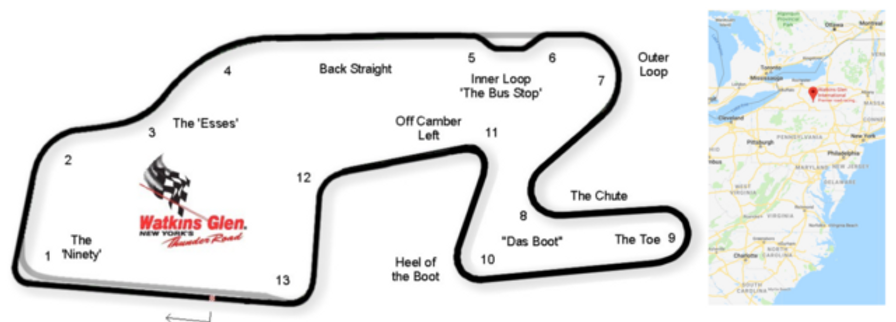
Ah, Watkins Glen. What can I say?  The best, just go.  And take the husband – he’ll like the wineries, the Glen, the Corning Glass Museum.

The season ends with NCR’s New Hampshire Motor Speedway event in October (yes, it might be a little nippy). Before we had Palmer and Thompson we did tons of events at NHMS and everyone complained, instructors wouldn’t sign up. Yes, there are a couple of bumps that are hard on full-on track cars and, yes, it is pretty short.  But it’s a fun track, very safe for newbies and it is a hoot being in this huge sports complex where the NASCAR boys go to play (climb up in the stands between run sessions for a sense of it). Along with Thompson, Palmer and WGI it has garages. And there are lots of good lodging and eating choices nearby (have at least one meal at the Makris).

So there you have it:  29 days at 8 different tracks spread out over the season. If you have never done a track day then you need to, damn it!  And if you are a regular then welcome the newcomers into your fun club. One final enticement:  there are socials when the track goes cold and (thanks to the successful ministrations of Pam Mascetta and Judi Mansing) even the most snobby beer geeks will find something to their liking. See you there!

-Bill Seymour


It’s 1970,  I’ve just graduated and started my new job at a Boston Consultant Engineering Firm.   I have an apartment off Comm Ave in Brighton,  so every day I’m commuting into the office on Stuart Street on the green line.    It’s a nice late summer day and I get off the Trolly a little early to stop at the Star Market for groceries and walk up Comm ave.   There’s a small single bay shop along the way that usually has a car in the window.   This time, as I go by,  there is an interesting looking  red sports car filling the window.   It looks somewhat familiar and by now I’m more than a little curious.    I think I know what it is but it’s hard to be sure through the somewhat dingy window.    But unfortunately,  the shop is closed for the day.

A few Saturdays later,  I walk by the shop again and this time it’s open.  I walk in and talk to the guy who is there and discover that the car is for sale.    Fantastic —  tell me more.   It’s a well used street version of a mid-engined race car.  6 years old and it has 30 something thousand miles on it and it needs an expensive full engine out service.    But they will sell it as–is for the, at the time,  rather staggering sum of $ 10,000.  Which as I recall,  was more than a year’s salary at my new job.   OK,  he probably just threw out a ridiculous price so I’d go away.   In 1970,  a 6 year old  well used Ferrari was still just another near the end of it’s practical life Italian money pit, it had been sitting for months waiting for parts that may or may not ever arrive.   But he was serious.   It was, after all,  as you may have guessed by now, a 6 year old well used Ferrari showing some wear and tear.   It was not perfect,  it had a few bumps and scrapes,  and , of course, it still needed that service.   The Market for old Ferrari’s was just not that good.   

  It was completely impractical to even imagine using it as a street car,  but I wanted that car,  I just couldn’t figure a way to buy it and hold on to it.   After a few weeks it was gone from the window.    I did finally buy a somewhat more practical Mid-engine car from a dealer on Comm Ave that was more in my price range a few months later.     A new off the showroom floor 914-6 from Commonwealth Porsche Audi. (Ted) Sold the 914-6 ,  which by that time had 120,000 miles and a 2.2S engine, for a  2.4 S sunroof Coupe  ( which was sold for a down payment on a House )   —    and the 2.4 S  is now worth  several  times what I paid for that 1st House. 

– Ted Shaw

” (As the header image) is a photo of that used up street car ( now serviced and restored )  that I never was able to find a way to acquire.   The 914-6 appreciated in price as well   —   Just not as much. One just like it ,  or maybe it was the same 250 LM  –  they only made 32 —  changed hands 5 years ago in Monterey for  $ 17 ½ Million. It’s anyone’s guess  how much more it’s worth today”

The company that I was working for was about to go public in the summer of 1995. I had a 1973E Targa about five years before and loved it. But I decided to sell it when we moved near the ocean and had no garage. The (ex) wife wanted a sailboat, so that’s what we did. I was interested in getting a new (to me) 911.

I was early at this particular startup, but not too early, so I could only justify about $20k for my purchase. My 30-day stock option lockup was about to expire, and one of our investment banks was managing option sales. I was told that I could buy and sell enough shares to buy the car in a day or so. I was looking for a replacement for the ’73E, maybe even an upgrade to an early 70s S.

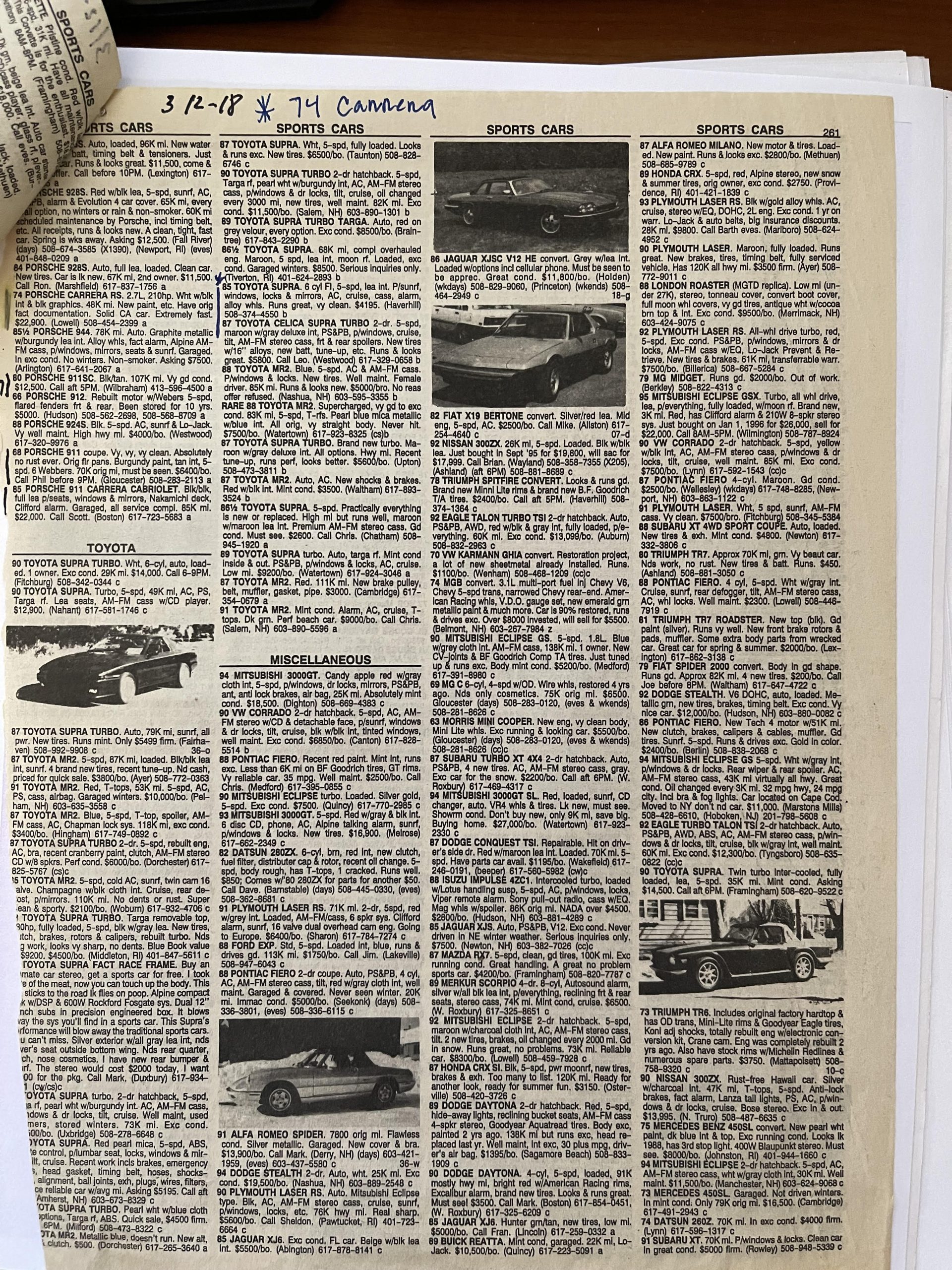
What I found, though, was a 1974 911 MFI Euro Carrera coupe. The seller was asking $21K for it. It was essentially the same car as the ’73 RS, but with the ’74 trim. People hadn’t caught onto the value of that model yet in the US. It was a gray market car, which had a negative connotation to a lot of Porsche buyers at the time. The car had just been refreshed and was being sold by a collector. He had the COA from Germany, where it was originally sold, and it was numbers matching white with black Carrera script. The owner was getting married and was selling it to buy his fiancé a nice engagement ring. His main collection was AC Cobras. The only non-original part on the car was a’ 75-76 whale tail, rather than the ducktail spoiler. I now know the German delivery cars didn’t come with a tail due to German safety regs, so that is likely why the wrong one was installed.

I drove the car and fell in love. So I placed a sell order on the shares to buy the car and gave the seller a verbal offer. But our investment bank, Hambrecht & Quist, claimed they didn’t have our shares set up to sell in their system yet, since  I was the first person to sell. My options had a strike price of about $12 a share, and when I placed the order, the shares were trading around $22-23. H&Q sat on the order for almost a week. During that time, the shares started to tank. The CEO of our company was fired in a surprise move. H&Q finally sold my shares at $15. Instead of making $10-11 per share, I wound up with $3 a share. I was pissed, but there was nothing I could do about it. In the end, I sold my shares for more than anyone in the company that didn’t sell them at the IPO. But I would have sold them at their peak.


I called off the Euro Carrera deal, brushed myself off, and bought a ’79 SC Targa instead. I kept that car for many years. But even then, I knew that the one that got away would be a real collector’s item someday. That car was in California the last time I checked a few years ago. I now have one of the first guards’ red 911s to come off the line in October of ’74. It’s a base Targa that a PO set up like a’ 75-76 MFI Carrera. It’s no substitute for the real thing performance (or $) wise. I’ll never be afraid to put miles on it, though.

Mark O’Connor

” Fyi, the car that is the subject of my story is pretty valuable these days. I watched an auction of a ’75 example about 9 months ago that sold on BaT for $321,911. I posted a comment on that auction recounting this story.”


https://bringatrailer.com/listing/1975-porsche-911-carrera-18/

Sim Racing may look really daunting from the outside looking in, but I definitely think it’s worth a try.  You’re finally able to drive the cars you watch on tv and read about online.  The only difference is you’re racing from the comfort of your own home and you don’t need to worry about the expense of crashing your GT3R 25 times in a row whenever Jeremy Mazzariello comes near you.  For people who have never done sim racing, the investment of time, equipment, and the steep learning curve are hurdles to consider before taking the leap into sim racing.

Before I get into what I believe the key to improving is, I’ll tell you a little about myself. I’m a 16 year old boy from Andover Massachusetts, and a competitive swimmer. I train with my club team 20-30 hours a week, while attending high school. In a mere 3 hours or so a week of practice in the sim I’ve been able to improve vastly.

This past June I started off by borrowing Anker’s extra sim rig, consisting of an Oculus Rift and g29 wheels and pedals. I invested in the software and started buzzing around Lime Rock Park in my little Miata. 

I sucked completely.  I found new ways to crash that no one else has managed to recreate. But with time and practice I came third overall in my class for the Zone Group Challenge Championship earlier this month. And yes, I achieved this before even having my actual drivers license.

My family and I were all enthralled with how lifelike Lime Rock Park was, or I’d assume it’s lifelike since I’ve never been. (working on that) It was so realistic it even had the Harpoon sign! 

Overall I think that the biggest thing for newcomers to understand is that there will be a steep learning curve. You need to adjust to the goggles/monitors, get used to the wheel and pedal setup you have, and in my case I had to learn how to drive a car.  It took a week of struggle before I could finish 2 laps in a row on Lime Rock.  Controlling your level of frustration is half the path to improving. 

Once you can finish laps, go to every PCA session you have time for.  In these sessions you need to ask one of the coaches to help you either through ride alongs or you hopping into their car. They are super helpful and will not judge you at all.  For me I was very fortunate that I knew Anker from going to autocrosses with my dad. Anker got me right into the car with Chris Braun (one of our NER coaches) who helped me right away on my first practice.  My first session was at Bathurst, which is a very hard track since there’s a lot of hills, hence the official name Mount Panorama.

That first lesson I had with Coach Braun was really difficult, he was using a lot of terms and concepts I was not familiar with yet.  By the end of the session I could finish laps on Mount Panorama, and if he can stay calm with a 16 year old who couldn’t even get out of the pits without binning the car 4 times, he can stay calm dealing with anyone.

After those first few sessions you will improve like I did.  After my first session I was about 15 seconds slower than the fastest people, second session I was about 10, then 7 and so on.  Today, about 8 months later, I am about 2 or 3 seconds off on most tracks.  So far in my sim racing journey the key to improvement has been to ask the coaches for help, it will pay off.

I hope that you reading this has helped influence your decision on whether or not to start sim racing. Sim racing has helped me immensely to learn car handling skills, which will be tested at Autocross next month. It also provides an awesome learning environment where you have nothing to lose. Iracing has allowed me to drive cars I likely will never be able to drive in real life, all on a lifeguard’s salary.

Please let your kids do sim racing. I’m lonely.

-Scott Kessel

Last night we attended a special event at the Audrain Motorsports Club in Newport.    We expect that most people know who Donald Osborne is from his appearances on Jay Leno’s Garage on TV (CNBC) and his appearances with Jay on the Audrain Museum You Tube Channel,   and also at Newport Motorweek and National Classic Car events.   If you were involved in motorsports way back in the 70’s you probably even know who Judy Stropus is.  However, for those PCA members, who weren’t yet born, please allow a short history update.

Back in 70’s there was no such thing as Computerized Timing and Scoring with transponders in every car.  Instead Timing was done manually with banks of stopwatches and rows of people with paper and pencil,  all unpaid trained volunteers,  sitting on benches as the official SCCA Timing and Scoring staff.    There was always a delay before the Official Results were announced, particularly during the long races where there were multiple pit stops. It was possible to lose track who was leading.   Disputes and confusion were frequent.  There were no Jumbo-tron screens keeping everyone informed in real time on who was leading.   Although there was often a public address loudspeaker system, it frequently was impossible to hear the commentary over the noise of the racecars, even when the PA was actually working.  The solution to knowing what was going on in the race meant that the spectators and all the individual race teams had to keep their own Lap Charts and Timing Sheets.  

This is where Judy Stropus comes in.   She had a special skill of being able to accurately track lap times and positions of the entire field of a race.    She was legendary for the accuracy of her charts.   So much so that, at the Trans–Am and Can-Am races in the 70’s,  the SCCA frequently  crossed checked her sheets with theirs before releasing the official results.   Her timing sheets changed the results in at least one Trans –Am race and helped Race Teams win others.

It truly is an extraordinary talent.   Her ability to focus on the conflicting tasks of watching the race cars go by while simultaneously writing down all the car numbers and their times without missing any of them.  And in addition to that task, accounting for the cars that may have stopped or crashed on the part of the track she could not see.   She did this all using just a single stopwatch and without taking a break, even for the 24-hour races.   She worked for many of the major teams of the time,  most notably for Roger Penske and Mark Donahue when they were a major force in the Trans –am, Can-am Series and the Indy 500.  She taught others her system of timing and scoring, but only a few were able to master her system.   Only Judy seemed to have the focus and built-in math skills to achieve such accuracy.   She laughing admitted to having made one mistake in her long career.   But that’s a story for her to tell.       

She gained worldwide recognition and respect during a time period when women in motor racing were yet to be taken seriously. Judy was a primary force in the movement to allow credentialed women into the working pits in NASCAR and USAC/Indy Car.  She was a significant instigator in providing wives and girlfriends with a meaningful way to contribute to the team and be recognized as much more than decorations and distractions.  

Judy worked with many famous Porsche Teams and drivers, for example,  Hurley Haywood, Al Hulbert, Bob Akin, Bruce Leven, Dick Barbour and Ted Field.      

Judy herself was an accomplished driver, an author and ran an award-winning public relations firm.   She was also part of the legendary original Cannonball Baker Sea to Sea challenge.   Her all woman team made it to Texas before the Cadillac Limo they had borrowed for the event came apart. 

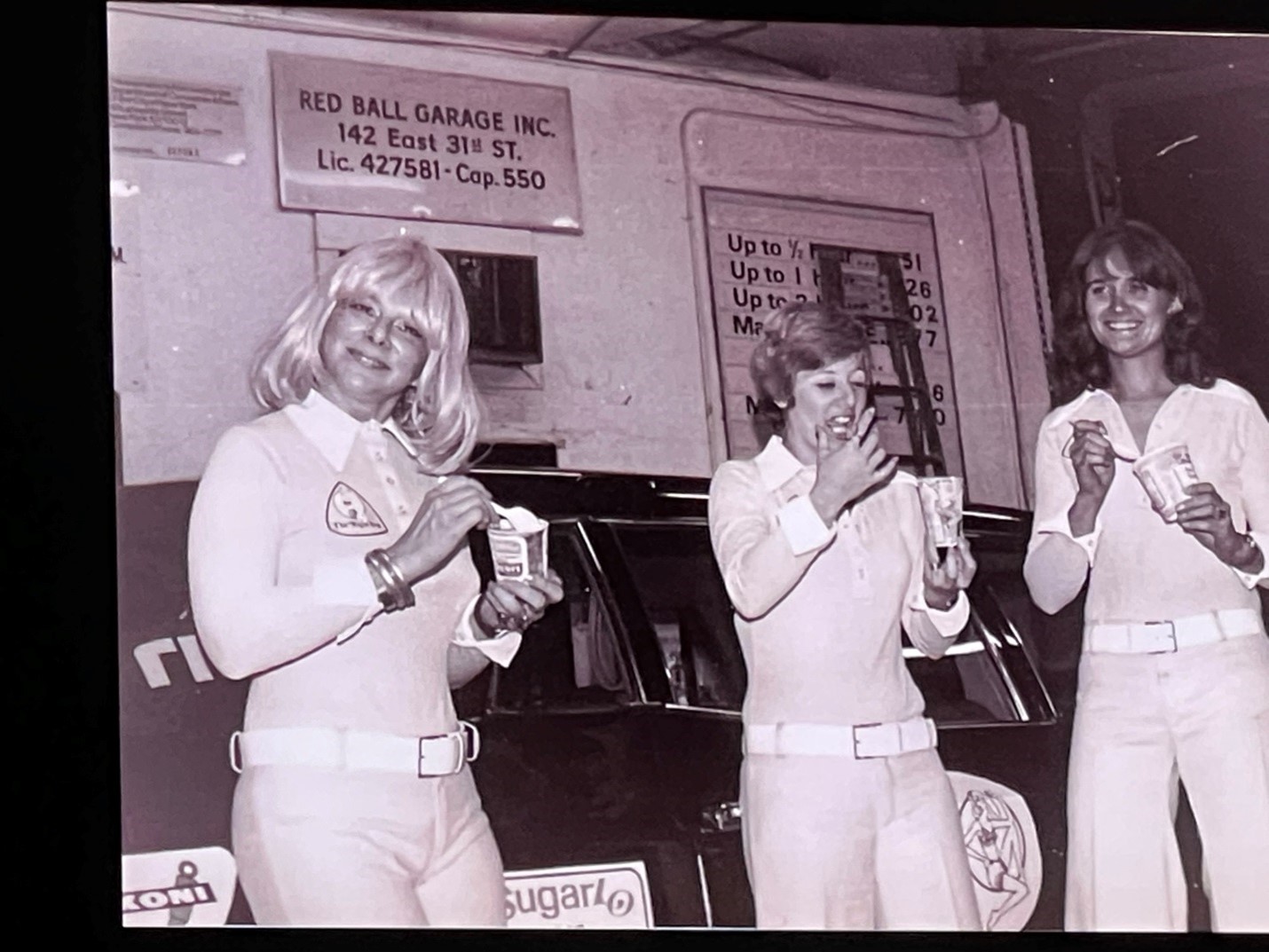
      Donna Mae Mimms,  Lynn St.James  and Judy Stropus ready to depart the Red Ball Garage for the Cannonball

It was an astounding evening with a legendary member of Motorsports and well worth the trip to Newport and back.   Stay tuned to the Audrain Channel on You Tube and hopefully the video of the event will be released soon.  Even if you weren’t around for the wonderful days of Motorsports in the 70’s you need to hear the stories and know the History.                    

Lesia and Ted Shaw

After a year and a half driving Rob’s 2014 C4S it was time to give the car back. It wasn’t a bad deal for him either as he had my 2015 Turbo S in his garage in Arizona. There was a tire/rim swap to be done between the two cars so it was necessary to have them both in the same place at the same time , at least for a while. Since the driving season was at full speed in the valley of the sun we decided that it would be fun to run both cars at a PCA Driver Education event when they were both in the same garage.

I set about getting a shipping company to pick up his car in Medfield and buying plane tickets and he worked on getting us into the same Run Group at the DE so we could play on the track together. To level the playing field a bit we put the Hoosier race tires on his car to compensate for the extra 200 hp that the Turbo produced. That was after a few modifications, like exhaust, intake plenum, and Cobb ECU tune boosted the output from 520hp to around 650hp. While I was driving his car Rob and his crew were playing mechanic on mine. With four year old street tires on my car we figured they would lap at about the same times.

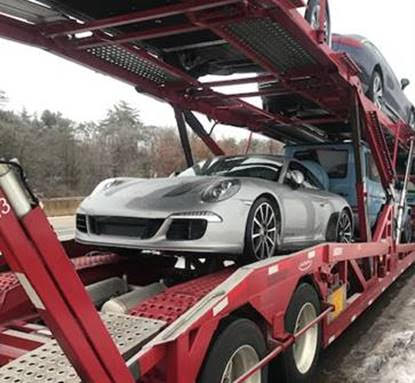
 The pick up went smoothly considering that it was in the middle of a snowstorm. It was pointed out to me that modern car carriers are now built so that the sides are open and the drivers door can be used for easy entry/exit. Apparently, in years past drivers had to get in and out of the car by climbing through the window.  For the 300lb driver that picked up this ride that would’ve been a nonstarter.

The trip out to Goodyear only took a week and the cars were finally together. Tires were swapped and the cleanup was done by Louie, Robbie and Tommy and they were rewarded with rides back and forth to school. Louie even ran errands with it after calling me to get permission. Great crew.

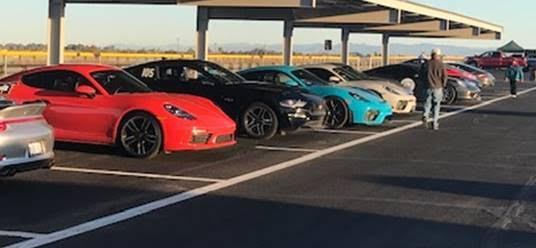
With the Arizona Motorsport Park less than a mile from the house the oil wasn’t even warmed up the morning that we drove both cars over to the track. It was chilly as the sun came up but turned into a great day for driving. Our shelf paper numbers looked great on the doors. The only panel done in metal anymore are the rear fenders so my old magnetic numbers have been retired to the back of the garage door. Rob made it easy by requesting numbers 31 and 311, all straight numbers in the Porsche font. Details are important.


Our advanced run group didn’t start until 9:30 so we had time to go back to the house for breakfast after dropping our gear in a premium parking spot.

The track is flat as a pancake, think big autocross, and over three miles long. With a couple of decent straights the C4S was going to have to be better in the turns to keep up with the Turbo S. The grippy race tires were definitely up to the task. There were to be four 20 minute sessions and they kept to the schedule down to the minute, very impressive.

The first session saw me finding my way, I didn’t want to be the guy who went off into the dirt and there was a lot of dirt. The video I had watched at home was helpful but it was tough to look ahead which what we tell every new student to do at a new track. If you know the track it’s easy to know when to keep your right foot down and when to tiptoe. As I was still learning, Rob was driving away. In the second session I had a better feel for the playing field and was able to keep up a little better. I chased him for a while but couldn’t get around him, he just went way too deep into the turns. He motioned me by to see if I could drive away but I couldn’t. We ran nose to tail the last ten minutes of the session, passing other cars like a train. Great fun.

By the third session it was catch me if you can. I had a better sense of the PCCB (Ceramic brakes) and could brake later that the C4S. Rob was still keeping up well but he ended the session early after his brakes began to fade. Turns out, he also corded a new Hoosier tire, a left front (we were running the track clockwise), so I know how hard he was trying. All in all, a terrific day at the track.

 The Big Dog is now back in Medfield having made the trip on the same truck with the same driver that took out the C4S. Strange how some things work out.

I may give the ’72 a rest this year and run the Turbo S in the Autocross series just to keep the young guys honest. I wonder how the Turbo S would look in a Martini suit? We’ll see.

Meanwhile, Summer is just around the corner.

KTF


Many years ago the Porsche club in New England used to run time trials up in New Hampshire on the ice in the wintertime. A favorite spot was Newfound Lake in Bristol, NH. A course would be set out using as few pylons as possible and timing was done from a bob house (think fishing shack) with a large plastic window looking out over the course. It was one car at a time like an autocross, just colder and slower. Most folks just ran their winter beater with snow tires but all were welcome. After PCA national stopped providing insurance for the event, the Boston Chapter of the BMW Club stepped in and continued the winter fun. That went on for many years until lake access became a problem (too much building around the lake). There were always events in upstate NY and in Canada but that always seemed like too far to go for just a few runs. I think my phone heard me talking about ice racing because a Facebook alert popped up that highlighted the Sports Car Club of Vermont (SCCV) and their ice race schedule near Montpelier, VT. That’s only a 3 hour drive north and with an empty calendar it seemed like a good idea.  Besides, Pearl, the Audi RS4 had a new engine installed and could use some road  miles. The extra 200 hp boost wouldn’t be needed on the lake but the ride up would be fun.


I called my friend Jeff Leeds who had also spent some time on the ice years ago and he was up for it so we motored up on a Friday afternoon for a Saturday event. Finding a great steakhouse in Montpelier VT gave us another incentive to go. The Open Table app had found the J Morgan Steakhouse (I don’t know what happened to the P) and the food was terrific.  If we didn’t drive well at least we’d had a nice dinner. 

Registration was online at Motorsportreg.com which made the process very easy. Drivers meeting was at 9am with the first run to start at 10 am which gave us time for the free breakfast at the Comfort Inn. While we didn’t see any other drivers eating that were headed to the lake, there was a big crowd that came for the free food.


We had both packed pretty much all the warm clothes we owned as the forecast was for a cold sunny day. It had been cold in Boston most of the previous week so that was no surprise. What was a surprise was the morning temperature in VT. I went out to start the car and the reading in the car was 20 below zero. That car had never seen a number that low, nor had I,  and it was going to get lower.   Elmore Lake was about 30 miles north of the capital and we had to have been 10 miles out of town before the heater started to put out any serious heat. By that point the temperatures in some of the low spots had driven the gauge down to minus 27 degrees.


When we arrived at the site they were lining up in a nearby parking lot that looked out over the lake. To get onto the ice another waiver needed to be signed, something to relieve the local town of any liability if you and your car fell into the water. There wasn’t much chance of that happening as the drilled surface had already been measured at 18”, more than enough to support all of us. Everyone lined up for a low speed familiarization run and the cars were all lined up in a plowed pit area afterward. That gave us a chance to get out of the car and walk around to see the what was running that day.


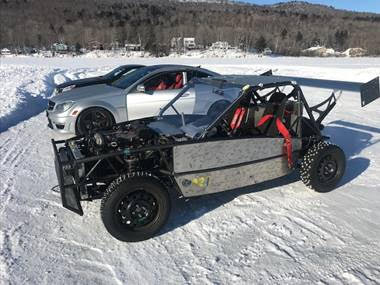
There were some real dedicated ice racers there with tire spikes so long they couldn’t be used on pavement. Fortunately they were in a Super Stud class which was even faster that the regular Studded Class. Pearl was just on a set of 5 year old Bridgestone Blizzacks without studs. Good on the street but a little old and hard to be really competitive in this kind of contest. Can you hear those slow time excuses yet?

 Since these drivers were mostly from VT and upstate New York, I’d say that most had studs of some type. After all, their roads stay snow covered for 5 or 6 months of the year.

The course and the parking/pit area were plowed out (see white truck above) which made the course easy to follow. There were only about 5 pylons on the entire course as nobody wanted to stand out there picking cones.  It was an easy course to see but not so easy to stay on if you were throwing your car around at maximum speed. The plow had  left a berm that was about 5” high but there were a few spots where it was deeper. Deep enough to high center a car that required a tow from the plow. High center means that the center of the car is  stuck on a mound of snow and ice and the wheels aren’t really touching the ground. No touch, no traction, studs or not, you’re stuck.

Jeff and I really didn’t want to be “that guy” so we were careful not to run off course. Of course that meant that we had to drive a little slower but it still seemed fast to us. See excuses, above.  Early in the day there was plenty of hard packed snow on top of the ice to get a decent grip. As the day wore on there were a few spots that were polished by spinning wheels that revealed black ice. Black ice is something you can’t stand up straight on, let alone drive on. The secret is a steady throttle and no sudden steering moves to allow the car to just roll over it. The key to a fast run is to find the white stuff and stay on it.


 Pearl made us proud and I even had a chance to use the loud button on the last run on the ice. I didn’t use it during the day because they had a 90db sound limit and after all that driving to get there I didn’t want to get tossed off the lake early . They loved it, like they say at the track: “we may not be fast but we’re loud”.  Oh wait, that was my High School Band and it was good, not fast.

 It was a great time, nice people, a well-run event and a mid class finish for us.  With darkness falling the event finished up early and we were on the road by 4. That left time for a nice dinner on the way home. A great car weekend in the middle of winter. What’s not to like? Well, maybe it might be closer to zero next time, we could spend more time out of the car.

As a reward for great service Pearl got a new outfit for Spring using my shelf paper method. For old timers, that’s a Datsun stripe, my thanks to Bob Sharp.

Tom Tate RS4 PCA NER


Can summer be far away?

-KTF