Archive for category: For Enthusiasts

“If you start listening to other people, then you wind up building something like other people would do. so if you just start with a clean place on the floor and do it the way you think it should be done; if it works it’s all yours, if it doesn’t you only have one person to blame.”

It’s easy to dismiss replicas as “not real Porsches” – they’re not! But Chuck Beck has been building his “fake cars”, as he calls them, for over 35 years now. And he’s built for OEMs. And he’s raced cars. And his son races. He’s the real deal. And he knows how to build a car – from scratch. The fact that you can get one of his 904’s for less than a “real” 993 right now – what an amazing value! And he’ll put any motor you’d like into it – from the original four cam four cylinder motor up through a water-cooled GT3 engine. He often “engineers for overkill” – evidenced by his Lister replicas that occasionally have 800bhp!

In an era of disposability and easy-as-bitcoin here today, gone tomorrow…Chuck Beck’s work is a reminder that genius is still around us. And he is still building amazing cars. By hand.

Check out his 904 work in more detail

Another visitor to Chuck’s shop describes it for us.

Over the course of 2019, Northeast Region will hold two Driver Education events named: Northeast Region Vintage Days (plus one being hosted by North Country Region). While these events fall under the auspices of the existing NER DE Program – they are purposely different. In fact, by design, they have been developed for those drivers who have left standard DE formats as frankly, our older cars just simply have an increasingly difficult time keeping up in the Solo typical Driver Education Run Groups and many of us have been jokingly referred to as the “Rolling Chicanes” by drivers of GT3s, GT4s, Cup cars, Caymen Rs – well, you know – “those kind’a cars”…

But, we in the Northeast Region think it’s time we take back the day and introduce a Driver Education Format which caters to continuing education, safety – and yes – fun as we pedal our older cars around the track, and frankly, some might argue, we are damn good drivers for that experience. So, that being the case, the NER Driver Education Team is proud to announce an adjunct to our current schedule and format – Vintage Days. In short, Northeast Region Vintage Days follows and adheres to all our existing PCA Driver Education procedures (passing rules, pre-tech, trackside tech, drivers meetings, etc.), but pushes a couple of aspects even further. For example, classroom sessions are mandatory – and there is at least one for each Run Group per day.

As discussed in Rennlist forums and on Facebook – we are trying to have each driver have AT LEAST 2.5 hours of Track Time each day + Classroom. As well, early sign-ups for a full day are… Ready? Are you sure? $200 per driver/car. Yep – $200…

OK, here is the schedule:

June 30th – Palmer Motorsports Park, Palmer, MA.  – Northeast Region’s first Vintage Day event of our second annual NER Vintage Day series of events will be held June 30th at Palmer Motorsports Park.

October 5-6th – Palmer Motorsports Park, Palmer, MA. – We will be wrapping up the second annual NER Vintage Day series of events on October 5-6th at Palmer Motorsports Park. This will be our first 2-day Vintage event and we hope to see more folks from outside our immediate area. We hope you join us on what will be the final days of the Vintage Season – and just the beginning of many more seasons to come!

A couple of things to keep in mind before you sign up… These events will strive to vigorously maintain the “spirit” of Vintage Days. Aggressive driving will not be tolerated – period. If you appear to be driving in the “Red Mist” and conduct yourself in that way, you will be ejected from Vintage Days. This series is meant to be fun – safe and serious fun – and re-emphasize all the aspects we fell in love with when many of us started doing Driver Education and can recall numbers of fellow 356s, SWB 911s, 914s and 912s on the track with us.

So, following are the NER Vintage Run Groups as classified to date:

NAF – Not As Fast
356 (all) 1948-1965
912 (all) 1965-1969, 1976
924 1976-1982
924 Turbo 1979-1982
924S 1987-1988
944 (not S/S2/Turbo) 1982-1989
914-4 1969-1976
914-6 1970-1972
911 1965-1977
911SC 1978-1983
986 Boxster 1997-2004

ALF – A Little Faster
911 Carrera 1984-1989
930 1975-1989
964 Turbo 1990-1994
993 1995-1998
964 1989-1994
928 1978-1995
968 1992-1995
944 S/S2/Turbo 1986-1991
Boxster S 2000-2004

Vintage Race
All cars/years classified above, but not Street Configuration

And finally, for those who know me – NER isn’t a region that really does something only “halfway”, so rather you can expect that Vintage Days to have it’s own permanent presence in the Northeast Region Driver Education Program. That means education classes and course materials specific to our cars. That means we will have a Student feedback and progress tracking mechanisms. And of course, that means that everything you learn at Vintage Days is transferable into our standard Driver Education Program – should you decide to get back into our standard DE program as well.

We have three great events for you to register for right now! Join us for the Winter Warmer at Herb Chambers Porsche in Boston on Feb 25th at 10am. Then come to Ground School and learn all about Driver’s Education (track driving) events, safety equipment, and how to get the most from your Porsche on March 3 at 9:30am at HMS in Danvers. And, of course, the 2018 Ramble heading up to Maine on April 27th.

[ by Gary Cooper ]
Our club is filled with many members who have been working on cars for years and even decades. I am always in awe when I hear about or read an account in the NOR’EASTER of someone who tackles a big, complex project in their garage or barn. I can’t imagine myself ever being at this level (nor do I have the room at home to take on big garage project).

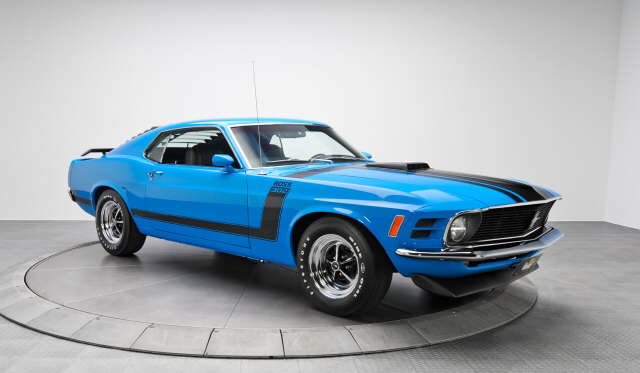
My brother seems to have been born with the ability to disassemble and rebuild any internal combustion engine – and any other car-related job, and I vividly recall his buying a 1970 Boss 302 Mustang (in Grabber Blue) and completely tearing it down. Slowly, bit by bit and piece by piece, every part of that legendary small block engine was taken apart, cleaned, repaired, and put back together.. And I was amazed at the day he hooked it up to a battery and started it out of the car on the engine stand.

mustang-grabber-blue

Alas, not all of us have the gearhead gene. I certainly don’t. But that is not to say there aren’t things that we can’t learn to do ourselves. Porsches, as we all know, can be expensive propositions to own and maintain. Often, we when one is faced with a daunting task the hardest part is just knowing where to start and taking that first step.

One of the many YouTube channels I have stumbled on and subscribed to is Heidi and Franny’s Garage. These two ladies are in Colorado, and own a nice stable Porsche of cars (and a Ferrari 308) produce some quality videos of their ownership experiences. You can view their channel here:

https://www.youtube.com/channel/UCut5i0tjCW-5Bg_mJtS-eRg

Franny seems to be the more mechanically-inclined of the two (although Heidi is no slouch) and recently put up a nice video that can be helpful for someone with little or no mechanical experience, who wants to get started. Take a look here:

By the way, my brother ended up selling that Boss 302 in the early 1980’s. The demands of raising a young family soon overwhelmed his time and money. But, the fact that he had a working engine, the body down to bare metal, and every part cataloged certainly helped him to sell it quickly and get his price. The day his ad appeared in Mustang Monthly, a buyer contacted and shortly thereafter arrived with a trailer.

The world-renowned 56th Rolex 24 at Daytona is scheduled for January 25-28, 2018 at Daytona International Speedway, Daytona Beach, Florida.  PCA welcomes all PCA members, Porsche owners, and their guests to the PCA Car Corral Hospitality Tent, located infield at “The Kink.” There will be interviews with Porsche drivers, product demonstrations, programs and updates from Porsche Motorsports North America. Don’t miss your chance to win one of the special drawings, such as a guided Hot Pit Tour during the races. (Must be present to win) You can also relax in the tent and watch the races on large screen television monitors.

Your general admission ticket to the races will get you into the infield, where the PCA Car Corral Hospitality Tent is located. Remember to bring proof of your PCA membership (membership card) or proof of Porsche ownership, such as your key, for admittance to the tent.

Read all the details ->

[by Glenn Champagne] Porsche. Ferrari. Bugatti. Jerry Seinfeld. Ralph Lauren. Pebble Beach.  This should be the beginning and the end of the story.

paul-russell-911-3

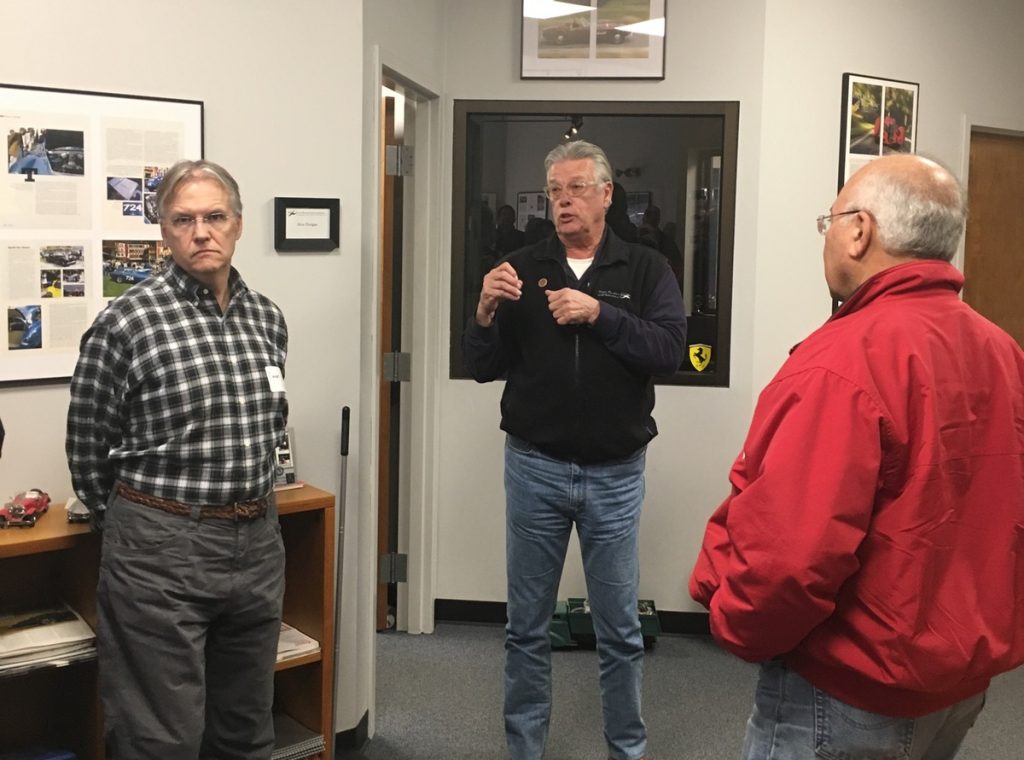
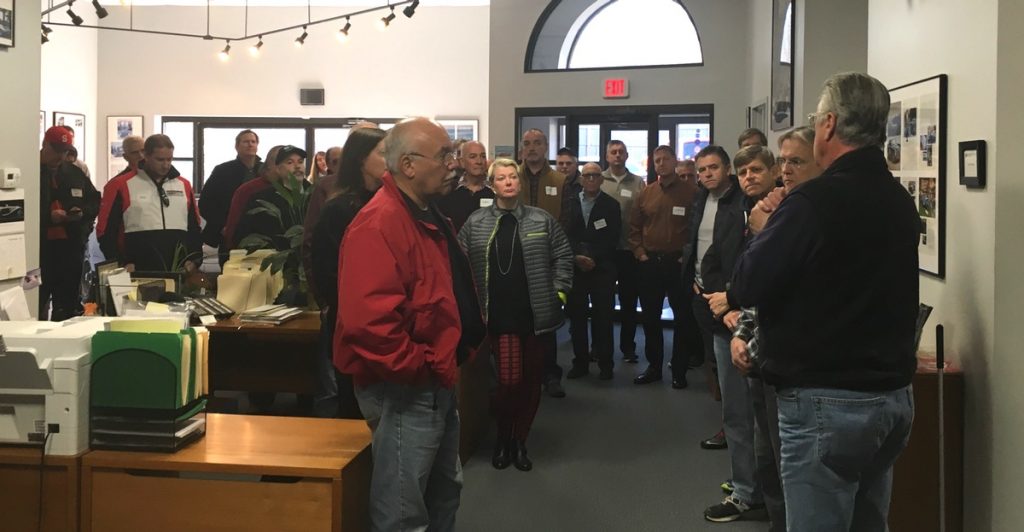
One of the fastest, if not the fastest, event to sell out in NER history, the group gathered at Paul Russell & Company at 10:00am on Saturday November 11th.  Part restorer, re-manufacturer, sales, and museum, this hidden gem is simply unmatched.  Alex Finigan, Paul Russell Inc sales manager, mesmerized us for the full two hours with history of some of the rarest cars in the world.

We started in the lobby, and after a quick two minutes of club business, I mercifully shut up and turned it over to Alex.  Alex began with a history of how it all started and how the word spread.  Due to the value of these cars and the celebrity of some of the owners, Alex politely and wisely reminded us that no photography was allowed.  More on that later…

paul-russell-911-2

From the lobby, Alex lead us into the metal shop.  A relatively short walk, but one with an implied reverence.  People were whispering.  It was church like. Immediately in front of us was the metal shell of a 1948 356 Gmund Coupe.  The owner asked the folks at Paul Russell to deconstruct it down to its shell and rebuild it.  About 10 feet away was a 1937 Bugatti.  We learned at that time, that not only does the company restore, but “re-manufactures” parts that they can’t find or accept the quality of replacement parts.  The frames of the doors were constructed from a hardwood.  Since you can’t find those door frames at your neighborhood O’Reilly Auto Parts store, the restorers had to recreate them with the precision of a professional furniture maker.  Another part they were “re-manufacturing” – is a trafficator.  The first person who can tell me what a trafficator on a 1937 Bugatti is wins a cookie.

paul russell alex finigan

Moving on the next room, Alex educated us on the magnitude of the effort that goes into these cars.  Paul Russell doesn’t make cars “pretty” so they be can enter Pebble Beach.  They will restore and remanufacture whatever needs to be done.  Some of the projects are 18-24 months long.  Some clients have 2 -3 cars in the queue.  Can you imagine the average car owner being told their car won’t be ready for 4 years?  In general, there is a 3 year back up and 5000 labor hours is average.

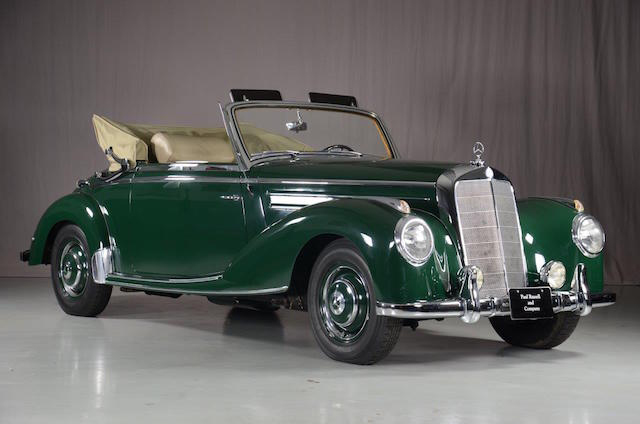
1952 Mercedes-Benz 220 Cabriolet A

1952 Mercedes-Benz 220 Cabriolet A

From there, we saw the metal body of one of only 38 Ferrari 250, short wheelbase, covered headlight California Spiders ever built.  It last sold for $18M.  It was not what I imagined $18M to look like.

Next room was the showroom.  One could also call it a museum.  Porsche Spyder, a Lancia, vintage Mercedes and former Ferrari ‘60s racecars.  Trophies from Pebble Beach.  Some cars can be sold with the crackly old original paint for just as much if it was restored.  Incredible.  Steve McQueen’s last turbo that he never got to drive.  A Ferrari 250 that ~ 10 years ago sold for $1.7M, sold last year for ~$9M.  That’s a 5.3X for you investor types.

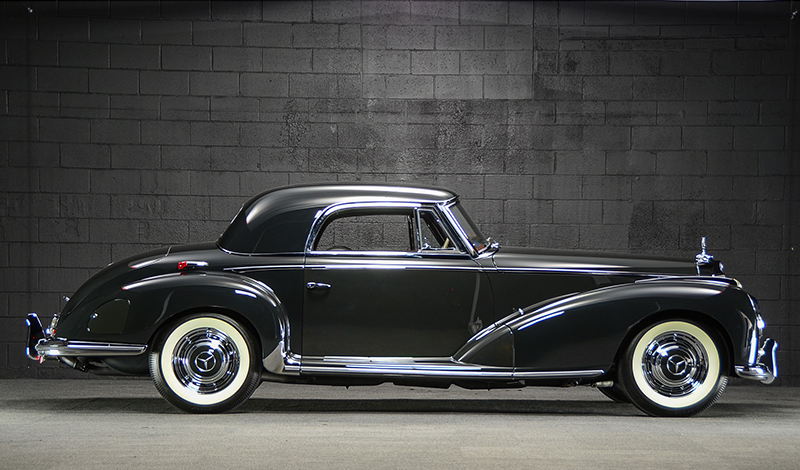
1955 Mercedes-Benz 300Sb

1955 Mercedes-Benz 300Sb

It was stunning and nearly endless.  We could’ve stayed there all day.

paul russell tour 2017

There was one violation of the photography rule:  Paul Skinner was so enamored with my red Holebrook Original Windproof sweater from Sweden, that he retrieved his iPhone and quickly took a picture of the emblem on my right shoulder.  Knowing full well of his violation, he quickly left the building.  It was 11:55. But maybe the start of my career as a men’s sweater shoulder patch model?

Saffron is beautiful, suble, exotic. And incredibly difficult to produce. As this video points out, it takes the stamen from 10,000 flowers to produce about 2 ounces (your standard size spice bottle) of saffron for cooking. And it has to be harvested by hand due to the inherent delicacy. So when Porsche names a new paint color, Saffron Yellow Metallic, you know there is something going on behind the scenes.

Major complexity. That is what is going on behind the scenes. This paint goes down in stages. First there is the base color coat for the yellow color. Then they put down a clear coat to make it pop. You could stop there. But not Porsche. They add another very complicated layer of metal-oxide-coated mica to create a shimmery final finish. They need to hand-sand cars between coats with this finish. Even the thickness of the finish can affect the consistency and final appearance of this paint. And then a final clear coat. Four layers in total.

Beauty certainly never comes without some sacrifice. Your wallet will surely need to make some sacrifices to offset the effort that Porsche has gone to to provide this option. Is this flavor is right for you? Who knows? But it can’t hurt to take a little taste, now can it. Hopefully we’ll see one of these in person soon enough. Is Saffron Yellow Metallic the next Miami Blue? 

In a new collaboration, Porschenet and one of our newer members, Niket Anjaria, and his company, VR Motion Labs, have teamed up to help us all understand the latest on the topic of full-motion simulators. We hope you will enjoy it.

Top-tier simulation technology has long been an exclusive, ‘members-only’ experience that is reserved for very high-end applications such as Formula 1 racing (also, interestingly, for aviation training, urban planning or disaster management!). Cost and complexity have kept this from us mere mortals, historically. Sadly, urban planners don’t seem to have as active a club of enthusiasts as we do around our Porsches. At least, not yet?

What we have had for some time are homemade racing sims. Like the one you may have in the basement with a used car seat, gaming wheel, and a set of pedals all hooked up to an Xbox. Luckily, the options are becoming a bit more sophisticated as of late. Simulators have been blessed by the same technological adoption curve that turned room-sized supercomputers into PCs. The expensive, sophisticated racing simulation tech is now far more accessible to the discerning enthusiast. Winter is coming. Admit it. You’re thinking about it.

How Real Can It Feel?

Software companies like iRacing are investing heavily in laser-scanning tracks and vehicles, modeling tire physics, and generating real-time telemetry data that would typically be accessible only to race engineers. For example, here’s an excerpt from a partnership press release with McLaren:

“ATLAS Express provides iRacing subscribers with detailed data such as real time tire surface temperatures, lateral acceleration data, steering wheel angle and damper/spring deflection.

Furthermore, the telemetry system comes with a powerful API that allows the data to be used for several purposes such as real-time data overlay for race broadcasts and a broad support for hardware devices such as motion platforms.”

Most even have VR support, which adds an entirely new dimension of realism to the experience.

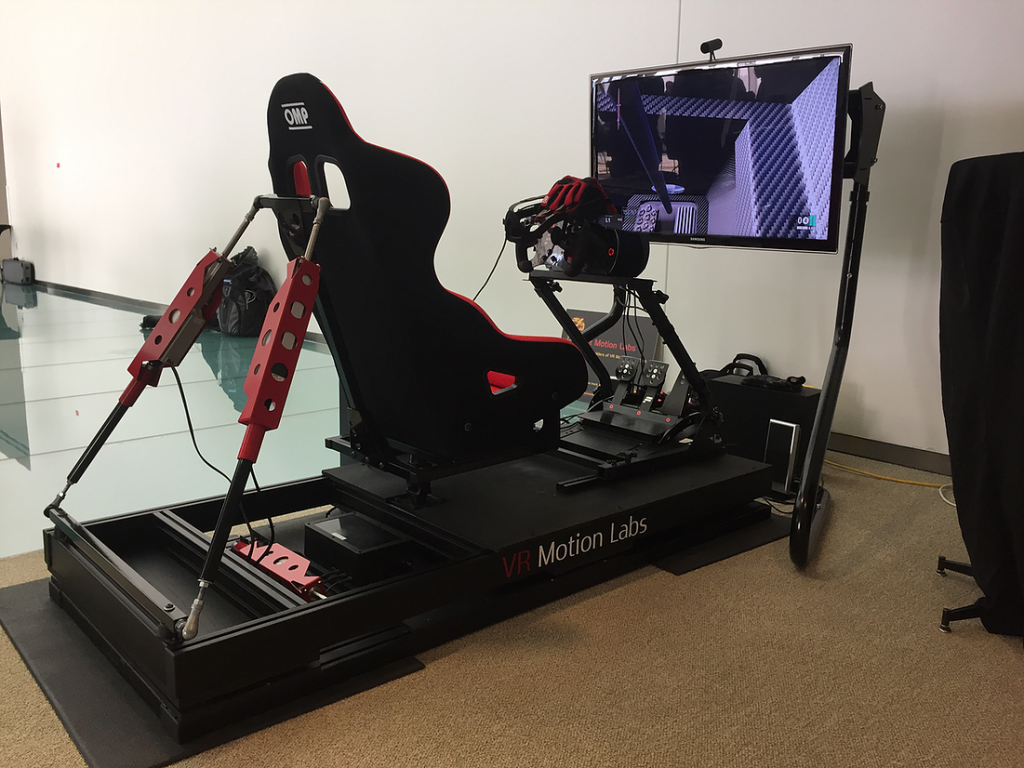
On the hardware side, VR headsets such as the Oculus Rift are not a novelty anymore, thankfully, and a talented team of engineers can synchronize the VR headset graphics with high speed motion actuators. A well-engineered setup can come very close to the real thing, and even simulate the experiences of oversteer and traction loss.

What has all of this achieved so far, you ask?

It Feels Like You Are There

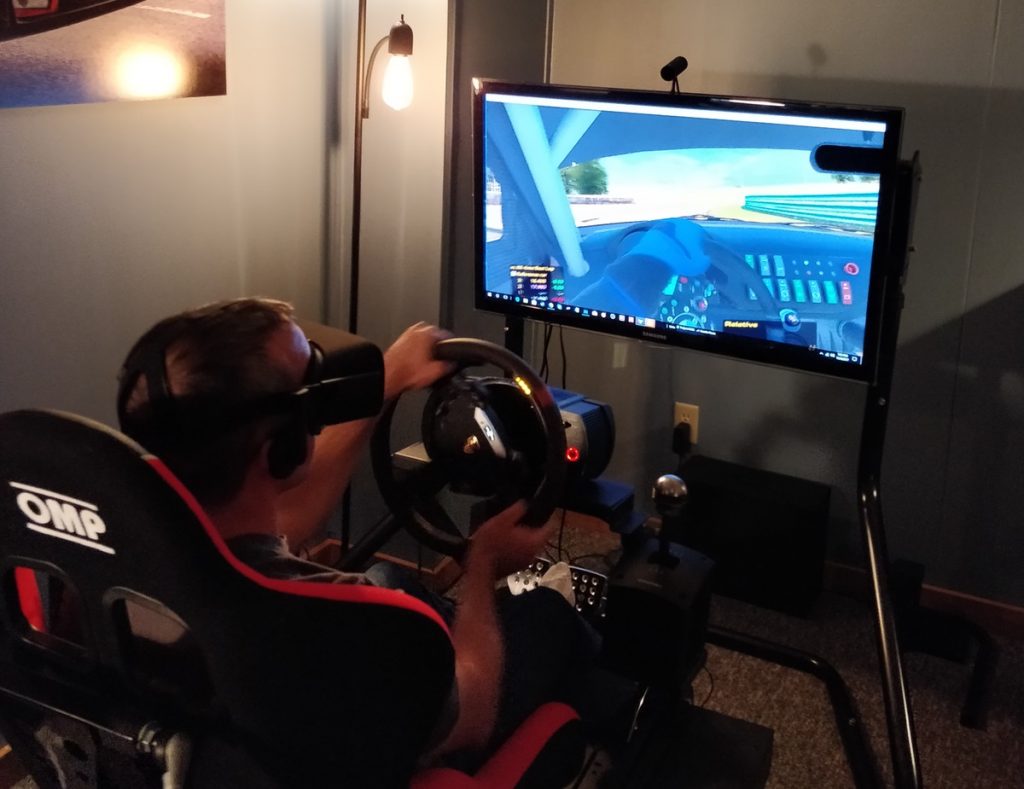
You’re on the back straight at Watkins Glen, rapidly approaching the braking zone while the 911 RSR screams its beautiful flat-six song. The VR headset lets you quickly check your mirrors to see a Corvette C7.R on your tail, but you heard it before that on your high-fidelity headphones. You begin braking, squeezing the hydraulic brake pedal, and modulating pressure as you go. You downshift using the paddles mounted on your wheel that looks just like the one in a Porsche 918 and hear the blip as your PDK downshifts. The motion-actuated racing seat rocks forward under braking, letting you know just when to turn in, and rocks you sideways under cornering as you take the bus stop in a single, precise arc. You feel the weight of the “car” shift as you turn into the carousel. Can you see this in your head yet?

Ten minutes in, and your body forgets that it’s in your living room. Your brain knows you’re not at WGI but it struggles to stay grounded in your physical location because the VR and motion have it fooled into believing you are on track in New York!

Don’t believe it? Run a few laps with a VR headset on and then drive into an Armco barrier at speed. You’ll brace yourself for the impact and then finally remember that you are actually sitting still! Try not to have someone filming you do this as it’s going to end up on Facebook or YouTube…
vr-motion-labs-simulator-racing

The Pros Are Way Ahead Of Us. And Not Just On The Track

Simulators have long been recommended by some of the best drivers and coaches in the world. A capable sim setup can help you progress more quickly because it opens you up to more practice time. This is true especially for beginner and intermediate level drivers who benefit by practicing techniques such as heel-toe, trail-braking, squeezing throttle, finding apexes, etc.

Your can read more about it in a post by Ross Bentley, a renowned driving coach who came to instruct our NER instructors this past Spring, on using simulators to improve your driving (through the eyes of a PhD engineer and instructor named Chris Ruckman). It’s a great assessment of both the strengths and inherent challenges, depending on the style of simulator and setup in use. With the intervening two years of progress since this article was written, some of the ‘cons’ have already been improved. In an article by Road & Track columnist Sam Smith, we see that “virtual reality” has greatly improved the overall experience.

Can There Be Cheap Racing?

The cost to benefit ratio of simulators is hard to beat. You can drive nearly any car type – from antique Fiat 500’s to exotics, street cars, race cars, vintage cars, classics…. You can even experiment with suspension setups (camber, toe, caster) or tire pressures, and comparison test your own car setups at different tracks. You can learn new tracks before actually driving there, and then go home and continue to practice and improve what you learned driving the track in person.

It’s also easier on your time – you can go from “dinner at 6 to winner at turn 6” (Niket is working on a copyright for that phrase, by the way) in a matter of minutes, and in the comfort of your home or garage. You could be battling the Corkscrew at Laguna Seca in the middle of a blizzard, or working with your coach who is halfway across the world. With winter coming soon to visit us yet again in the Northeast, this might be almost as good as the summer house in Florida near PBIR. And no baggage check.

What’s the Catch?

Sounds great, right? But keep in mind some cautions from Niket – “It’s a serious undertaking. While a VR Motion Simulator is not the full racing experience – it comes very, very close to the real thing. To do this, it uses some pretty slick components and a lot of engineering goes behind getting them all to work together. As with your own cars, there’s no upper limit to how much you can spend on these components and setups.” I think we’re all probably familiar with our automotive shops giving us this same warning. If you’re like me, you do all you can to ignore it.

We thank Niket for being a great part of our membership community and hope you’ll take a moment to learn a little more about his company, based locally in Plymouth, MA.

About Niket’s company – VR Motion Labs

VR Motion Labs builds custom simulators to order, and can incorporate a wide range of preferences. They can tailor the rig to your weight and height, and even use components that match those in your track car. Customizable parts include seats, harnesses, wheels, shifters, and headsets – each with their own range of options.
vr-motion-labs-simulator-racing

Their simulators come with software licenses and maintenance plans, and you are welcome to drop in for a test drive by appointment. Visit them at https://www.vrmotionlabs.com/