Archive for year: 2021

The Tortoise and the Hare

Do you remember the fable of the tortoise and the hare where the hare mocks the tortoise who challenges him to a race that the tortoise ultimately wins when the hare falls asleep when he takes a break!

This fable is very relevant to Sim racing. As a novice, most of us, including me, find it very hard to slow down in corners, and we tend to be overly anxious to pass slower drivers in spots where there is a high risk of messing up. What we haven’t realized is that a simple mistake like missing an apex can have a relatively huge cost. Spinning costs a lot more, and just one spin can set you more back than you can possibly recover. Hitting a wall and having to pit for repairs typically regulates you to being lapped at least once.

Grasping that you become faster by going slower is counterintuitive, and even when you understand that it is the case, It is insanely hard to do when someone is on your rear bumper, or you have just been given the green flag or light at the start. It took me two years of sim racing to do it.

Another thing that fascinates me is the differences in driving styles, brake points, and lines even pro-level drivers exhibit. What they do share is incredible consistency. They can hit exactly the same line plus throttle and brake application lap after lap. The lesson for me is that it doesn’t work to try to emulate your hero’s line, brake, and application inputs. What you need to do is figure out what works best for you and your current skill level and stick with it.

The Difference and Similarities Between Reality and Simulation in Racing

A common question regards how realistic Sim racing is. The short answer is that in some aspects, it isn’t and never will be, and in others, it is amazingly realistic.

Starting with where it is different, the sensory inputs that you use are something you have to learn. In a real car, you primarily use forces to tell you what is going on. You can feel your car rotate when you lose traction, your pedal pulses when ABS kicks in, and so on. In a simulator, it is impossible to replicate the forces that you experience in a real car. Not even a motion rig can come anywhere close. Brake and turning forces in a real race car can exceed one G. To replicate one G, a motion rig would have to be able to tilt you 90 degrees, and for more Gs than that, you would need to put the rig in a centrifuge. Even you did that, you can’t replicate the force transitions without having the simulator perform the exact same motions as the race car, which would require a track-sized simulator!

A motion rig does, however, help by adding physical forces to your body that can be extremely useful in spite of being unrealistic. I find exaggerated nose-diving helps me modulate my braking, especially when trail braking. Because my motion rig has a yaw actuator, I can feel a loss of rear traction in my butt.

So how do sim racers know what the car is doing? Force feedback steering wheels and pedals can replicate the motions and forces of the real race car.

Moving to the similarities, hearing, and vision can be replicated to the extent where they are totally immersive. A single monitor is too restrictive, but triple monitors or a Virtual Reality (VR) headset can be fully immersive. Auditory inputs benefit from being unrealistic. Tire noise is the most important, and it helps to dial down engine noise to make it easier to hear subtle changes.

To enhance realism, sim racing software takes great care to replicate the tracks as accurately as possible. The track and its surrounding are laser scanned and also videoed, so they look exactly the same. The physical properties of the race track are also replicated accurately down to traction, patches, grooves, and bumps.

I have driven Lime Rock Park both in a real race car and in the simulator, and I can testify that the track feels exactly the same in the two modalities.

The last area I will cover is the interaction between cars—turbulence, wind, and drafting work exactly the same. The one difference that can’t be replicated exactly is contact. Because of network delays, the simulation software uses a predictive algorithm to guess where cars will be relative to one another in spite of the delays, which usually are in the order of 9 to 10 milliseconds. What the software can’t predict is what the driver is going to do, so on occasion, the simulator will flag a car contact that actually didn’t happen. This is called a netcode in sim racing speak. Netcodes can be identified after the fact by looking at logs taken by the central server that runs the race.

I almost forgot pit crew simulation. The sim racing services and third parties provide simulated pit crews both for fueling and repairs but also for crew chief spotting for the racer plus lap and sector timing announcements. A particularly useful simulation is fuel calculations.

The final difference is in driver attitude. A crash in real life can cost you life, limb and serious damage to your wallet . A crash in the simulator has no financial cost, no risk to your and your co-racer’s health and at most causes a relatively brief pit stop in your race. This has a real effect on race attitude in sim racing drivers towards driving at 10/10ths or even 11/10ths. It makes races unfold differently. League races tend to have fewer incidents and crashes because the league organizers discourage aggressive racing; but in some uncontrolled sim racing environments there are an inordinate number of incidents and crashes.

To give you a feel for much of I have written here, including the tortoise and hare section, you can watch this broadcast video from a recent race in the PCA National league. In that race, I was able to successfully be the tortoise!

Bang!

At the very last Autocross of the season on October 3rd, it was pretty cool, in the 50s. In spite of the cool temperatures, I did mount the Toyo race tires on the Caterham. Not surprisingly, I had wheel spin every time I put down the throttle. I did manage to avoid any spins, but in the afternoon, I was going through the sweeper from the runway to the main runway pushing the car hard when I heard a loud bang from the rear, followed by a lot of ugly sounding clanking. I was able to coast to a position where I wouldn’t interfere  with the course, and only Lev did a slowdown, mainly to hear whether I was OK. When I came to a stop, I tried to see if the car would move under its own power. No go, just the clanking noise. When the round was over the course workers around me helped push the car towards the pits, and Rob MxAlpine came out with his truck and a tow strap to get me the last part of the way.

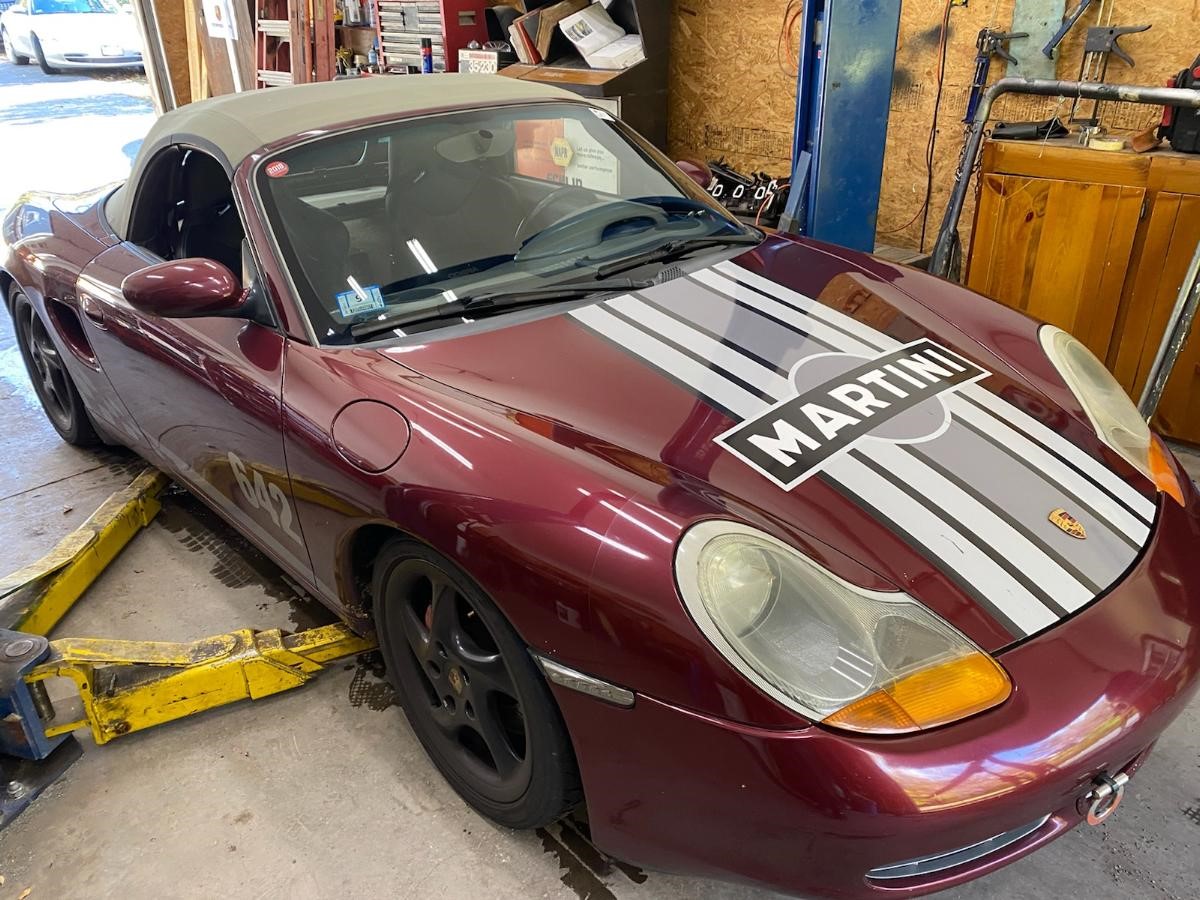
When I jacked the rear up it became very clear what had happened: the universal joint on the left half shaft at the differential end had shredded itself—lots of bent sheet metal. Ollie was extremely helpful by allowing me to load my car into his trailer and take it to my home while I led the way in his Boxster.
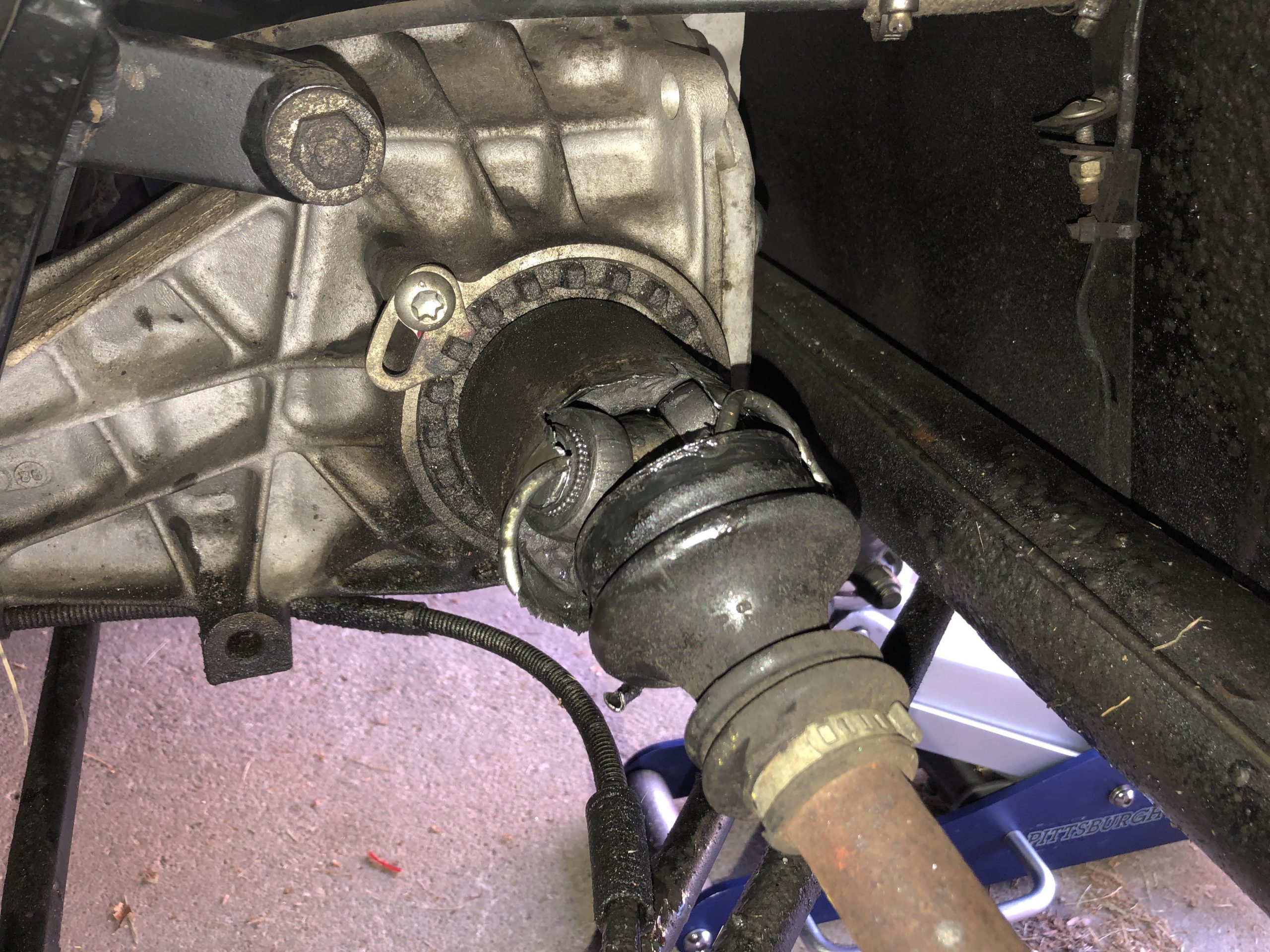
The next day I did some more investigating but was limited by my inability to find a 41 mm socket locally to remove the hub nut. Fortunately, I have all winter to get the car back into shape. I have ordered two half shafts, which only can be sourced from Caterham, plus two hub nuts. I will also have to send the left front damper back to Spax in the UK for a warranty repair, so the poor Caterham will spend the winter on jack stands in the garage.

The learning process

I have subscribed for a couple of years to Ross Bentley’s Speed Secrets emails and really enjoyed them. Several times I have replied to them, and he has always responded, which is unusual. For quite a while, I have kept suggesting that he set up a training service for sim racing, and a few weeks ago, he asked me to beta test exactly that. He was also looking for a few bodies to help him run the service, and I immediately stuck up my hand and yelled, “Me! Me!”. He took me up on the offer, and I am managing and moderating the Discord server. There are a couple of other team members that fill other roles, and it has been and looks to be a fun thing to do. Take a look at https://simraceracademy.com/

Ross is also really great at responding to musings. One I haven’t shared with him, but will very soon is about how people learn. Here it is:

Learning to drive a race car is like any other learning process. You start by having a goal, like learning to threshold braking and transitioning to trail braking. So you know what you want to. It sounds simple, but braking performance depends on a huge number of factors, some of which are track temperature, road surface, tire wear, corner shape, camber, slope, car weight distribution, brake bias, and more! If you don’t take all factors into consideration, bad things happen!

You can take two approaches. 1. Emulate precisely what the better drivers do on every corner of the track. The trouble is that you have to find an expert to emulate every time you get to a new track or car and that what you emulate only works if the conditions are exactly the same as when the expert ran it. 2. Learn what the expert learned to be able to figure out how to brake optimally in every condition. I call 1. the what and 2. the why or how. To become really good, I believe you have to take approach 2. But there is a lot more to it. Even if you know the theory, it is a different matter to put it into practice, so you have to also learn that. Initially, and possibly for a long time, you will have to focus your mind on doing that, but that may distract you from performing other tasks well, so eventually, you will have to apply the task unconsciously, just like you automatically hit the brake pedal when a kid runs out in front of you. You don’t think, “kid on the road, I may hit it, need to stop the car, do that by moving my foot from the accelerator to the brake pedal, push really hard.” No, your foot is hard on the brake pedal without any thought process. You may feel that you are plateauing as you go through the process of moving the application of theory from conscious to automatic, but in reality, you are progressing all the time, getting ready to go into the next phase of learning.

-Anker
“Winter is coming”….

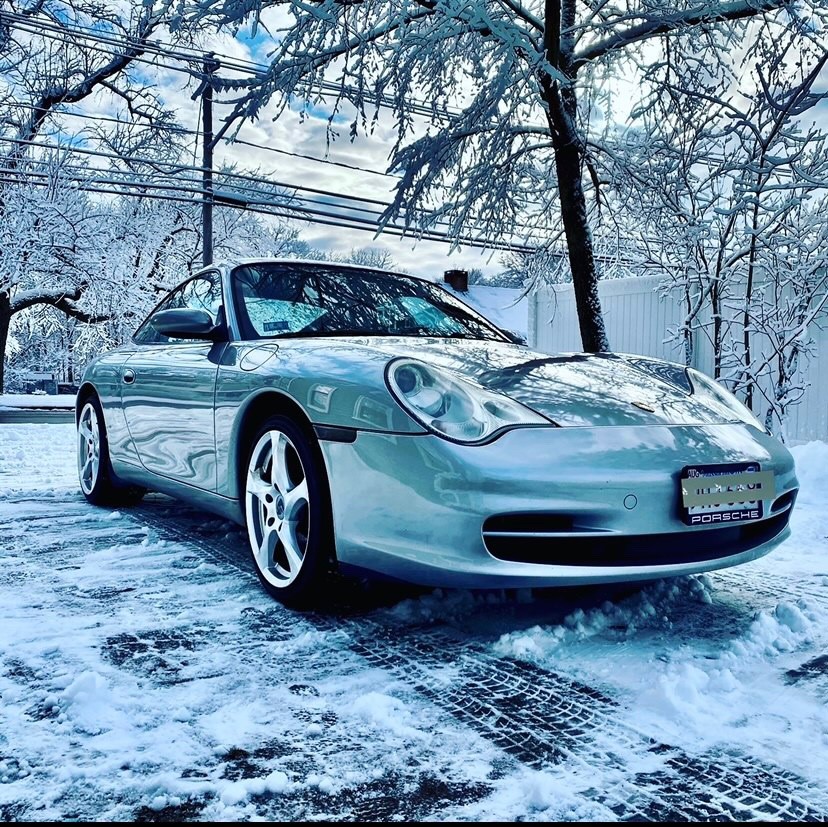
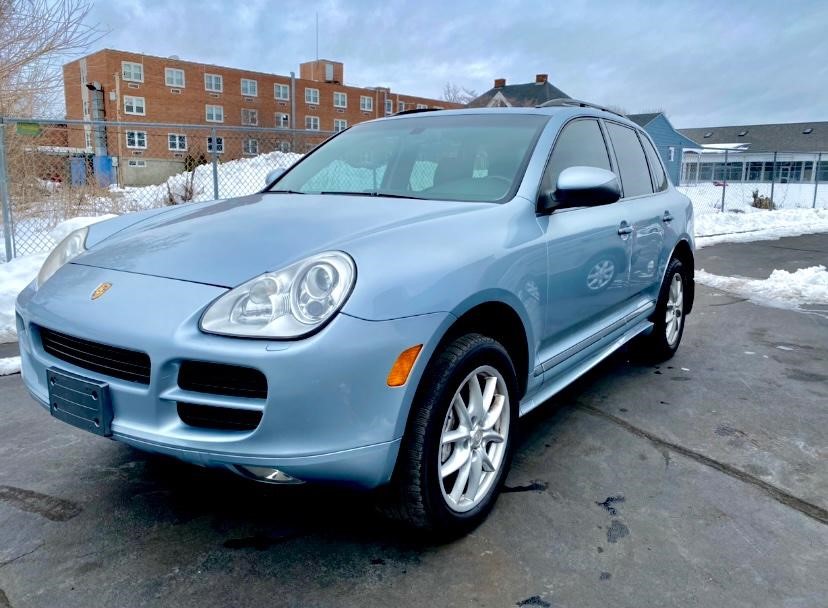
And walking to my car the other morning, it was a brisk yet sunny 37 degrees when I noticed the webbed frost, spread across my silver 996, from the fried eggs to the hips. Having spent the night at my parents’ place, it spent the night outside, but typically, my pampered 911 sleeps in an insulated (and hopefully soon to be heated) barn. Conversely, Big Alice, our 06 Cayenne S Titanium is a fearless beast. The SUV sleeps outside, impervious to the climate and ready for any adventure – sand, city or snow. Hands down, this Porsche wears the hosen in our haus and I fall in love with it more and more with every time I drive it (the caveat being, it’s also Jane’s daily driver)…do we need two Cayennes? 

Seeing the iced-over car, I also thought about Paul Skinner, who came over the other day to get his Boxster ready for hibernation. Then it occurred to me… that I too, need to prep my 911 for the Winter months.

So I went down the list of what that entails and what I needed to do…

  • Trickle charger – no
  • Cover – no
  • Mothballs – gross, and absolutely not
  • Fluids flushed and topped off – check
  • Carpet under the tires to avoid flat spotting – no

Ok so far so good! Then I considered additional Winter necessities:

  • Hose to spray the car down in between drives and proper washes (when not freezing) – check
  • Drains cleared, to avoid interior leaks – check
  • Blizzak wrapped winter wheels – safety first – check
  • Mini-Shovel, blankets and ice scraper in the frunk, can’t get stuck without ‘em– check
  • Ski Rack to shred the slopes – check
  • Tire gauge, compressor and basic tools – also in the frunk- check
  • Service and maintenance being up to snuff, because they should be anyway – check

Alright, I’d say my 911 is prepared for the Winter!

Some of us at NER may seem crazy to drive our Porsches year-round, but for some of us at NER it seems crazier NOT to drive our Porsches year-round.

To quote our year round,718 Spyder driving, Joe Cracco, ”Just try it once.” And if you already do it, join us for our “Winter Beaters” line up consisting of tech sessions, Cars and Coffee meet-ups (long johns recommended), SIM Racing and other events to keep having fun in the frigid months ahead.

Lastly, if you have cool ideas (no pun intended) or would like to volunteer for any events, please reach out and let’s have another awesome season at NER.  

See you soon PCA Crew!

-Luis


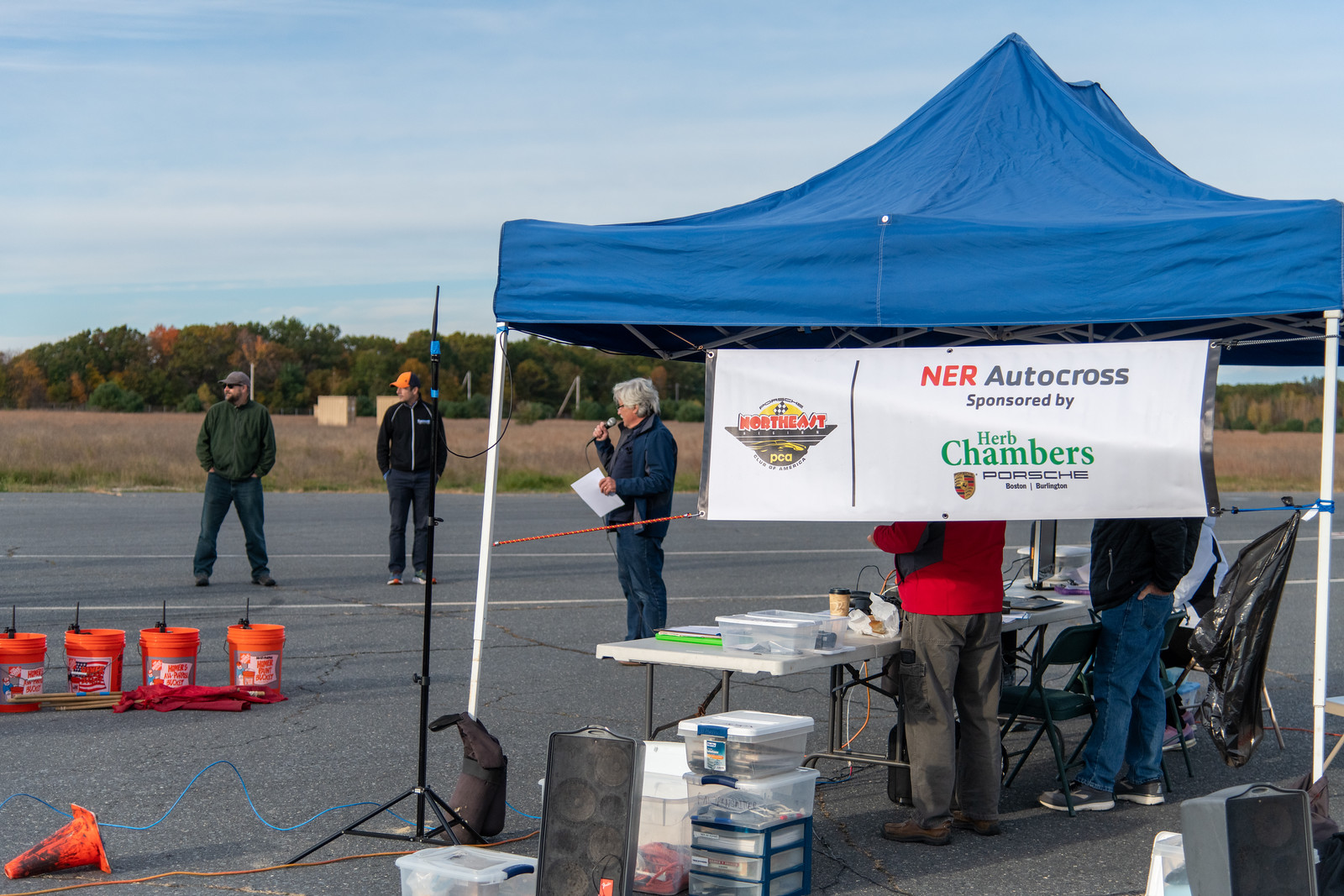
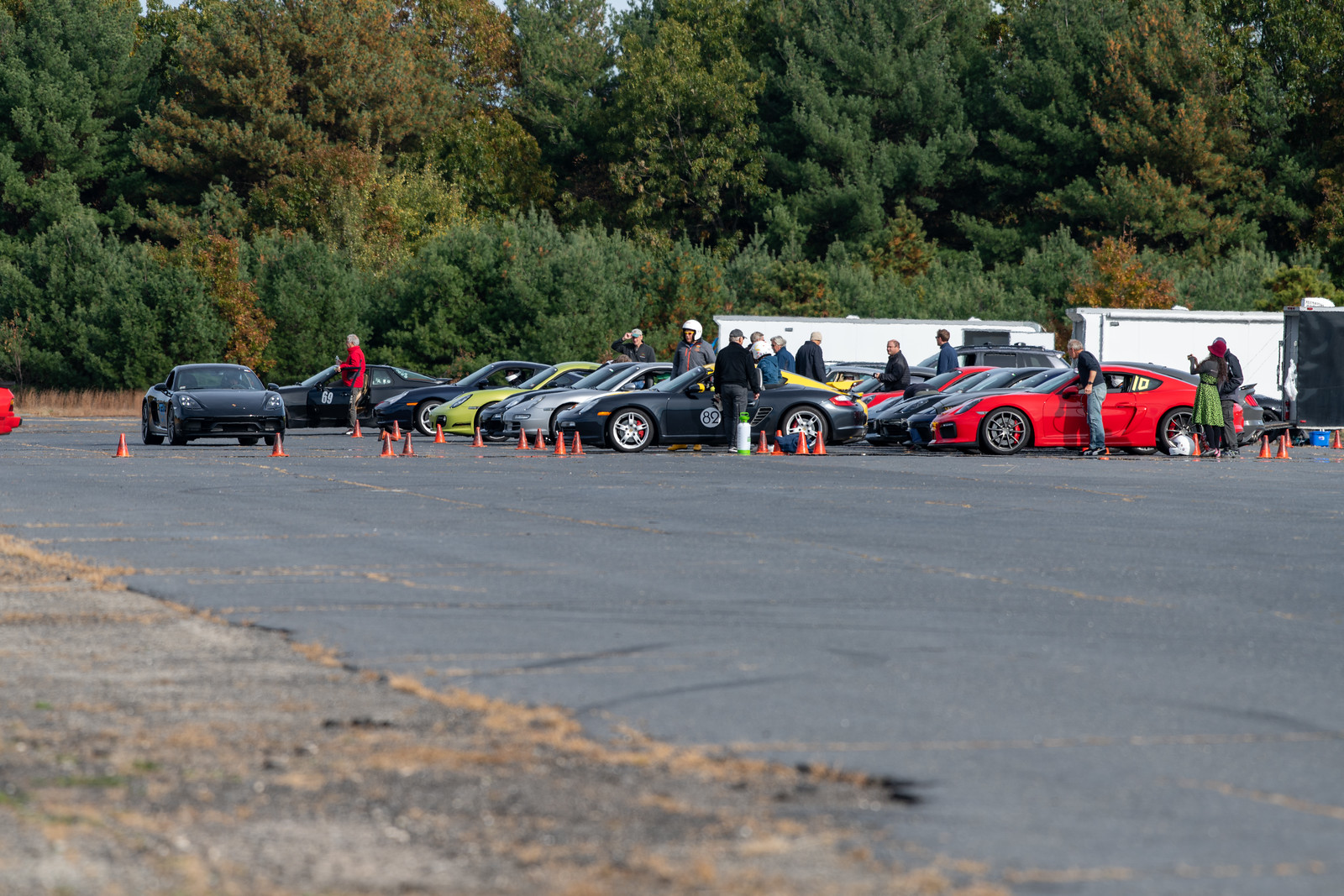
NER Closed out its Autocross season under sunny skies with a Fall chill in the air. The event was sponsored by Herb Chambers, a perennial autocross supporter, and we thank them once again for their continued support.

Fifty-seven drivers ended up posting times for the event. This number of drivers was lower than usual, largely due to a number of no-shows. Several of those had the courtesy to notify us ahead of time they would not be there, and that was appreciated. However, there were several who had registered for the event, but simply skipped out unannounced. As a reminder, when we confirm your registration, we ask that you notify us before the event if you are not going to make it -no-shows make staffing and running an event particularly difficult – I hope people will take that more seriously next year.

Once again, we had a fair showing of Novices (12), which will now be minus one (Adam Norton) as he took first in the Novice Class and thus will be registered in his regular class (Class 7) at his next event. Congratulations Adam!

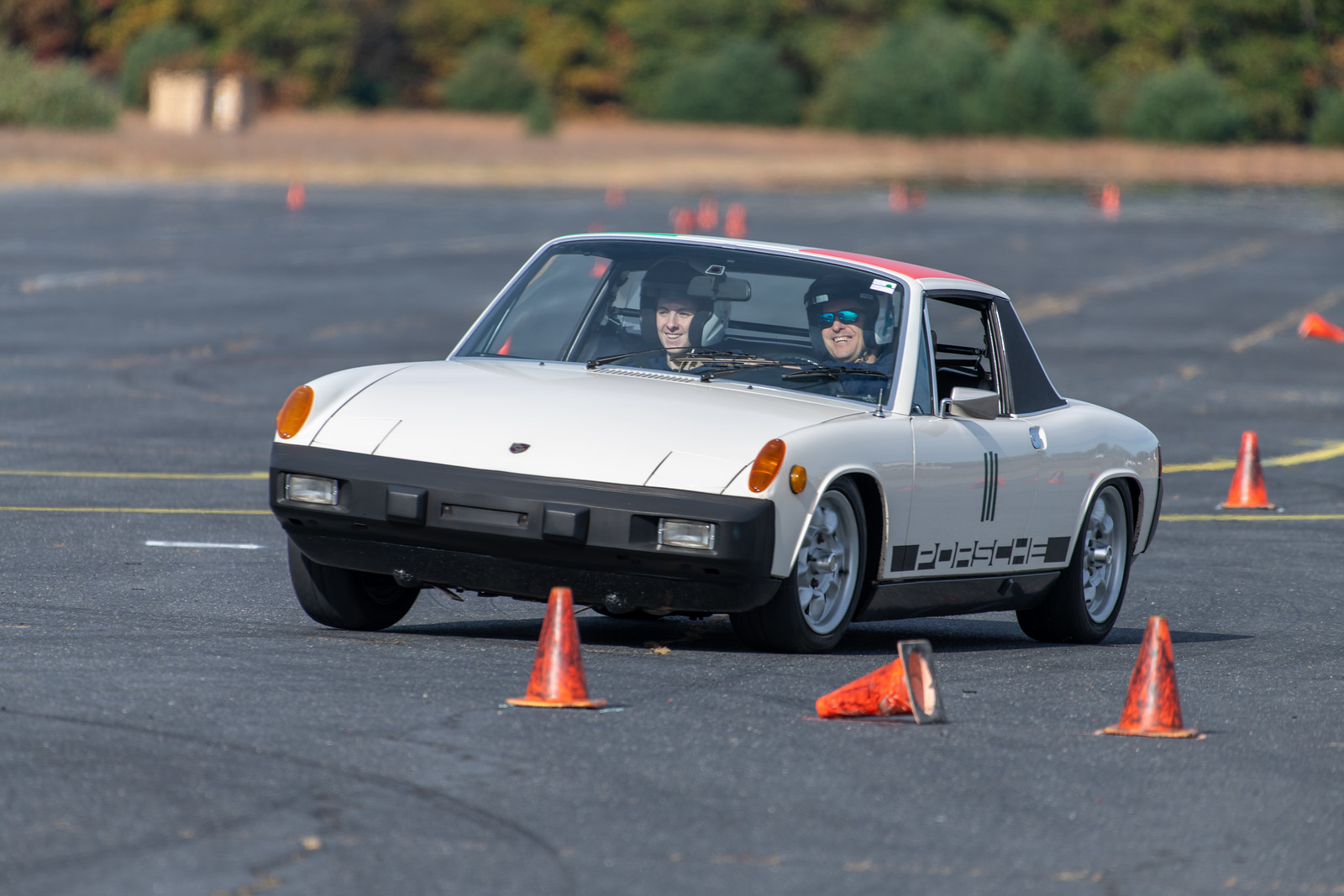
Elsewhere in the day, Chris Darminio took Class 1, posting an 81.35 in his ’76 914 to beat our old friend Jack Goudreau who returned in his ’73 914. John Staton  posted an 82.94 in his ’77 911S in Class 2. Great to see these old cars showing up for our events!

Chris Hubert was tops in Class 4 by about 2.5 seconds; Lev Tabenkin took Class 5 by beating out the Boxsters by 5.5 seconds; Ernie Grasso took Class 6 in his 718 Cayman, just edging our Eric Kessel and yours truly by .3 and .6 seconds, respectively. Tony Miniscalco was the winner in Class 7, while Jeremy Mazzariello won Class 8, even after having to spend lunchtime digging small pebbles out of his tire bead after an “agricultural excursion” from the course. Bill Aubin and Ollie Lucier took classes 9 and 10, respectively, while Wil Koscielny (2020 Miata) beat our course designer Rob MacAlpine (1999 Miata) in the non-Porsche Class; taking FTD in the process!

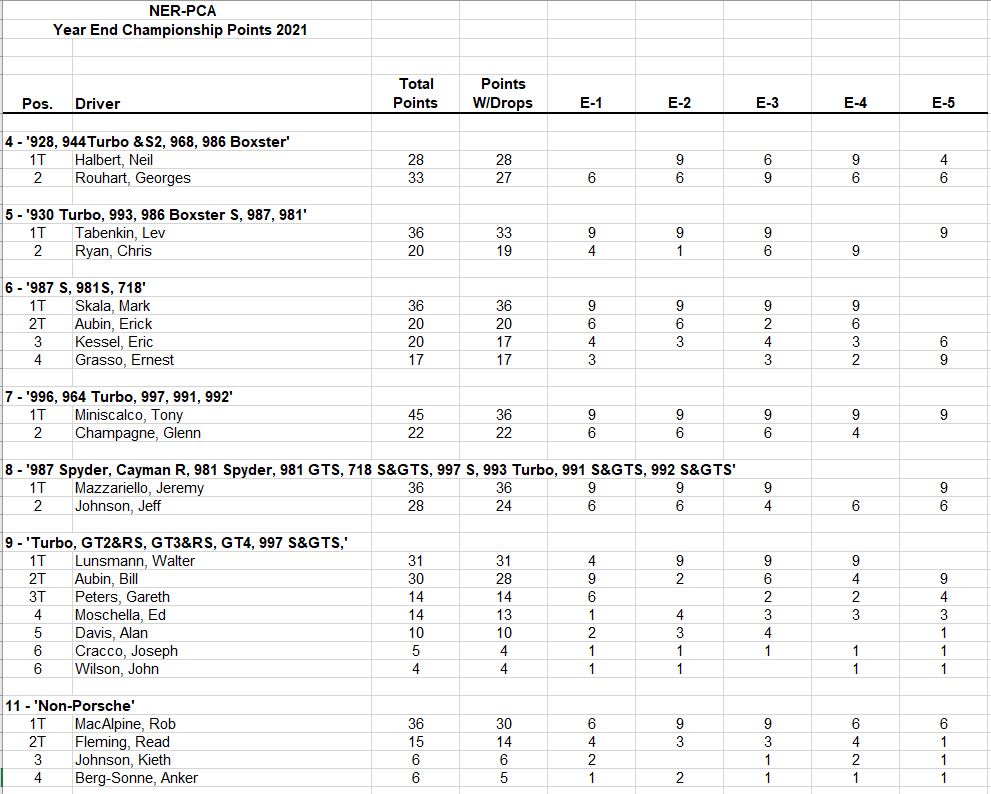
The qualifying (minimum of 4 events run) Class Winners for the Season were: Neil Halbert (Class 4), Lev Tabenkin (Class 5), Mark Skala (Class 6), Tony Miniscalco (Class 7), Jeremy Mazzariello (Class 8), Walter Lunsmann (Class 9), and Rob MacAlpine (Non-Porsche Class 11). This year, we plan to have the Season awards made in conjunction with NCR at Billiards Café sometime in January – stay tuned for announcements with further details.

Thank you to everyone who participated and helped run the events this year – especially Rob and Sheryl MacAlpine. We hope to see you all back again in 2022 – including all you Novices – and bring your friends!

-Chris Ryan

Results:

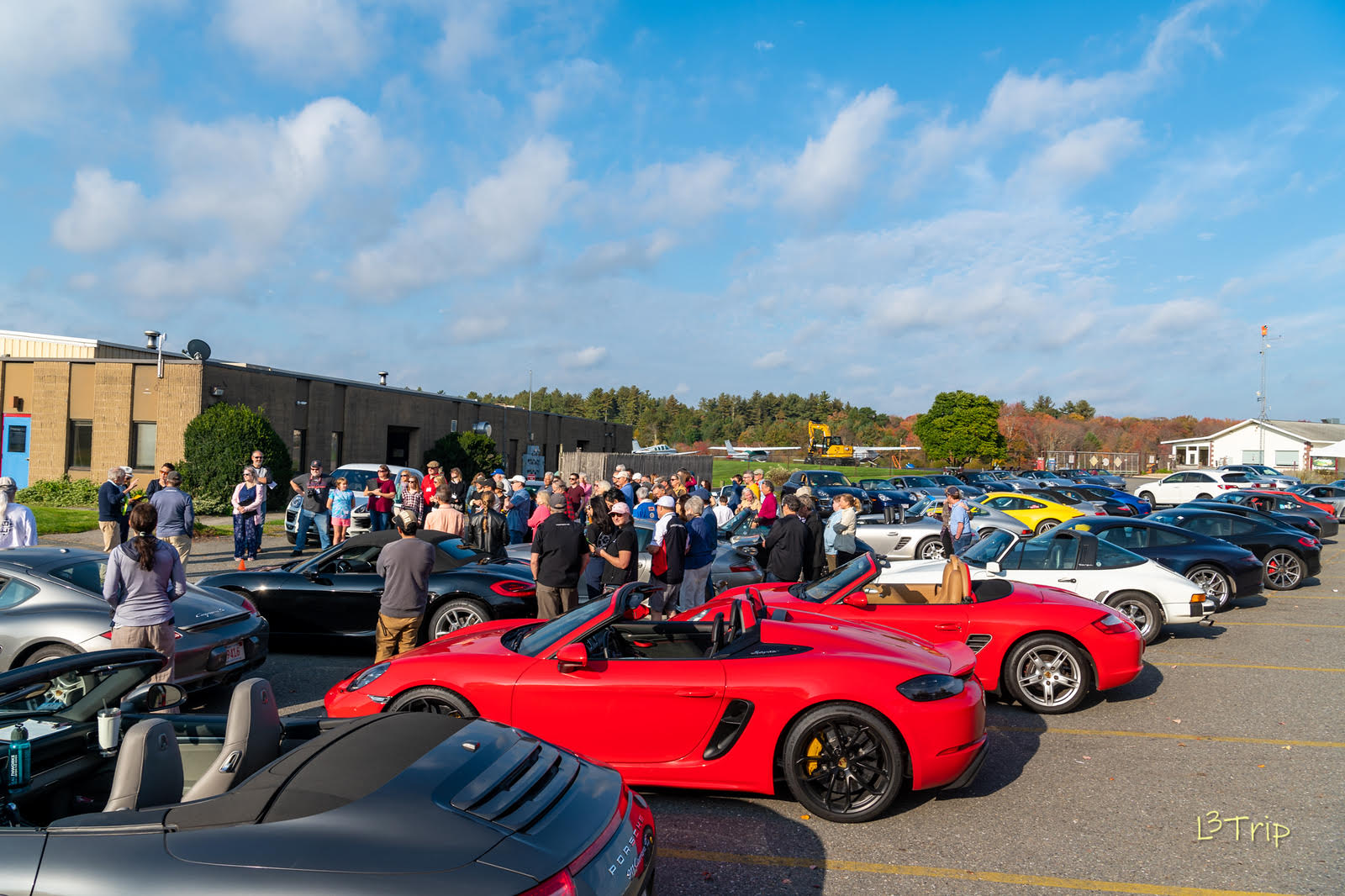
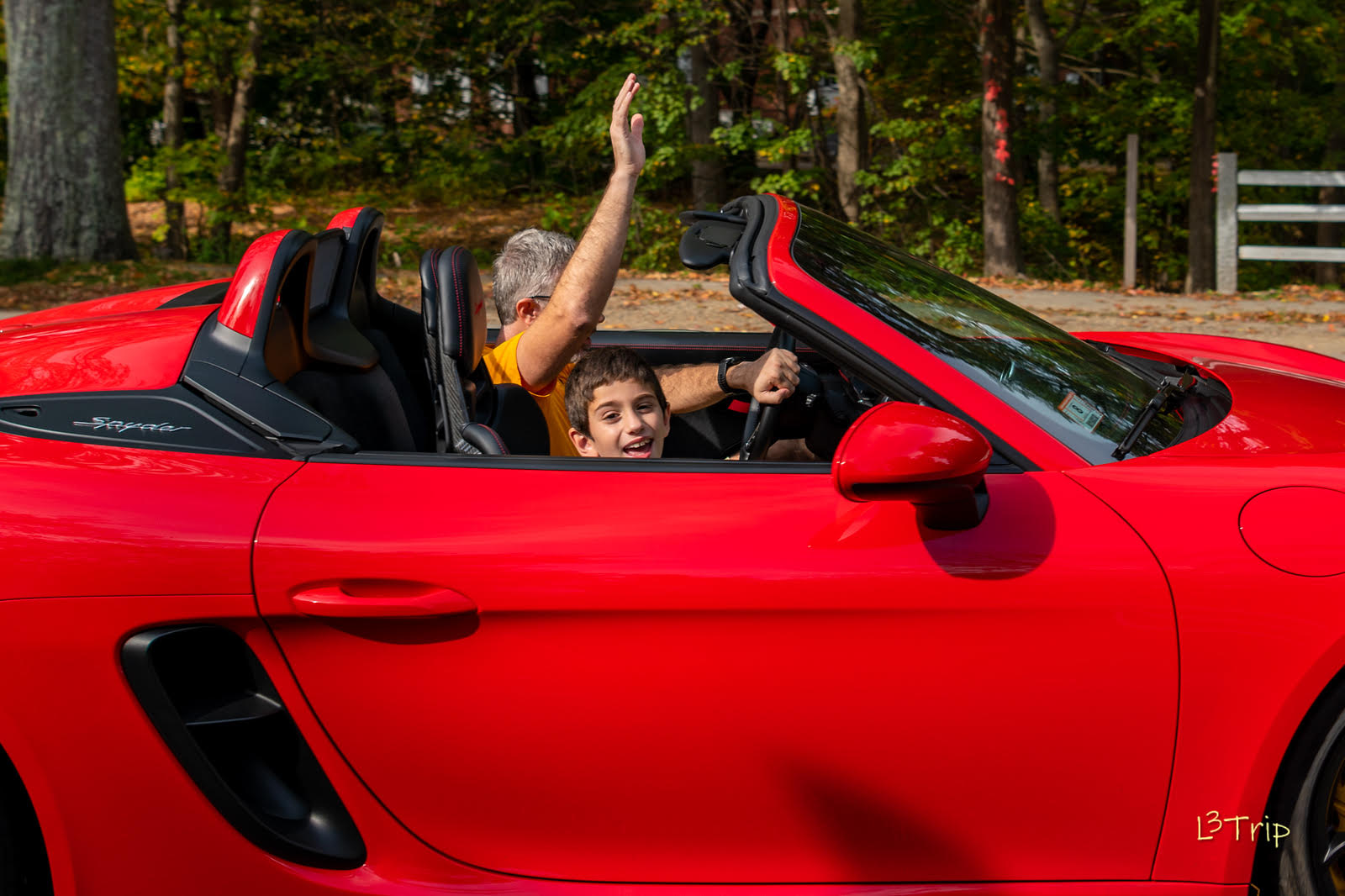
On Saturday, October 16th,  37 Porsche’s and 80 people of all ages (along with several 4 legged companions) gathered at the Minuteman Airfield parking lot in Stow, MA for camaraderie and competition in the 4th Annual Charlie & Martha Dow Rally (previously Tour).  The location served as the rally’s start and finish on what turned out to be a stunningly beautiful fall day.  Charlie & Martha Dow were active members of NER for decades.  Their son Eric, daughter Heather, granddaughter Hannah, and Eric’s wife Daryn (with Eric and Daryn in Charlie’s yellow 911 and Heather in her own Boxster) were in attendance at the rally’s start to personally thank NER and the rally participants for keeping the memory of their father alive. 


The rally route took participants on a 58-mile tour of historic colonial areas of central Massachusetts on scenic 2-lane roads.   Along the way, driving teams were challenged with questions about the areas they passed on route.  The winners were the team with the most correct answers.  Upon our return to the airfield, bag lunches were provided while the event organizers tallied answer sheets.  No team got all 21 answers correct, but there was a surprising 7-way tie for the lead with 18 correct answers. By virtue of having the lowest recorded mileage (i.e. fewest navigation errors), the tie was broken by Team First (Driver: Bill VanderClock & Navigator: Donna VandeClock), who placed first and won a set of NER scarves  Team 2L’s (Driver: Lance Nelson  & Navigator: Lorraine Nelson) placed second and won a set of NER baseball caps for their efforts. 

Dow Rally PCA NER         2021 Dow Rally Lunch PCA NER


Ultimately, by being able to drive our Porsche’s with friends on a beautiful fall day in New England, we were all winners.  Many thanks to the team that made this year’s Dow rally happen:  Anker Berg-Sonne, Lisa Burke, Luis Rivera, Joe Cracco, and, the envy of cat herder’s everywhere, Bill Seymour.


Submission by: NER’s Very Own, Winter Convertible Driving, Joe Cracco

October was a nice month of car events starting with the NER Concours at the Elms in Newport. David Melchar, Chair for the last two Concours, apparently has sold his soul to the Devil in return for unbelievable weather. He also has successfully recruited a great team of volunteers, and the 2021 event was equally as well run as the one at Chateau-sur-Mer in 2019. This year I was a volunteer judge, and they wisely assigned me to score the cleanliness of the rear storage areas of Macans and Cayennes (no, I’m not making that up). They were all really clean. I was so good at my job that Larry Levin, who takes most of the photos that you find on our website, won a trophy with his white Macan (but not first place – don’t blame me, Larry, I gave you a perfect score!).

I rode down to Newport with our Treasurer, Kristin Larson, and after the awards ceremony, we walked down to the Tennis Hall of Fame, where the Audrain parade cars were parked. What a show! Click here to watch a few minutes of the cars as they drove off — all in all, a great way to spend a fall day.

The following Friday, I was at Palmer to instruct at one of their “Arrive and Drives” (they have a fleet of caged Miatas, and you pay $500 for four instructed sessions).  Another day of perfect weather, and I had one of the best students ever.  She had only been on a track once, seventeen years ago, but by the end of the day, she was hitting all the apexes and driving most of the corners close to the limit. It’s a nice program – the Miatas aren’t pretty but work well and are fun to drive. To add to the day, both of the previous Jamaican Bakin’ vehicles were there:  Miata and E30. Mike has made some serious upgrades to the Miata and was kind enough to let me take it out. I’d like to say it was an old home week, but the truth is the old home has been heavily renovated (better engine, new suspension) and drove way better than I remembered. Really nice that the cars are in good hands and being enjoyed.


The third October event was the annual Charlie and Martha Dow Rally (switched from a tour because rallies are easier to run and perhaps more fun anyway). There is a full report elsewhere, but I’ll throw in a few comments.  1)  We got lucky with the weather – rain was predicted, but it turned out gorgeous.  2)  People really seemed to enjoy it, and there were quite a few “newbies.”  3) Anker and Lisa did a great job with the route and the logistics.  4)  Charlie and Martha’s family was very well represented and appreciative of keeping Charlie’s memory alive.  (Eric commented that Martha had objected to the previous title of “Charlie and Martha Dow Memorial Tour” since she is very much alive and is now pleased that it is the “Annual” rally.)

In other news, there are two new (to me) vehicles in the extended fleet. I finally gave up on the Pilot and upgraded to a used Audi Q7, which will hopefully tow much better. The primary user of this vehicle was not happy to discover that it actually has quite a bit less room inside than the Pilot (not to mention her preferred Odyssey) and fewer places to store stuff and transport groceries. She does admit that it drives better. I was foolishly optimistic that Turbo (dog), who pants and shakes during car rides, might be calmer in a quieter vehicle but no such luck.

The other addition is the latest Jamaican Bakin’ race car:  a BMW E36 that will replace the Mustang (still for sale – don’t forget to use code PCANER for your 5% discount). While we are taking a step back in terms of speed, this will be in compliance with AER rules and also be eligible for Champ car events. Dave, Dennis, and Chip retrieved it from Maryland down and back in the same day – road warriors!  Some assembly required – a few tweaks but mostly getting a good seat that works for all of us. We hope to get a few laps in at a Thompson Club day before the snow flies. Speaking of which, make sure you get out and enjoy these last few weeks before the cars go to bed for the winter.

Because the apple picking resulted in a packed lawn last month, I was at Sweet Berry shortly after 9 AM Sunday to ensure that the parking of Porsches would be as orderly as possible.  By 9:30 AM more than 6 Porsches arrived. By late morning parked Porsches exceeded 60. 

I have to say that these monthly meets are one of my more pleasurable experiences; the sharing of stories exudes enthusiasm of Porsche ownership.  There is a consistency in design from my first Porsche (65 356C) to my current 996 C4.  The view in both cars is similarly shown to the driver, like the gauges seen through the steering wheel.  And, I have always been impressed with the stiffness of the body design, and the absence of rattles, even as the car ages.

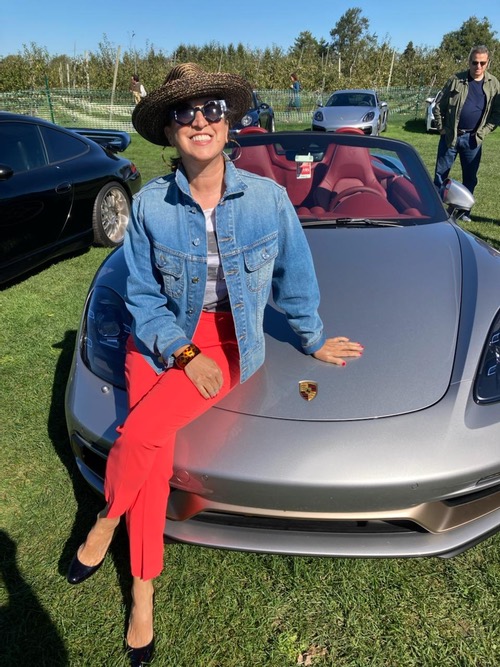
Elizabeth Kahane exuberantly parked her 2021 25th anniversary Porsche Boxster; it is #364 out of 1250. On the passenger side of the dash is the engraved number beneath the Boxster 25. Silver, with a red interior, this Porsche is a keeper.  With a stick shift Elizabeth says the car is sexy, fast, and fun to drive.  Previously she owned a 2017 Boxster.

Elizabeth Kahane's 2021 Boxster

Elizabeth Kahane’s 2021 Boxster

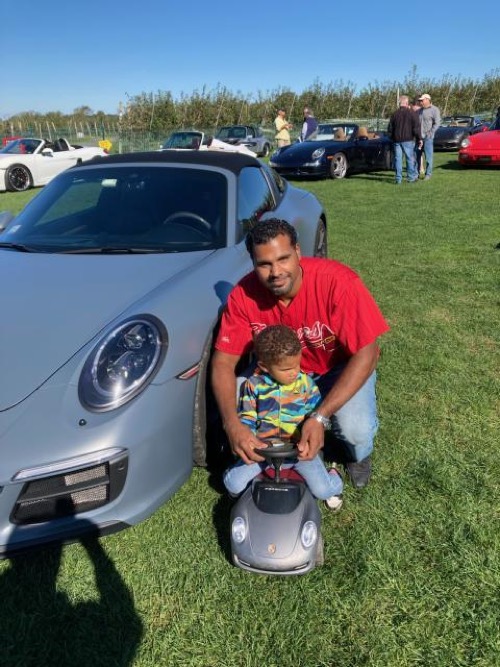
Ariel, and son Apollo arrived in a unique and attractive 2018 911 Targa 4GTS.  A graphite Blue metallic with a matte paint protection film reflected an attractive glow.  This is Ariel’s first Porsche, bought new, now showing 31K.  Ariel says that he “always liked Targas and the best part is feeling it, even just around town”. 

Ariel and son Appollo's 2018 911 Targa 4GTS

Ariel and son Appollo’s 2018 911 Targa 4GTS

Matt Meeks parked his basalt black, with sand beige interior 2006 911 C4S.  This is Matts first Porsche; he is the third owner, purchased this past February, now showing just 47k miles.  I like the option of the white gauges and Matt likes some of the older attributes making the car a bit analog.

Matt Meeks' 2006 911 C4S

Matt Meeks’ 2006 911 C4S

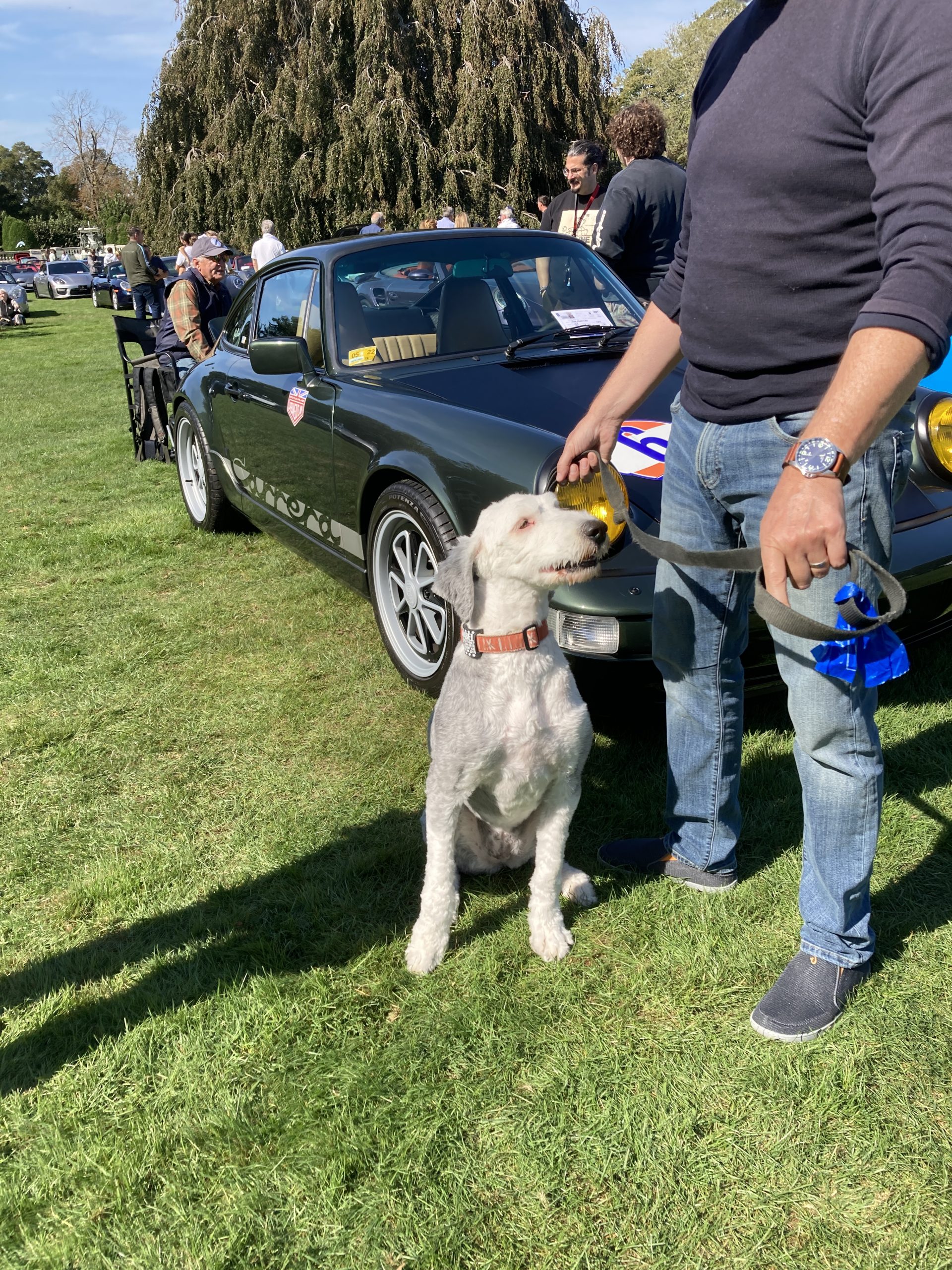
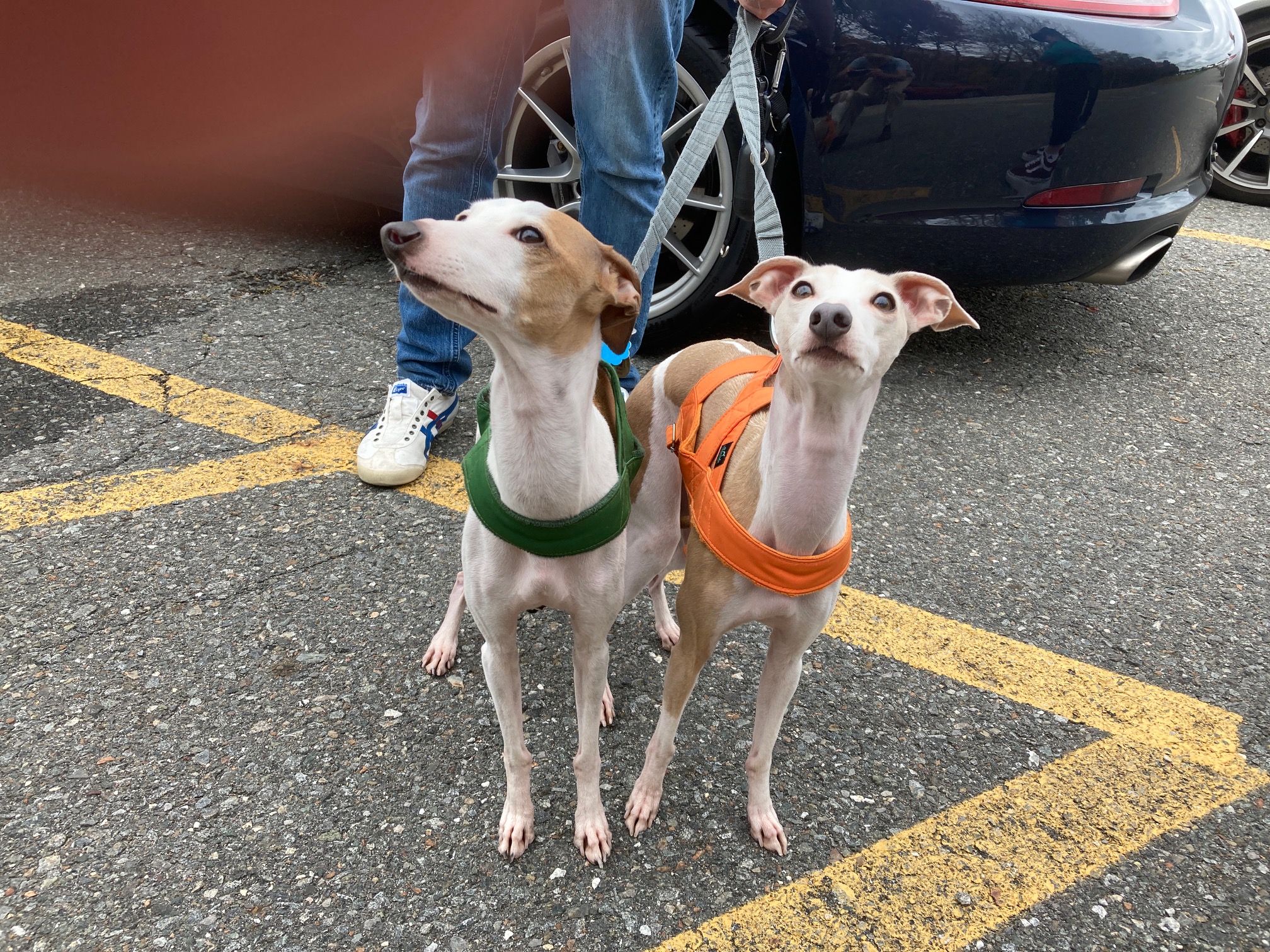
In closing. I have to mention that this coffee had more dogs as Porsche passengers than any previous time; I think there were five different Porsches with dogs, two as passengers in one of the selected photos.

This was our last SoBo of the season. As you may know, the first SoBo of the season starts before Sweet Berry Farm officially opens. So, if anyone has any ideas for an early alternative location anywhere south of Boston, please forward your suggestion.

Rog Slocum
127 Center Ave.
Middletown, RI 02842
e-mail:  [email protected]

This content is password-protected. To view it, please enter the password below.

Get a few more laps in before your Porsche hibernates for the Winter!

Visit links to learn more and register:

10/23 NER – Autocross #5 – 7:00 AM to 5:00 PM
 
10/30 NCR DE at NHMS – 7:00 AM to 5:00 PM