Tag Archive for: Columns

Posts

With the Mustang a no-go for the series we want to race in (American Endurance Racing and Champ Car), the Jamaican Bakin’ team bought an E36 BMW M3 race car as a replacement. The car was a successful BMW Club racer that was built out with the correct aftermarket parts. We took it out to the last Thompson member day for a trial, and it worked great – easy to drive, ran fine, good to go, nothing needed before next season, right? Well, no. Of course, there are a few things that need to be done – perhaps a day or two of work?
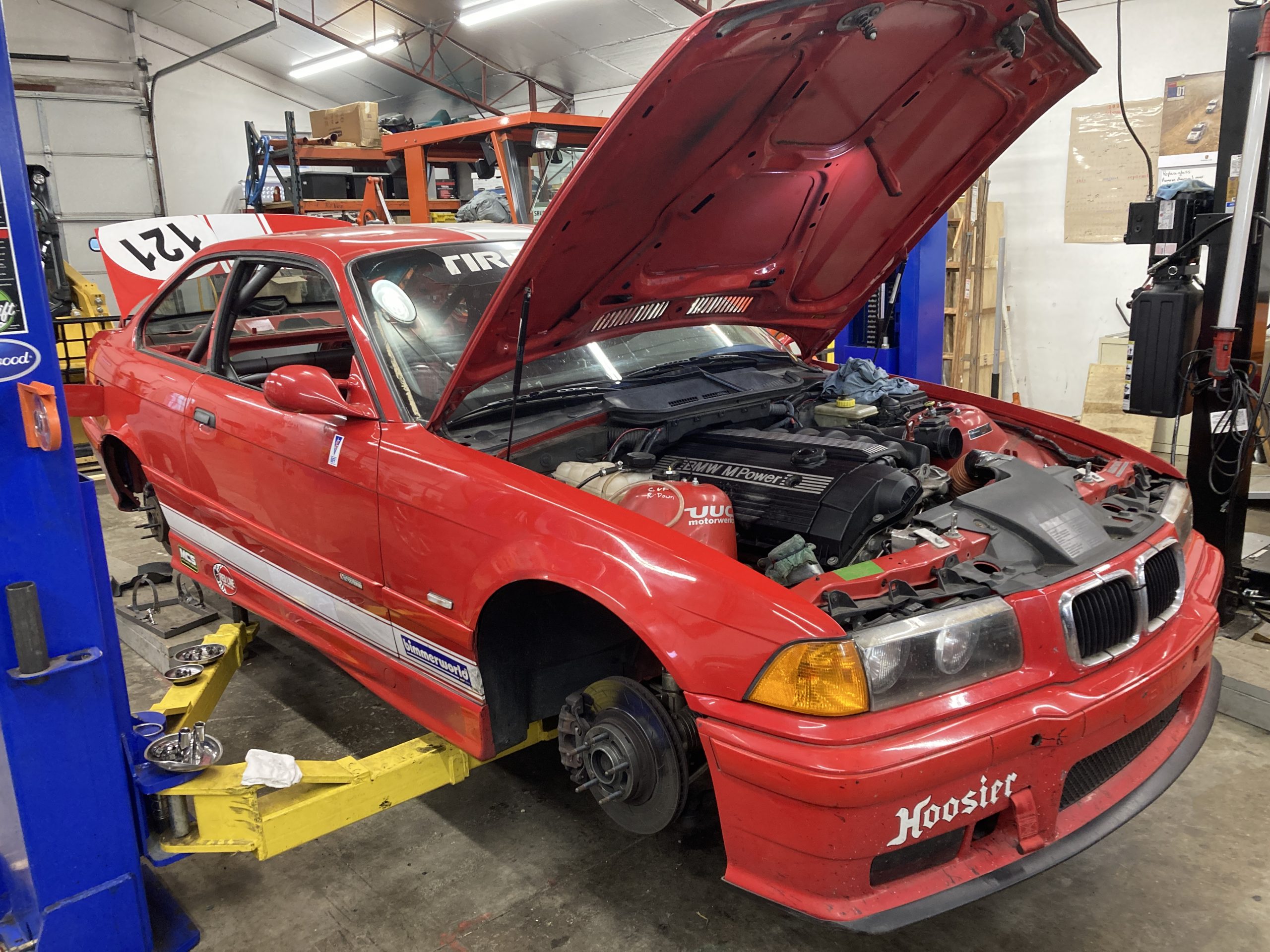
Let’s start with the obvious. To run successfully, we need to be able to go 90 minutes between stops. The stock fuel tank holds 17 gallons (perhaps 16 useful before it starves on corners) – not quite enough. So a pony tank will need to be installed in the spare tire wheel well. With a fuel pump to pump from the pony to the stock tank. With wiring, switches, etc. And while we are at it, we might as well replace the fuel lines, just to be safe. But with a pony tank in the trunk area, we now need to fabricate a firewall to separate that from the driver compartment.

We also need to move over the endurance racing stuff from the Mustang to the new ride. The cool-suit system and the telemetry system (don’t forget the antenna mounting) require some brackets to be fabricated and a fuse box added to deal with the additional electrical demands. Oh, and since we are messing with wires, we might as well take out some of the unnecessary original wiring and clean that up. Oh, and don’t forget the rain light (noting that AER mandates one type and Champ Car requires a different one.) Or the flagging system device and its wiring.

We were all reasonably comfortable doing short stints when we had the car at Thompson, but for long stints, the seating position wasn’t great for all of us. So we need a new seat which will require fabricating new brackets for the slider and the back brace. (Poor Chip is the one with the machine shop and thus gets more than his share of assignments.) And the steering wheel angle and location suited the previous owner but not us, so a little work to move the wheel down and away from the driver. Piece of cake! Plus, the mirror is too far back and needs to be moved.

The belts that came with the car are OK and have another year left, but the ones in the Mustang are better, so let’s swap those out. And, yes, there is a center net, but we don’t like the way it is fastened, so that will require some work. And the door net is a bit weird, so it will require some attention. While we are at it, for safety sake, let’s replace the original interior door handles with cables that are easier to find and pull in an emergency. Finally, on the safety side, the fire system is out of date and needs to be refreshed.

Oh, yeah. As an endurance car, we need to add a differential cooler (which needs to be powered plus a temperature sensor added – see wiring comments above), and it needs a NACA duct to draw in air. The easy solution is to replace the rear windows with Lexan and put in the duct – it lightens the car too! – and we need another duct to bring in cool air for the cool system anyway! And don’t forget that we need to do something to defrost the windshield since we might be doing long stints in bad weather.
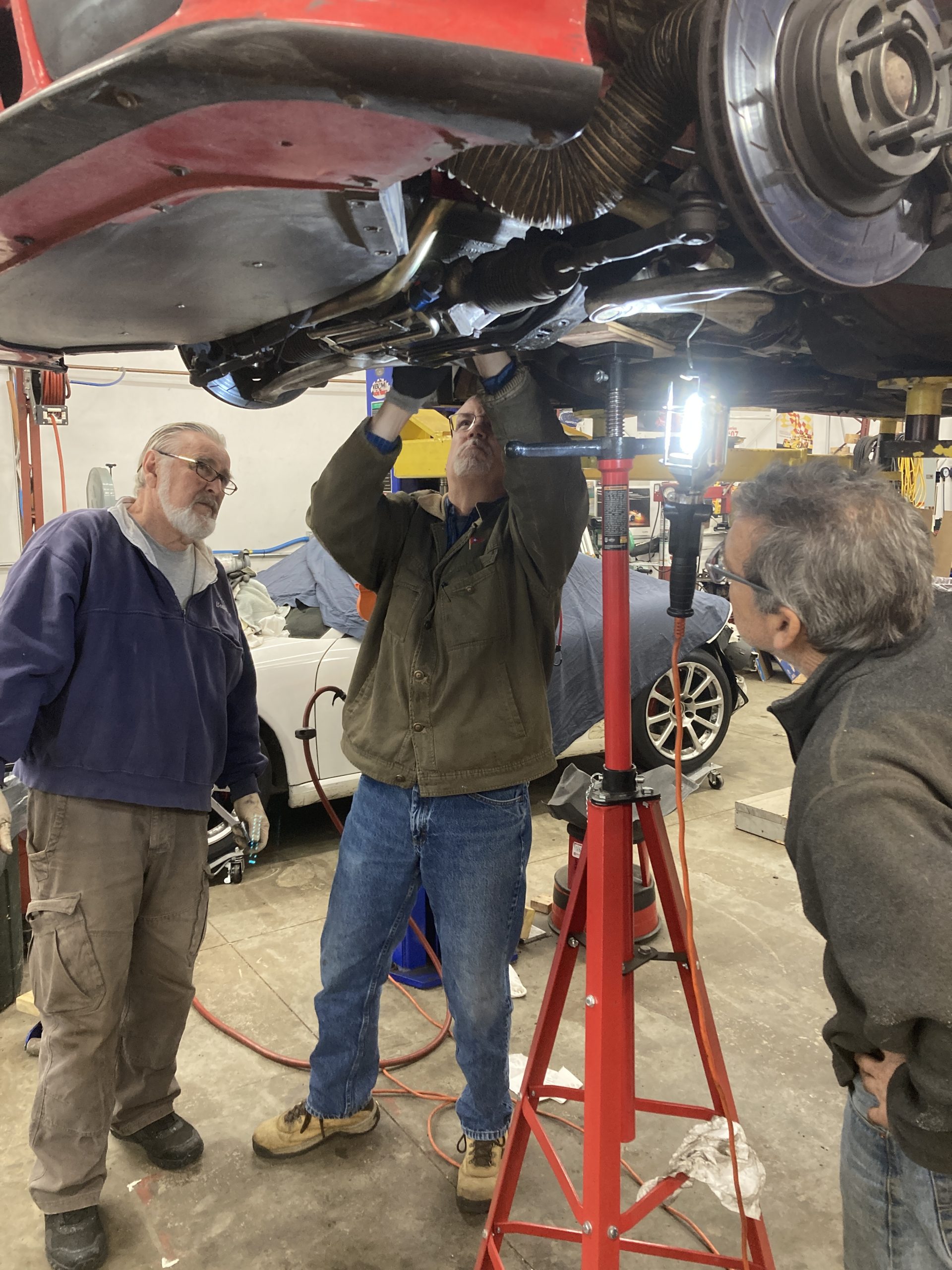
While the car came to us as described, there were a couple of small problems. There was a crack in the windshield and a battery tie-down that would not get past an AER tech (but apparently got past BMW club racing). But, hey, we need a lighter battery anyway, so Chip has one more thing to fabricate. And there is a slight tear in the left ball joint boot. Now that we think about that, maybe there is a suspension upgrade that would require new front control arms anyway – we’ll look into that. And the clutch works fine but takes up very close to the floor. It would be more aesthetic with a higher catch point. And anyway, we should flush the system. Never mind, let’s just preemptively replace the clutch slave cylinder – it’s probably pretty old.

Let’s move on to the wear parts that could fail. Might as well do those now rather than just stockpile parts and wait for something bad to happen at a race! (Since I’m a lousy wrench, I get assigned to source the parts – made harder by my lack of knowledge, age of the car, and uncertainty of which are stock and which race aftermarket.) I’m looking at your bearings and half shafts! And perhaps the solid motor and transmission mounts are too stiff for the wear and tear of endurance racing? Let’s research and debate whether to go with OEM or poly. OK, poly it is.

OK, now we are almost ready to go racing. My final job (note the skill involved) is to remove the old number panels, work hours with acetone to get all the glue off, and then put on the shiny new “420” number panels and Jamaican Bakin’ Racing decals. Vroom. Vroom. Let’s hope we are ready.

P.S. One nice benefit of working on the E36 is that we have been reaching out to old NER friend Mark Schnoerr for advice. He and Sigrid send their regards from Texas.

-Bill Seymour

Luis and the other millennials may not get the joke in the title, but I couldn’t resist. The new (to me – a 2018 actually) Audi Q7 had a couple of minor flaws that needed fixing, so I found myself in a loaner 2021 Audi Q5, which turned out to have a few bells and whistles, not on my older model. First off, it started yelling at me whenever I went faster than 80mph (the speed required to avoid being rear-ended on Rt. 128 – oops, I95) on the way to Thanksgiving dinner. On the way home, now in the dark, it started dimming the high beams without prior authorization by me. It generally made good choices but wasn’t as quick to go back to high beam as I would like (older eyeballs seeking as much illumination as possible). Then it started to steer for me when I tried to change lanes. I had experienced this behavior in other cars but hadn’t realized this car had it and that I had inadvertently turned on this feature. To add insult to injury, it started telling me to put my hands on the wheel when it seemed to me they were already there. I was afraid it was going to yell “CLEAR” and put the paddles on me next. I suppose these things make cars safer, but I do worry that it encourages lower concentration.

The second non-Porsche story for this month is the tale of one of my duplicate bridge opponents, Helene. She is 99 and sharp as a tack.  At age 92, her kids chipped in and got her a five-year lease on a Mercedes. When the lease ended, they suggested that she should perhaps not drive anymore, but she promised to take Ubers at night and prevailed by noting, “and I don’t need a Mercedes.” So, she got a two-year lease on a Honda Accord Sport (I’m not sure that “Sport” gets you more than a better radio). This lease was to end in May, but she extended it for six months and recently turned in the car with the notion that she wouldn’t drive in the winter anyway. I asked her what she was going to do in the Spring. She said she thought she would buy a Tesla! – and tells the following tale:  she came into some money a few years ago and asked her financial planner – who also is her granddaughter – what she should do with it. She was told she was pretty secure; why not buy a growth stock.  Which one?  Her great-granddaughter had recently been in a science fair with a tesla coil experiment, so it was natural to buy Tesla stock. And so why not get a new Tesla for your hundredth birthday? And while she is a good bridge player, I’m not volunteering to be in the right seat if she ever puts her right foot on the floor. God love her. I’ll bet she does it.

The third and final non-Porsche story is the new Bakin’-mobile.  The Mustang is still being prepared for sale (it would make a nice Holiday gift – don’t forget to use the code PCANER for your 10% discount), but we got the new BMW (as in 1997 M3) to Thompson for a shakedown. Two of our team belong to the Drivers Club there, and we made it to the last member day of the year. (Shout out to Lou Gingerella and the other Thompson folks for a great catered lunch, relaxed atmosphere, and perfect November weather.)  While the M3 isn’t going to keep up with the Mustang on a big track, it handled beautifully, sounded great, was easy to drive quickly, and we all got down to decent – and almost identical –  lap times. There are a few nits to pick over the winter, but it will be a fun car to campaign next year.

And don’t forget to sign up for the Gala at Foxboro Stadium. Go Pats – who needs Brady anyway?

Finally: A Race Report

Just what nobody was looking for, a race report. While the COVID pandemic pretty much closed all the race tracks in 2020, the flags are up, and the pits are open around the globe. That includes the bottom feeders that I run with, like the 24 Hours of LeMons.

The Champ Car series is also back in business, and son, Rob, and I ran Watkins Glen back in May, but the Oct LeMons race in NH is always a favorite. The Fall colors of the season, cooler temperatures that the cars love, and the array of junk on the track make for a great weekend. After some testing at Palmer and Thompson, the missing horsepower was found in the turbo diesel Audi TT, and we were ready to race again. It was not by accident that we parked by the outhouses when testing that can be seen in the photo below.                 

The weather in NH was looking as good as it gets with no rain in sight, and after some practice, on Friday,  I was picked to start the race the next day. There were 108 cars circling, bumper to bumper when the track went green at every corner at the same time. We used a great radio setup with small speakers in the helmet (green, green, green ) and a push to talk button on the steering wheel, so I had the go pedal down flat before many other drivers saw the green flag waving at the next corner. Most drivers that started the race were experienced drivers, many instructors, so there was not a lot of drama as the field began to sort itself out. Over the years, as race organizers have clamped down on wild drivers, the car-to-car contact has been reduced. Not eliminated but reduced.

The TT was doing a great job of passing cars on the uphill sections of the track as the torque of the diesel engine was best at low rpm. One of the drivers I talked to later said that I went up the hill after turn three and “left him for dead” as his gas engine just didn’t have the muscle to keep up. I was about an hour into my stint when a big blue Mustang, running his first race (all bright and shiny). He chose to dive bomb me going into turn one. He wasn’t close enough to make it stick and introduced his right front corner to my driver’s door. That caused the Audi to spin with just a scuff mark on the number, but it snapped the tie rod off the right front wheel of the Mustang. With the tire pointed right and the other three pointed straight, he was able to drive it back to the pits, but that corner put out more smoke than a Southern BBQ. I was told to be wary of new drivers in new cars and went right back out, and the Mustang was back in action after about an hour and some new parts upfront.

Our second driver, AJ,  took over and did a great job staying out of trouble.  We were making good progress through the field and were up to 30th overall and 7th in class. Because of the fact that we were the last car to pass start/finish after the track went green (just a random bit of bad luck), we were excited to be making such progress. We did have a couple of visits to the Black Flag Lane that slowed our accent in the order.  One was another contact  (that was me), and another, passing under yellow was a mistake, wasn’t us.

Bob, the owner, started the next day, but a flat tire was going to start a series of setbacks.  Apparently, there was a repaired crack in one of the rims that let go, and that caused a tire to go down. Not a big deal; we had more tires. However, when the tire was put on, the crew member used an impact gun and thought that the heavy click, click, click it made was torque enough to keep it on. It wasn’t.

Three laps later, the rim was loose, and it sheared off all five studs. The wheel went on down the track, passing the TT in the process. The car was towed in, and repair began. The remaining portion of the studs were drilled out and new ones were put in with blue lock tight.                                                                     

I took the next tour and was going to do three laps to see if the fix would hold. I didn’t make it.  At the end of the front straight on lap two, the right front wheel again went its own way leaving me to take a drive through the grass, which the front spoiler collected like a NASCAR ride. This time the studs had pulled out of the hub, and I thought our day was over, but there was a used hub in the trailer, and it only took an hour to install. I think there were enough spare parts to build another race car. It really pays to be prepared.

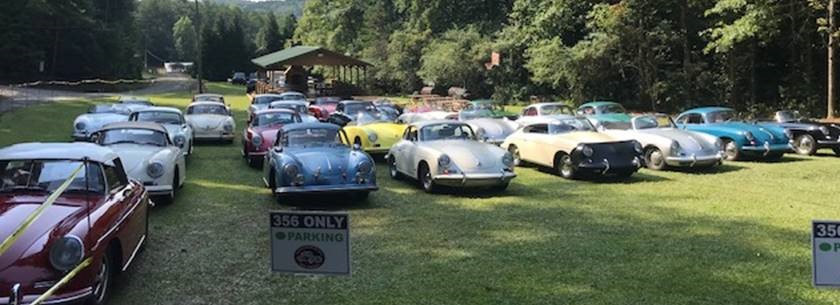
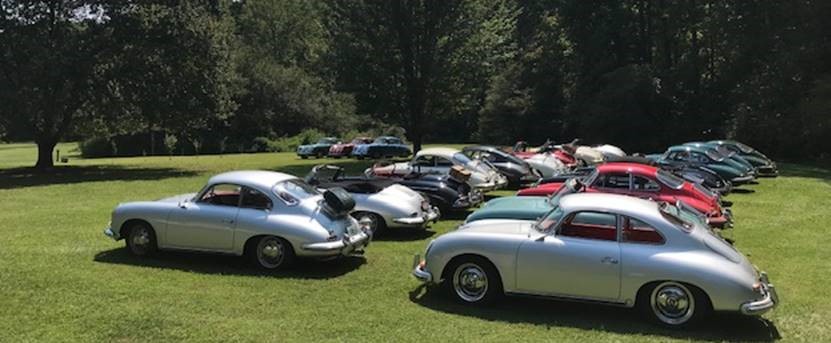
The 356 Southern Drive has been every other year event now since 2007. It is a gathering of 356 owners in the North Georgia mountains for a couple of days of driving, eating, drinking, and talking about our cars. There is no car show (more about that later), no tech sessions, and no dress-up dinners. It’s just the best laid-back group of early Porsche owners to be found anywhere.

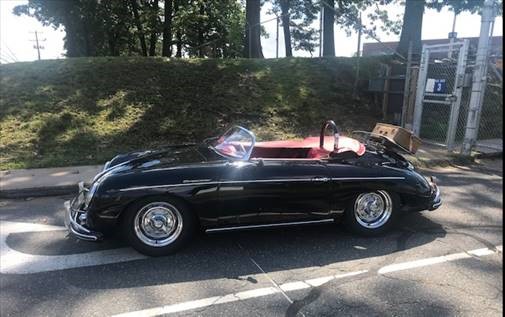
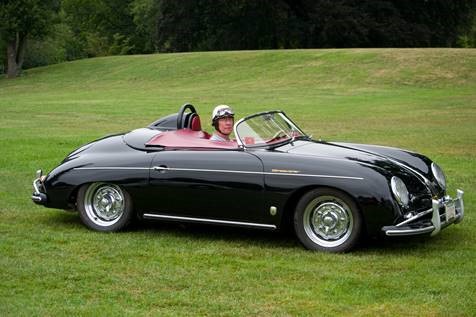
A few of us from the North have been joining the crowd since about 2011 on the 2400-mile trip down and back. I had promised brother Bill to take my Speedster this year, so I reconfigured it to install the convertible top that had been stored in the garage loft since 2001. He’s been taking his every time, but I always found a reason to leave Blackie at home. Something about not wanting to get wet again. I also had a new tonneau cover just made by my daughter-in-law, Marie, and it looked great.

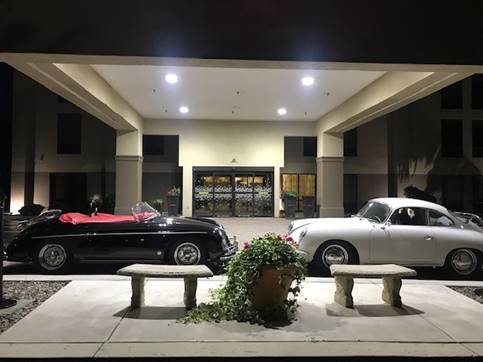
We start the journey usually in a Mass Pike rest area and collect others along the way. The first stop this year was near Hershey, PA, where the Hampton Inn folks offered us covered parking to add some style to the property.

Brother Bill joined the pack in northern Virginia where Rt 66 meets I 81, and we rode on to Wytheville, Va to have dinner at the Log House 1776 Restaurant, a local landmark. We were at a Hampton Inn there too but didn’t get covered parking, and sure enough, it rained during the night. I can attest to the tonneau cover holding water because I forgot to check the forecast and didn’t put the top up. I’m still learning.

We normally pick up two more drivers in Wytheville, but they were a day ahead of us, so it was just the three Tubs going down the road waving at folks taking pictures from their SUVs. Great fun.

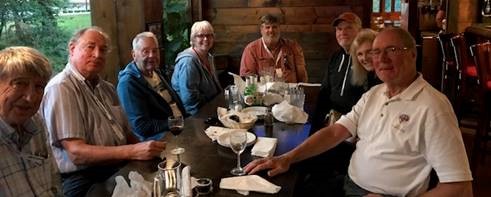
 Arriving at the lodge on the third day, we found many old friends and some new folks that we had only talked to on the phone. Dinner in Helen the first night found us at the Hofbrauhaus along with 356 Registry Trustee Cliff Murray and wife Jean, along with Tom Olson all the way from Wash state in his blue ’65 356 and racer Tim Baker and his wife, Shonney.  

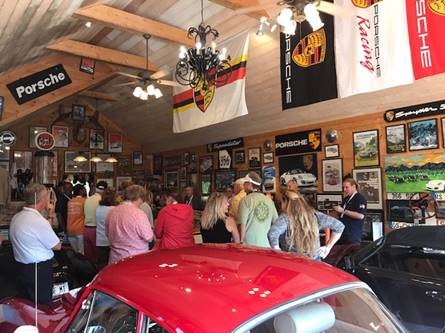
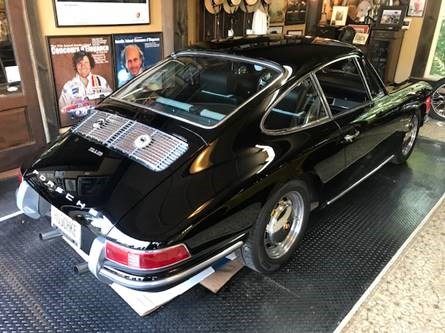
Friday was a great ride for half the attending cars and a luncheon visit at the Wolf Winery owned by a fellow Porsche enthusiast who owns 6 P cars, including a Speedster, a 356 Notchback, and a black 912. That garages (there were four that I counted) had more photos and stuff than most museums.

There were 25 cars in our caravan to the winery, and it seemed that folks in the small towns we passed through had all come out to see the parade. We rolled back through the woods in time for a BBQ dinner at the lodge and lots of 356 talk, well into the night. It came with some live country music but no banjos.

We spent the next day with a smaller group driving the mountain roads and played tourist in Dahlonega, GA site of the first US gold rush in 1829. Of course, we had a pig roast on Saturday night with more music.

Sunday was the final day, and what else but another scenic drive to another winery. We lined up at the lodge, ready to make our final group drive.

 Arriving at Glen Ella Winery, we were asked to line up on the grass so that the owner could view all the cars. Not being a Porsche owner, she had been asked to select her favorite Tub. That is as close to a car show that we get on the Helen drive.

The lunch was great as always, and after recognizing the staff for all their planning and hard work on the Southern Drive, the owner was asked to announce her pick and award a bottle of their best wine. It was Blackie.   After all that, I guess I’ll be keeping that car for a few more years. Blackie never missed a beat, nor did any of the other Tubs (one hit a bear, but both the bear and the car kept going) and got 30 mpg.   It may not be as fancy as a 911 C4S or as fast as a Turbo S, but it sure made the trip more fun than the title suggests.

Another nicely run NCR event at Tamworth, this time with really nice weather and thus no excuses for my sorry driving.  My fastest session of the weekend was the first of the event – on a damp track – and I never improved from there. It seemed like I was pushing fairly hard, sliding around quite a bit, and I was quick to blame my tires.  Mr. Frugality believes he can go a whole season on one set of tires (the car is so light they don’t cord), but I thought perhaps they go off after a lot of heat cycles (I was up to 35 or so).  But data don’t lie. When I got home and compared that event to my previous better runs, there was no evidence of a lack of grip and a lot of evidence of not braking late enough or hard enough. I continue to struggle with not using braking markers, and I was giving up almost a second in Turn 1. You can’t teach an old dog new tricks, so I’m lucky that I’m just a pup and will obviously get better.

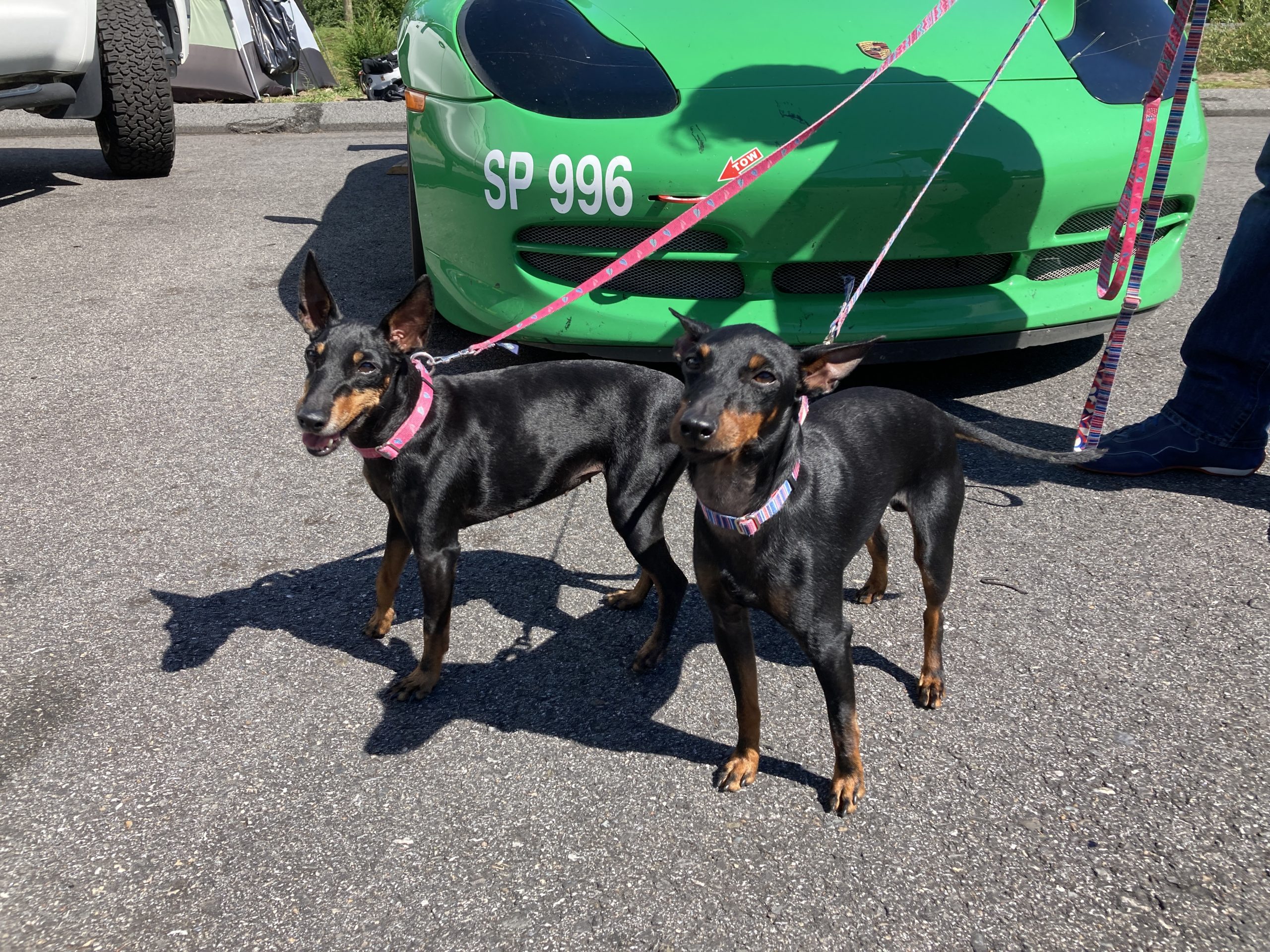
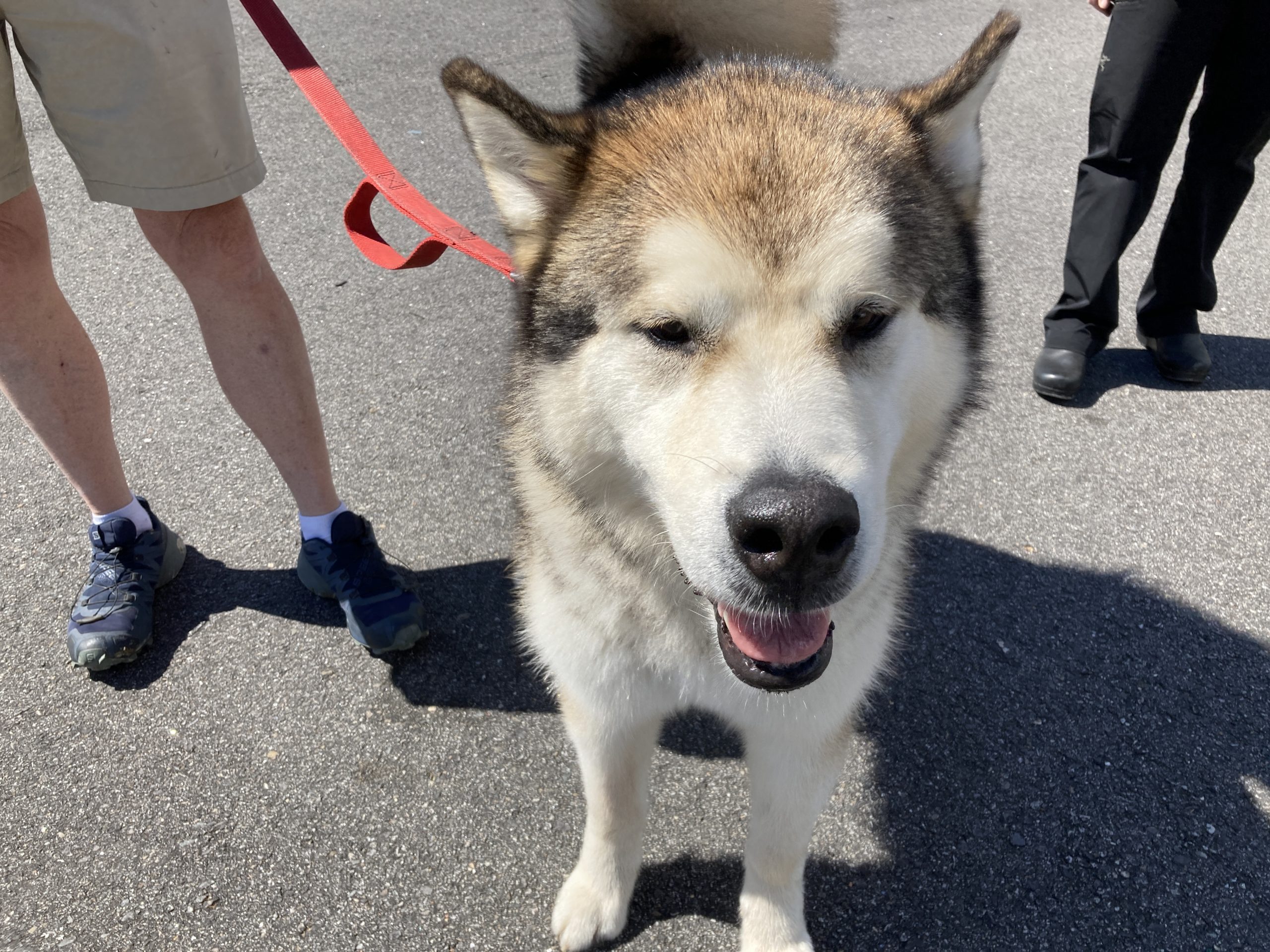
Speaking of pups, please enjoy Part Two of the Dogs of Tamworth.  I know that cute kitties might be better clickbait, but I couldn’t find any at the track.  Note in particular that Misty and Butzi are the pets of Kristin Larson’s Mom (and you know why Butzi is named Butzi!).

On to less happy tails (tales), let’s wander into the Jamaican Bakin’ Team garage and see how the Mustang is coming along.  In case you missed previous episodes, I’ll remind my reader that Sally’s motor blew up at the Watkins Glen American Endurance Racing event.  At considerable expense, we bought a replacement motor and have been slowly doing the swap (Nick is at race tracks all over America, and Chip has been struggling to relocate his machine shop).  Dave, in his role as Coroner, performed an autopsy on the victim and the picture shows the corpse.  Still not clear why the connecting rod let go, but the results are unattractive. The new Sally fired up right away, and so now we just need to get it to the dyno and put the snout back on. 

However, the bad news is that AER is changing their rules and for 2022 will not allow a car to run with a power to weight ratio below 9.  The Mustang, svelte thing that she is, weighs in at 3,200 pounds, and the old motor put out 400 hp at the rear wheels.  The new motor, with the fancy intake, is good for over 500 hp. Even the most math-challenged will agree that we’ve got a problem. We are advised that with a restrictor plate we can detune down to the necessary ~360 hp, but the car would then need to be short-shifted at around 4,000 rpm to stay in the torque band. This on a car that could put out over 500 hp and rev to close to 8,000 rpm.  What a waste!  And our experts pointed out that we would be better off driving a lighter car with less horsepower.  A zoom meeting was arranged to discuss options, and the decision was reached to move to a new car. Once the car is dyno’ed (we’ll have the specs to use in the sales brochure) and tested (at a Thompson club day) we’ll post it on Racing Junk and see what happens.  If anyone is interested in a roaring beast, just let me know!  (Use code “PCANER” for a 5% discount.  Buyers’ commissions are offered.  Driven on a closed track by a professional driver.  Do not try this at home.  Etc.)

So what is next?  Prior to the Mustang purchase, we had been looking at E36 or E46 BMW’s, and those certainly are candidates. Some of the JB team have a Boxster or Cayman that could be pressed into service, perhaps. Dave is a big fan of Acura Integras (front-wheel-drive car? C’mon!).  Or perhaps the answer is, as always, “Miata?” (With the Acura motor swap.)  Gives us something to do over the winter.

-Bill Seymour

As many of you know, we lost NER legend Steve Ross back in March.  He was a friend, a mentor, and a leader whose impact was unmatched.

Paying it Forward is a term that most of us have heard and probably used.  In fact, it has been around forever. It has been the subject of books, movies, YouTube videos, websites, and foundations.  There’s even a Pay it Forward Day.  An Australian started Pay it Forward Day, which is now celebrated on April 28th by eighty countries.   Defining it simply as “an expression for describing the beneficiary of a good deed repaying the kindness to others instead of to the original benefactor”.  Steve practiced Paying it Forward naturally.

If you are new to NER, Welcome!  If you are one of our more tenured members, try remembering your first day or NER experience.  What was your onboarding experience like?  This was mine:

When Betty and I joined NER we knew no one.  And I mean no one.  Soon after, we met Steve during lunch on a Fall Tour.  We quickly became friends and Steve launched into all things NER.  He summarized each event or program with his big smile and excitement.  And it was genuine. Steve had the natural ability to “sell” without selling. For some, it can be learned.  For others, it comes naturally.

Over the years, Steve was my “go-to” guy when I had any questions regarding the car, NER, Porsche, recommendations for events, introductions to fellow NER members and service providers.  Sometimes it was those classic conversations like storing the car or not.  One time, I talked to him about a rare 50-degree January day with no snow or salt on the road and my regret for storing it.  He looked me straight in the eye and said – “you bought the car to drive, drive it!”  I felt like I got hit over the head with a 2X4. 

At the end of each autocross, Steve would announce the upcoming NER events. Each of them with his Steve Ross smile.  At one AX (Autocross), Steve talked about a July DE (Driver’s Ed) event in Mont Tremblant Quebec.  Having skied there, I knew Mont Tremblant as a ski resort but did not know about a track.  Coincidently, the village of Mont Tremblant hosted the annual Canadian Blues Festival.  Steve’s pitch was, “If you are going to do one DE event, THIS IS the event that you need to do!”  Betty and I registered that day.

Steve told me about this event called “The Ramble”.  Maybe you are one of the 400 people who attend the annual event?  If you do not, you need to. Again, we registered late and got the absolute last two tickets.  And once again we were hooked.  Steve was spot on.  The Ramble remains my favorite NER event.

With me, and many others, Steve had the ability to look you directly in the eye and make you feel like you are the only person in the world, and what you were saying was more important than anything else. This is a gift.  His enthusiasm was genuine.  He was unpretentious, never arrogant, and never demanded something in return. His passion for all things Porsche could be infectious.  NER was more than a club to Steve, it was family.

Over the last few years, many of us watched Steve become more and more confused and forgetful.  Those of us with family members or friends with Alzheimer’s know these symptoms all too well.  When fellow NER member Alicia Kullas came to me in 2018 with Steve’s diagnosis, she suggested that we recognize his club contributions now, before it was too late.  I could not have agreed more.  I presented it to the board in June of 2018, and we unanimously agreed to move forward with it.

Why did I entitle this article Paying it Forward?  Because it was what Steve did.  He encouraged and paved the way for many of us.  He reached out to many new members welcoming and encouraging them to get involved. Whether you are new to NER or a tenured member, think about your first experience with the club.  What was it like?  What was your first impression? Did you feel welcome?

Whether you have been with the club for a short period of time or many years, reach out to new(er) members, give them a “hand up”.  Be a friend. Be a mentor.  Share your great club experiences.  Share your connections. Participate in one more event. Help produce a new or established event. Encourage new ideas.  Pay it Forward.

-Glenn Champagne

A Drive Down Memory Lane

I’m back from the Watkins Glen DE, and it’s column time.  After a very wet driving season (no, I don’t have rain tires because I have no interest in getting soaked and scaring myself), it was great to have decent weather.  Despite some clouds, I got in all 4 of my runs on Friday and Saturday, and Sunday saw perfect weather and five sessions as Adam combined the final Red, Black, and White run groups.  Plus, I drove a couple of student cars and had a session in Bob/Marcia Binder’s 2010 Cayman (almost identical to mine – the blip-shift is a great addition! – thanks!).  Congratulations to the NER DE team for a great event.

I love Watkins Glen – both the track and the area. I have very fond memories of my times there and probably have written about them in some previous column – if you can find it, you should read that one which is probably better than this will be.  But with talk of Porsche returning to F1, let’s have a little history lesson – some personal, some Porsche.

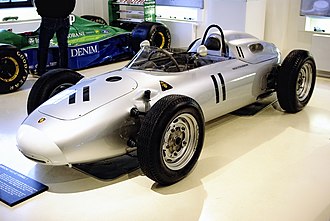
While early 356’s were successful in racing, the first pure Porsche racecar was the Typ 550 (well known as the James Dean car), which first appeared in 1953.  Like the 356, this had a flat-four air-cooled engine, but, unlike the 356, this had the 4-cam Fuhrmann engine (code 547) in a mid-engine location. It competed successfully in sports car racing, and an updated model raced in F2 races (initially as a two-seater, then as a single-seater).  When F1 changed to a 1.5-liter formula in 1961, the former F2 cars were now eligible.  Labeled Typ 718/2, these cars made 186hp @ 8,000 RPM and, weighing under 1,000 lbs, were capable of 150+ MPH (with drum brakes!).  For the 1961 season, “Porsche System Engineering” campaigned two cars in all 8 Grand Prix for Dan Gurney and Jo Bonnier.  Gurney (Car and Driver Magazine ran a campaign for him to be elected President in 1964) placed second in three races (including Watkins Glen) and finished the season fourth in the Driver Championship while Porsche was third in the Constructors Championship.  Ferraris were dominant, winning the Constructor Championship and Phil Hill winning the Driver Championship (after his teammate Wolfgang von Trips was killed in the next to last race).

For the 1962 season, Porsche introduced a new model, the Typ 804, which was similar in appearance to the Typ 718 but built to accommodate a flat-eight air-cooled engine (code 753).  Although slightly heavier and with no more power it was narrower, lower and smoother, which contributed to a higher top speed (167 MPH).  It was the first Porsche to use disc brakes and rack and pinion steering.

The 1962 F1 season saw a complete reversal from 1961:  the British constructors were ascendant with new V-8 engines, and Ferrari struggled with labor woes.  BRM won four races (Graham Hill), Lotus three (Jim Clark), and Cooper one (Bruce McLaren).  Porsche again campaigned two cars for Gurney and Bonnier, and Dan won the French Grand Prix – Porsche’s only F1 win (until 2025?).

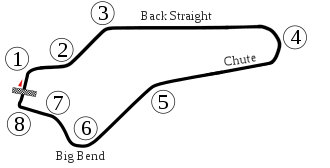
1962 was the fourth year that the U.S. hosted an F1 race:  Sebring in 1959 and Riverside CA in 1960.  But those events were unprofitable, and Watkins Glen got the race for 1961.  (Attendance was 60,000, and the race continued to be at Watkins Glen until 1980.)  The course was very different from what we drive.  While somewhat similar to the current NASCAR layout (which omits “the boot”), there was no front straight as we now know it.  It was 2.35 miles long. 

Since Ferrari was totally out of contention, they didn’t bother to come to the Glen in 1962 (they also skipped 1961 because they had already won the Championship).  With one race left after Watkins Glen (the South African Grand Prix), Hill could win the Championship if he finished ahead of rivals Clark and McLaren. 

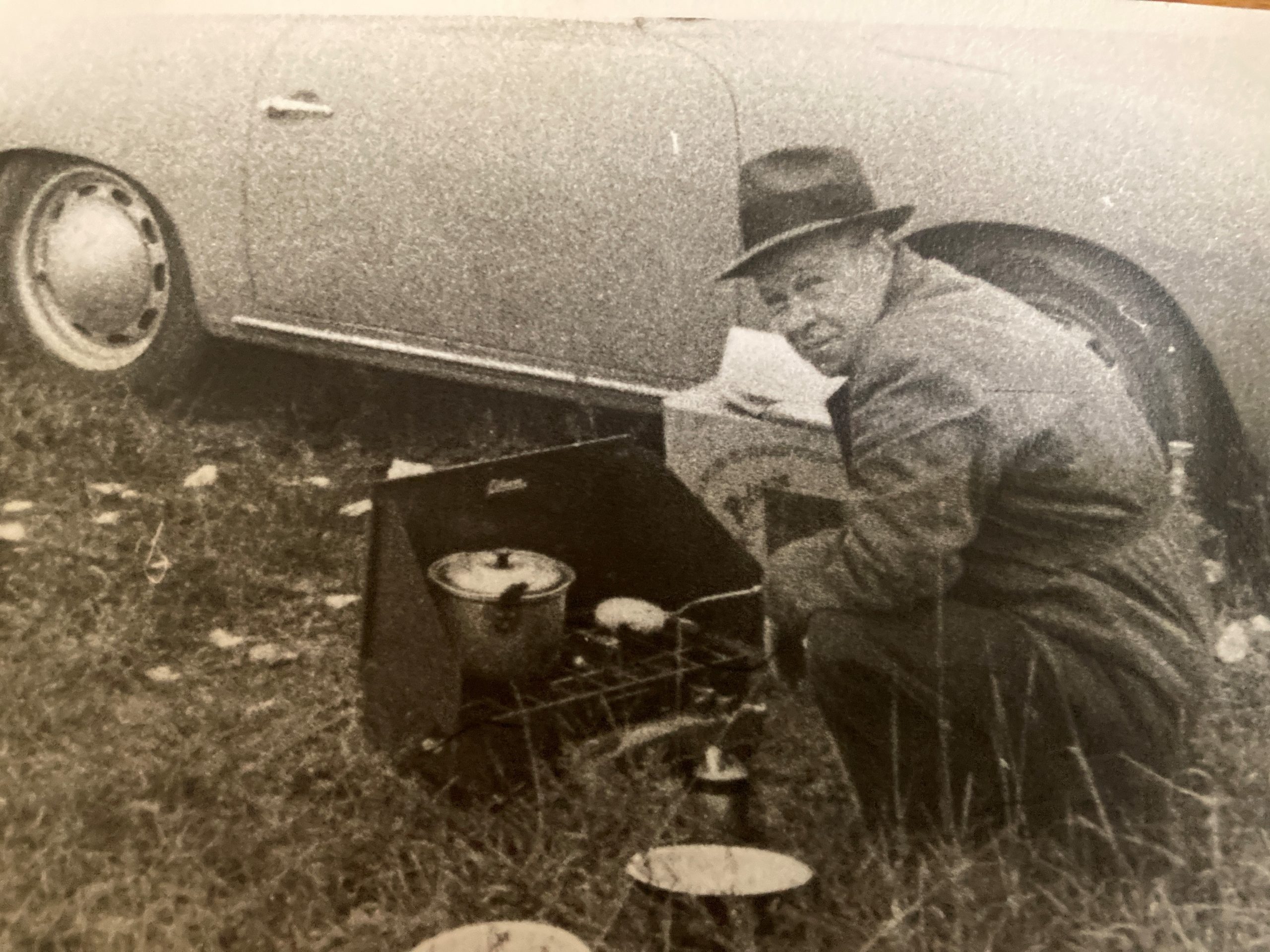
The race weather was dry but overcast. Ask me how I know.  My Dad and I had packed beer, a cookstove, and sleeping bags (no tent or anything useful like that – we were not a camping family) and headed to the race.  On the way out, I drove the 356 for the first time (underage, of course).  My Dad pulled over on the N.Y. Thruway and turned it over to me.  As I carefully matched the speed limit, he prodded, “if you are going to drive, then drive it,” and I was probably around 80 as we passed a State Cop in the median.  I saw my life flash before my eyes.  But he stayed put, and I pulled over as soon as we were out of sight.

We arrived the day before the race, parked in the infield, and set about cooking a steak.  After dinner, we wandered around and then attempted to sleep despite some fairly rowdy and drunken neighbors.  Although not cold by October Watkins Glen standards, it was pretty chilly on the ground in a crappy sleeping bag, so we retreated to the 356, reclined the seats, and spent an uncomfortable night.

Qualifying was different in 1962 than it is now:  practice and qualifying were combined, and there were sessions on Friday and Saturday afternoons.  Clark, in his Lotus-Climax, set a new course record of 1:15.8 (averaging 111 MPH with ~185 HP on skinny tires!) on Friday, and this held up due to rain on Saturday.  He started on the pole among a total of 18 cars.  Gurney qualified fourth.

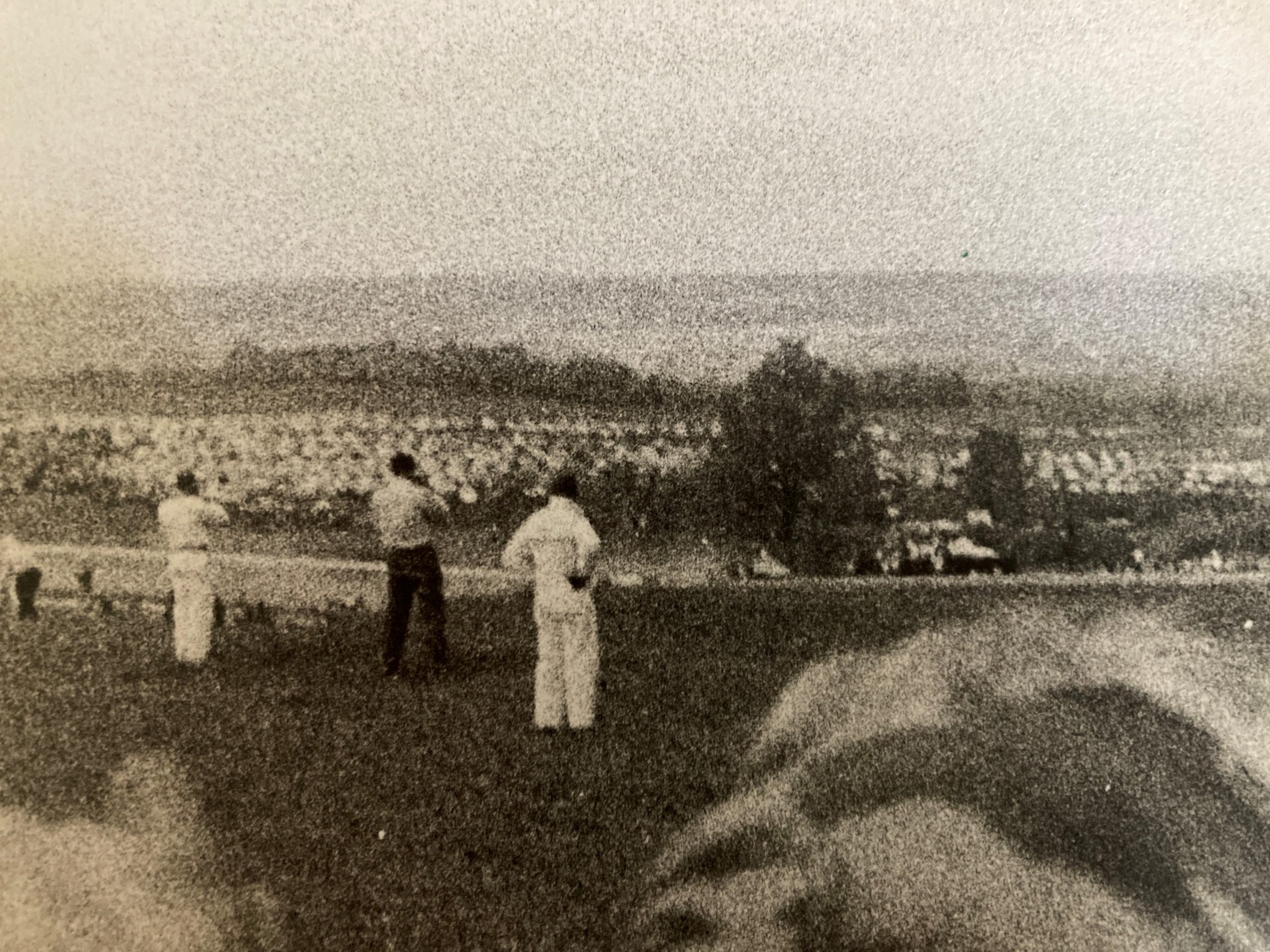
Without a cell phone and Race Hero or big scoreboards, it was pretty difficult to follow the race.  The report which follows is based on web research, not my teenage memory.  (And actually, I had always thought I went to the 1961 race.  It was only in researching for this column that I noticed the number on Gurney’s car, which meant it was 1962.)  Clark and Graham Hill ran away with the race, swapping the lead a couple of times, but Clark winning by 9 seconds.  No other cars were on the same lap, and only 13 cars were running at the end.  Gurney ran as high as third, but his car fell off at the end, and he finished fifth. 

In the final race of the 1962 season, two months later, Clark was leading easily before an oil leak ended his day. Graham Hill won the race and the Championship. 

Back to the Glen story, my Dad and I packed up and headed home.  He drove the whole way.  I later went to one other WGI F1 race with my Dad when I was in college.  That was the first time I ever had a beer in the morning to combat a hangover. 

Everyone needs to go to the Glen! And make sure you drive the old original road course.  Here is a nice article about the history of the courses used.

Interesting note: the really crappy pictures that I took were done with the camera that is shown in one of the pictures, which was a pretty weird little camera – not a common one. It was a half-frame 16mm thing, and the pictures always sucked. I don’t know why my father used it.


– Bill Seymour

This month’s column is about membership communications and more Sim Racing.

With our website and social media being our primary communications vehicles to the membership, you will see much more content than you used to find in the NOR’EASTER appearing on porschenet.com. To ensure that there is a steady and interesting flow of content there we have established a formal submission and publication process. In addition to the regular contributors, we would love to hear more from any members that have something interesting to share, like a trip report, or your experience from your first DE, Autocross or Rally, the new or old Porsche that you just bought, or anything else that you would like to share with the rest of us.

Submissions should preferably be in Microsoft Word format and emailed to [email protected] with any pictures attached. The pictures should be in the highest possible resolution you can provide. Once we receive the email, we run the text through Grammarly to fix any punctuation, spelling, or grammatical errors, but we do make sure that your writing style is preserved. It is also categorized and tagged in order to make it easy to locate in the future. After that is done, it is sent to our web team, who add the content to the website and schedule it for publication. New content is summarized on the front page. Then, on a weekly basis, we send an email to all members summarizing and linking to all new content published after the previous email and a calendar for the current and following month to ensure that you don’t miss anything interesting. Any questions or comments you may have for us should also be emailed to [email protected]. We look forward to hearing from you.

The summer Sim Racing race series and both the regional and national levels are wrapping up, and the fall race series are about to start. This is a good time to jump in and join the fray. We have loaner equipment that we let members take home to get a taste of Sim Racing with minimal investment. If you are interested, send an email to [email protected].

At the regional level, the next series will be racing Porsches on a weekly basis. Race evening is Tuesdays at 8 PM and lasts about two hours with practice, qualification and races. We have a friendly, welcoming, and fun group and work hard to keep it this way. We also invest a lot of effort in bringing new racers up to speed with advice and practice races. To learn more, join our Facebook group at https://www.facebook.com/groups/810156892838722

At the National level, we will be racing the Porsche GT3 R, a sweet car, in an 8-week series. National also works hard to be accommodating to newcomers and has programs targeted towards bringing them up to speed and into the races. They have divided the races into four classes, Challenge, Sport, Club, and Pro, according to the driver’s abilities, so you will race against drivers with similar skills. The next series, number 7, will be published soon on the National Sim Racing League’s website pcasimracing.com. The website has a wealth of information about what Sim Racing is, how to join, and much more, so head over there and take a look.

At the National level, December, January, and February are dedicated to races between the PCA Zones. They have been organized into five groups that each will run their own races in December and January to select the top 8 drivers in each class for each Zone Group. These 32 drivers will participate in a series of three races in January that will crown the Zone group and individual winners within each class.

While we wait for Series 7 to begin, there will be an exciting two-race series between International Porsche club teams. The races will be broadcasted on YouTube and will take place (virtually) at Road Atlanta on September 11th and Spa Francorchamps (no rain!) on September 18th. It will feature the best Sim Racers in the PCA and is guaranteed to be exciting. When I know the exact times and have the URLs to connect to, I will let you know.

Finally, a few comments about myself and Sim Racing: the series that just completed was organized by the West Coast Zones in PCA and featured the Porsche GT3 R in 8 venues. 7 were road races, and one was an oval race at Indianapolis Speedway. To do well in these races, requirement one was to participate. To increase your chances of placing well, you also had to finish well in at least 7 of the eight races. To do that, you had to avoid incidents (crashing, getting penalized for violating racing rules, spinning or running off the track), and finally, you had to have a decent pace. Good pace with incidents leads to worse results than slower pace and fewer incidents. It also requires a huge amount of self-control. It is easy to increase speed when you are anxious to pass a slower driver or when a faster driver is on your rear bumper, but increased speed also increases the risk of incidents, so the best strategy is not to let the adrenalin surge take control and lead you into trouble. I have worked on this for two years now, and it finally came together in this series, and I placed much higher in the rankings than I expected.

It was a good thing that only 8 out of 7 races counted. My performance on the oval was embarrassing. I was involved in multiple crashes (but didn’t cause any) and was black-flagged multiple times for infracting rules that I didn’t quite understand. It was fun but very much a learning experience. If you are interested in seeing a 10 minute summary of the race, check out https://youtu.be/cU1VilIrWsU  for a 10-minute video or https://youtu.be/lmr3GXoHO08 for a 30 minute video.

Anker