Archive for category: Monthly Columns

As many of you know, we lost NER legend Steve Ross back in March.  He was a friend, a mentor, and a leader whose impact was unmatched.

Paying it Forward is a term that most of us have heard and probably used.  In fact, it has been around forever. It has been the subject of books, movies, YouTube videos, websites, and foundations.  There’s even a Pay it Forward Day.  An Australian started Pay it Forward Day, which is now celebrated on April 28th by eighty countries.   Defining it simply as “an expression for describing the beneficiary of a good deed repaying the kindness to others instead of to the original benefactor”.  Steve practiced Paying it Forward naturally.

If you are new to NER, Welcome!  If you are one of our more tenured members, try remembering your first day or NER experience.  What was your onboarding experience like?  This was mine:

When Betty and I joined NER we knew no one.  And I mean no one.  Soon after, we met Steve during lunch on a Fall Tour.  We quickly became friends and Steve launched into all things NER.  He summarized each event or program with his big smile and excitement.  And it was genuine. Steve had the natural ability to “sell” without selling. For some, it can be learned.  For others, it comes naturally.

Over the years, Steve was my “go-to” guy when I had any questions regarding the car, NER, Porsche, recommendations for events, introductions to fellow NER members and service providers.  Sometimes it was those classic conversations like storing the car or not.  One time, I talked to him about a rare 50-degree January day with no snow or salt on the road and my regret for storing it.  He looked me straight in the eye and said – “you bought the car to drive, drive it!”  I felt like I got hit over the head with a 2X4. 

At the end of each autocross, Steve would announce the upcoming NER events. Each of them with his Steve Ross smile.  At one AX (Autocross), Steve talked about a July DE (Driver’s Ed) event in Mont Tremblant Quebec.  Having skied there, I knew Mont Tremblant as a ski resort but did not know about a track.  Coincidently, the village of Mont Tremblant hosted the annual Canadian Blues Festival.  Steve’s pitch was, “If you are going to do one DE event, THIS IS the event that you need to do!”  Betty and I registered that day.

Steve told me about this event called “The Ramble”.  Maybe you are one of the 400 people who attend the annual event?  If you do not, you need to. Again, we registered late and got the absolute last two tickets.  And once again we were hooked.  Steve was spot on.  The Ramble remains my favorite NER event.

With me, and many others, Steve had the ability to look you directly in the eye and make you feel like you are the only person in the world, and what you were saying was more important than anything else. This is a gift.  His enthusiasm was genuine.  He was unpretentious, never arrogant, and never demanded something in return. His passion for all things Porsche could be infectious.  NER was more than a club to Steve, it was family.

Over the last few years, many of us watched Steve become more and more confused and forgetful.  Those of us with family members or friends with Alzheimer’s know these symptoms all too well.  When fellow NER member Alicia Kullas came to me in 2018 with Steve’s diagnosis, she suggested that we recognize his club contributions now, before it was too late.  I could not have agreed more.  I presented it to the board in June of 2018, and we unanimously agreed to move forward with it.

Why did I entitle this article Paying it Forward?  Because it was what Steve did.  He encouraged and paved the way for many of us.  He reached out to many new members welcoming and encouraging them to get involved. Whether you are new to NER or a tenured member, think about your first experience with the club.  What was it like?  What was your first impression? Did you feel welcome?

Whether you have been with the club for a short period of time or many years, reach out to new(er) members, give them a “hand up”.  Be a friend. Be a mentor.  Share your great club experiences.  Share your connections. Participate in one more event. Help produce a new or established event. Encourage new ideas.  Pay it Forward.

-Glenn Champagne
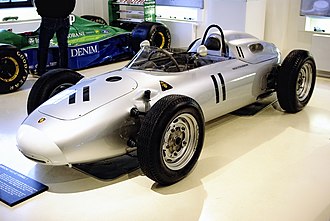
A Drive Down Memory Lane

I’m back from the Watkins Glen DE, and it’s column time.  After a very wet driving season (no, I don’t have rain tires because I have no interest in getting soaked and scaring myself), it was great to have decent weather.  Despite some clouds, I got in all 4 of my runs on Friday and Saturday, and Sunday saw perfect weather and five sessions as Adam combined the final Red, Black, and White run groups.  Plus, I drove a couple of student cars and had a session in Bob/Marcia Binder’s 2010 Cayman (almost identical to mine – the blip-shift is a great addition! – thanks!).  Congratulations to the NER DE team for a great event.

I love Watkins Glen – both the track and the area. I have very fond memories of my times there and probably have written about them in some previous column – if you can find it, you should read that one which is probably better than this will be.  But with talk of Porsche returning to F1, let’s have a little history lesson – some personal, some Porsche.

While early 356’s were successful in racing, the first pure Porsche racecar was the Typ 550 (well known as the James Dean car), which first appeared in 1953.  Like the 356, this had a flat-four air-cooled engine, but, unlike the 356, this had the 4-cam Fuhrmann engine (code 547) in a mid-engine location. It competed successfully in sports car racing, and an updated model raced in F2 races (initially as a two-seater, then as a single-seater).  When F1 changed to a 1.5-liter formula in 1961, the former F2 cars were now eligible.  Labeled Typ 718/2, these cars made 186hp @ 8,000 RPM and, weighing under 1,000 lbs, were capable of 150+ MPH (with drum brakes!).  For the 1961 season, “Porsche System Engineering” campaigned two cars in all 8 Grand Prix for Dan Gurney and Jo Bonnier.  Gurney (Car and Driver Magazine ran a campaign for him to be elected President in 1964) placed second in three races (including Watkins Glen) and finished the season fourth in the Driver Championship while Porsche was third in the Constructors Championship.  Ferraris were dominant, winning the Constructor Championship and Phil Hill winning the Driver Championship (after his teammate Wolfgang von Trips was killed in the next to last race).

For the 1962 season, Porsche introduced a new model, the Typ 804, which was similar in appearance to the Typ 718 but built to accommodate a flat-eight air-cooled engine (code 753).  Although slightly heavier and with no more power it was narrower, lower and smoother, which contributed to a higher top speed (167 MPH).  It was the first Porsche to use disc brakes and rack and pinion steering.

The 1962 F1 season saw a complete reversal from 1961:  the British constructors were ascendant with new V-8 engines, and Ferrari struggled with labor woes.  BRM won four races (Graham Hill), Lotus three (Jim Clark), and Cooper one (Bruce McLaren).  Porsche again campaigned two cars for Gurney and Bonnier, and Dan won the French Grand Prix – Porsche’s only F1 win (until 2025?).

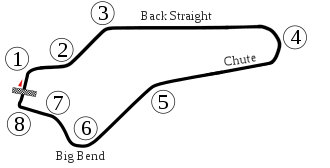
1962 was the fourth year that the U.S. hosted an F1 race:  Sebring in 1959 and Riverside CA in 1960.  But those events were unprofitable, and Watkins Glen got the race for 1961.  (Attendance was 60,000, and the race continued to be at Watkins Glen until 1980.)  The course was very different from what we drive.  While somewhat similar to the current NASCAR layout (which omits “the boot”), there was no front straight as we now know it.  It was 2.35 miles long. 

Since Ferrari was totally out of contention, they didn’t bother to come to the Glen in 1962 (they also skipped 1961 because they had already won the Championship).  With one race left after Watkins Glen (the South African Grand Prix), Hill could win the Championship if he finished ahead of rivals Clark and McLaren. 

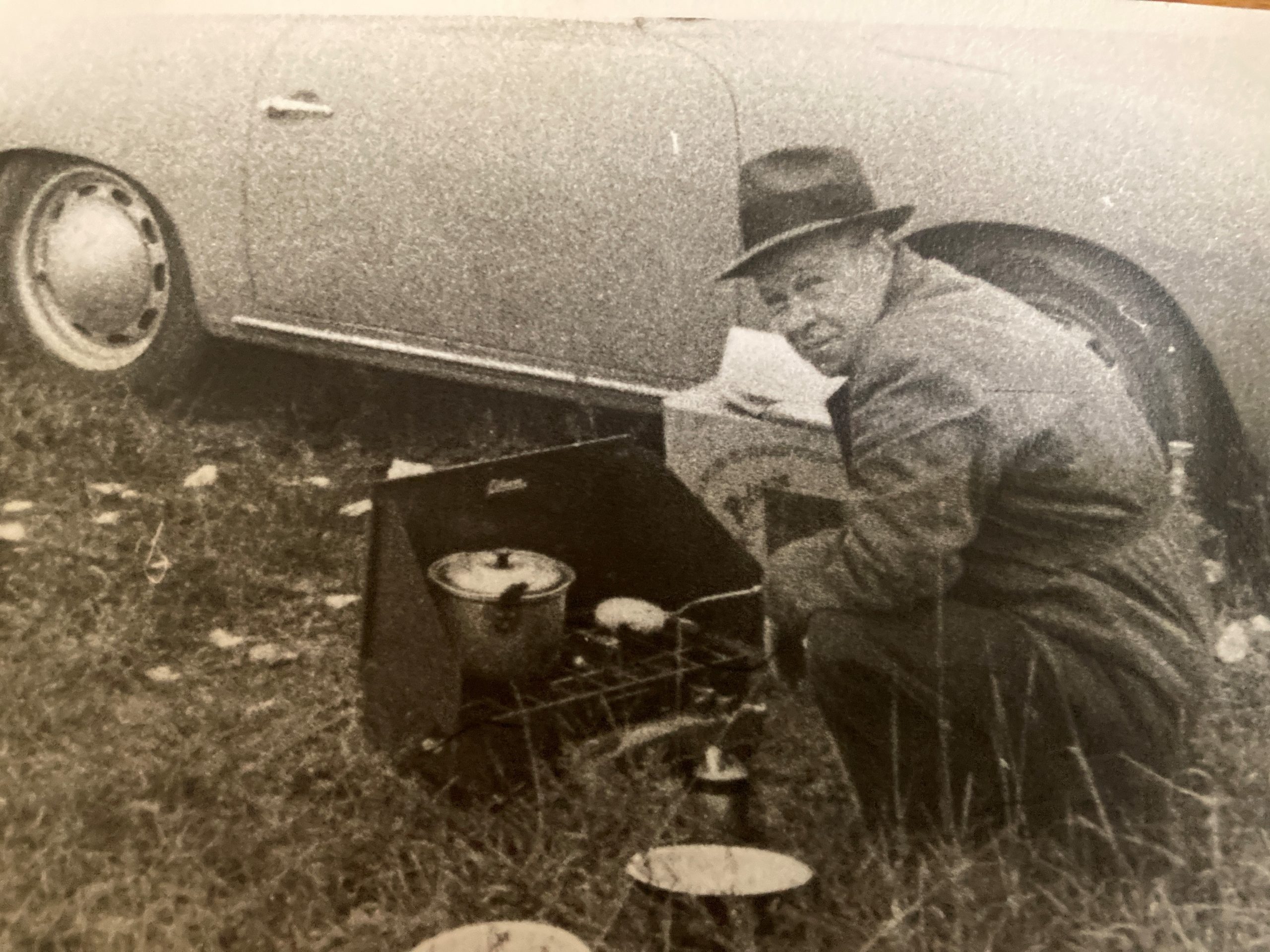
The race weather was dry but overcast. Ask me how I know.  My Dad and I had packed beer, a cookstove, and sleeping bags (no tent or anything useful like that – we were not a camping family) and headed to the race.  On the way out, I drove the 356 for the first time (underage, of course).  My Dad pulled over on the N.Y. Thruway and turned it over to me.  As I carefully matched the speed limit, he prodded, “if you are going to drive, then drive it,” and I was probably around 80 as we passed a State Cop in the median.  I saw my life flash before my eyes.  But he stayed put, and I pulled over as soon as we were out of sight.

We arrived the day before the race, parked in the infield, and set about cooking a steak.  After dinner, we wandered around and then attempted to sleep despite some fairly rowdy and drunken neighbors.  Although not cold by October Watkins Glen standards, it was pretty chilly on the ground in a crappy sleeping bag, so we retreated to the 356, reclined the seats, and spent an uncomfortable night.

Qualifying was different in 1962 than it is now:  practice and qualifying were combined, and there were sessions on Friday and Saturday afternoons.  Clark, in his Lotus-Climax, set a new course record of 1:15.8 (averaging 111 MPH with ~185 HP on skinny tires!) on Friday, and this held up due to rain on Saturday.  He started on the pole among a total of 18 cars.  Gurney qualified fourth.

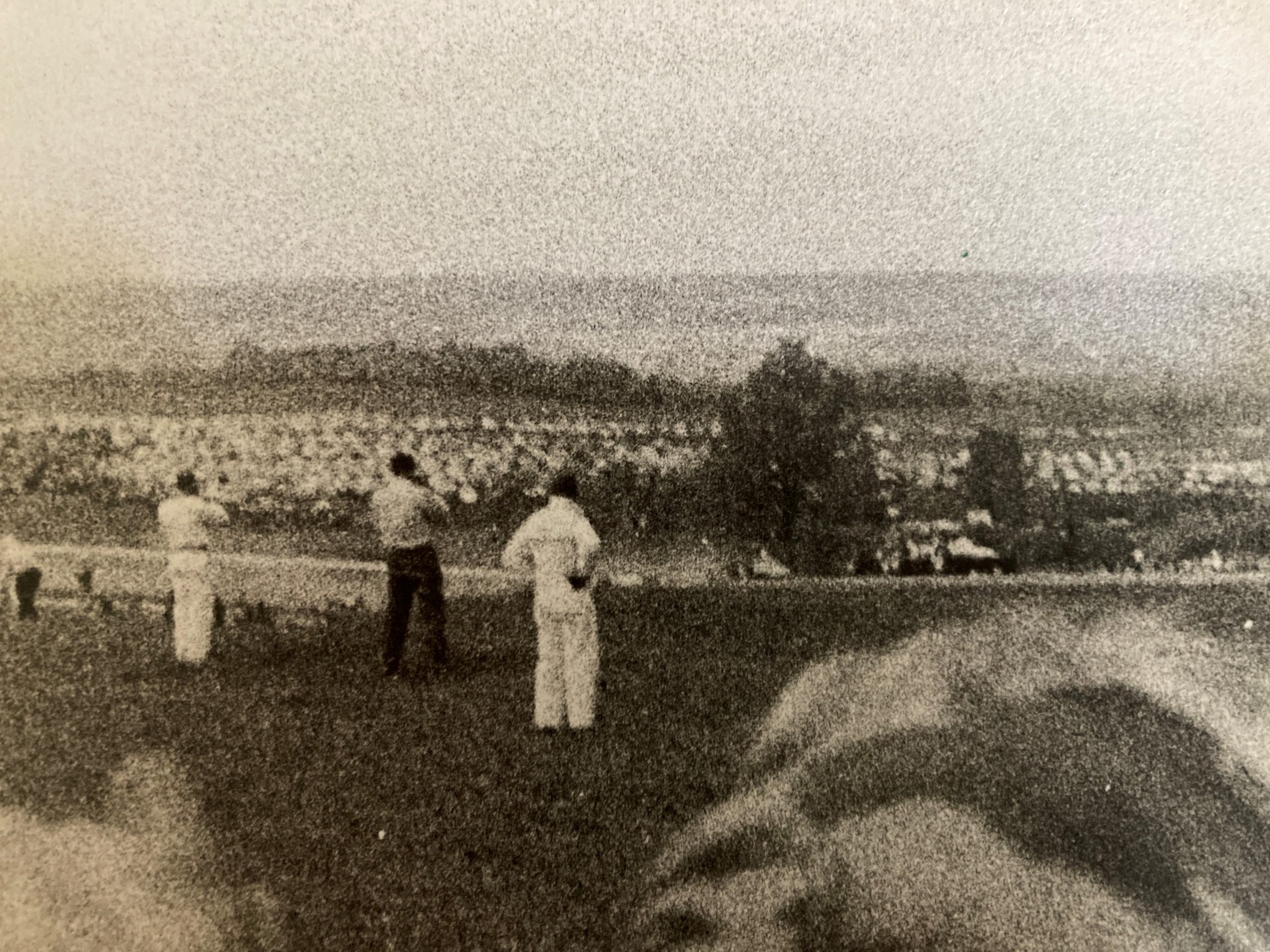
Without a cell phone and Race Hero or big scoreboards, it was pretty difficult to follow the race.  The report which follows is based on web research, not my teenage memory.  (And actually, I had always thought I went to the 1961 race.  It was only in researching for this column that I noticed the number on Gurney’s car, which meant it was 1962.)  Clark and Graham Hill ran away with the race, swapping the lead a couple of times, but Clark winning by 9 seconds.  No other cars were on the same lap, and only 13 cars were running at the end.  Gurney ran as high as third, but his car fell off at the end, and he finished fifth. 

In the final race of the 1962 season, two months later, Clark was leading easily before an oil leak ended his day. Graham Hill won the race and the Championship. 

Back to the Glen story, my Dad and I packed up and headed home.  He drove the whole way.  I later went to one other WGI F1 race with my Dad when I was in college.  That was the first time I ever had a beer in the morning to combat a hangover. 

Everyone needs to go to the Glen! And make sure you drive the old original road course.  Here is a nice article about the history of the courses used.

Interesting note: the really crappy pictures that I took were done with the camera that is shown in one of the pictures, which was a pretty weird little camera – not a common one. It was a half-frame 16mm thing, and the pictures always sucked. I don’t know why my father used it.


– Bill Seymour

This month’s column is about membership communications and more Sim Racing.

With our website and social media being our primary communications vehicles to the membership, you will see much more content than you used to find in the NOR’EASTER appearing on porschenet.com. To ensure that there is a steady and interesting flow of content there we have established a formal submission and publication process. In addition to the regular contributors, we would love to hear more from any members that have something interesting to share, like a trip report, or your experience from your first DE, Autocross or Rally, the new or old Porsche that you just bought, or anything else that you would like to share with the rest of us.

Submissions should preferably be in Microsoft Word format and emailed to [email protected] with any pictures attached. The pictures should be in the highest possible resolution you can provide. Once we receive the email, we run the text through Grammarly to fix any punctuation, spelling, or grammatical errors, but we do make sure that your writing style is preserved. It is also categorized and tagged in order to make it easy to locate in the future. After that is done, it is sent to our web team, who add the content to the website and schedule it for publication. New content is summarized on the front page. Then, on a weekly basis, we send an email to all members summarizing and linking to all new content published after the previous email and a calendar for the current and following month to ensure that you don’t miss anything interesting. Any questions or comments you may have for us should also be emailed to [email protected]. We look forward to hearing from you.

The summer Sim Racing race series and both the regional and national levels are wrapping up, and the fall race series are about to start. This is a good time to jump in and join the fray. We have loaner equipment that we let members take home to get a taste of Sim Racing with minimal investment. If you are interested, send an email to [email protected].

At the regional level, the next series will be racing Porsches on a weekly basis. Race evening is Tuesdays at 8 PM and lasts about two hours with practice, qualification and races. We have a friendly, welcoming, and fun group and work hard to keep it this way. We also invest a lot of effort in bringing new racers up to speed with advice and practice races. To learn more, join our Facebook group at https://www.facebook.com/groups/810156892838722

At the National level, we will be racing the Porsche GT3 R, a sweet car, in an 8-week series. National also works hard to be accommodating to newcomers and has programs targeted towards bringing them up to speed and into the races. They have divided the races into four classes, Challenge, Sport, Club, and Pro, according to the driver’s abilities, so you will race against drivers with similar skills. The next series, number 7, will be published soon on the National Sim Racing League’s website pcasimracing.com. The website has a wealth of information about what Sim Racing is, how to join, and much more, so head over there and take a look.

At the National level, December, January, and February are dedicated to races between the PCA Zones. They have been organized into five groups that each will run their own races in December and January to select the top 8 drivers in each class for each Zone Group. These 32 drivers will participate in a series of three races in January that will crown the Zone group and individual winners within each class.

While we wait for Series 7 to begin, there will be an exciting two-race series between International Porsche club teams. The races will be broadcasted on YouTube and will take place (virtually) at Road Atlanta on September 11th and Spa Francorchamps (no rain!) on September 18th. It will feature the best Sim Racers in the PCA and is guaranteed to be exciting. When I know the exact times and have the URLs to connect to, I will let you know.

Finally, a few comments about myself and Sim Racing: the series that just completed was organized by the West Coast Zones in PCA and featured the Porsche GT3 R in 8 venues. 7 were road races, and one was an oval race at Indianapolis Speedway. To do well in these races, requirement one was to participate. To increase your chances of placing well, you also had to finish well in at least 7 of the eight races. To do that, you had to avoid incidents (crashing, getting penalized for violating racing rules, spinning or running off the track), and finally, you had to have a decent pace. Good pace with incidents leads to worse results than slower pace and fewer incidents. It also requires a huge amount of self-control. It is easy to increase speed when you are anxious to pass a slower driver or when a faster driver is on your rear bumper, but increased speed also increases the risk of incidents, so the best strategy is not to let the adrenalin surge take control and lead you into trouble. I have worked on this for two years now, and it finally came together in this series, and I placed much higher in the rankings than I expected.

It was a good thing that only 8 out of 7 races counted. My performance on the oval was embarrassing. I was involved in multiple crashes (but didn’t cause any) and was black-flagged multiple times for infracting rules that I didn’t quite understand. It was fun but very much a learning experience. If you are interested in seeing a 10 minute summary of the race, check out https://youtu.be/cU1VilIrWsU  for a 10-minute video or https://youtu.be/lmr3GXoHO08 for a 30 minute video.

Anker

With the recent coverage about modern cars, it’s time to renew our attachment to those loveable Tubs, which is the basis for these monthly columns. The very best way to do that is to get back on the road. So let’s take a drive to the Catskill Mountains in New York.

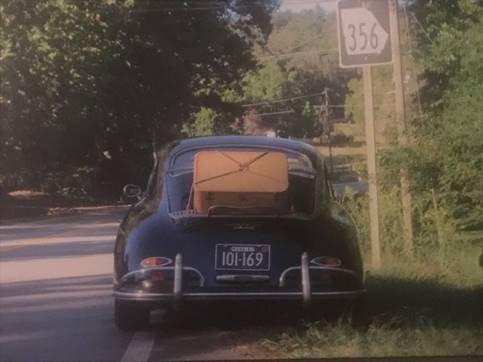
 As many know, the 356 Registry has groups all over the world, and many of them have annual events like the TYP356NE, the local New England region. One of the active groups is FOG, or the Florida Owners Group. Every other year they organize what is called the Helen, GA Drive. Helen is a town set up back in the ’60s with a German theme to attract tourists after the lumber industry died. Touches of Bavaria are everywhere, and a local road is Rt 356.

This image has an empty alt attribute; its file name is 356-rd.jpeg

 A group of us have made the run down to the north Georgia mountains four times now. There are BBQs, swap meets, and lots of drives on mountain roads (like Tail of the Dragon), all in a low-key, run what you have brung atmosphere.  Collecting more Tubs while passing through NJ, PA, and Maryland made for a great caravan. Over the years, we have talked about having the same sort of event up north on alternate years.

Since 2020 was an open year, a few of us started planning back in 2019 and found a great location near Catskill, NY, a German resort from the ’50s that was still operating. It is called Riedlbauers Resort, has over 50 rooms, a banquet hall, and is surrounded by Porsche roads that run all over the Catskills. Brother Bill set about designing drives for the group, and a couple of guys drove over from New Jersey to take an onsite look.  

 It looked like a go, and the wheels started turning, but we all know what happened to the summer of 2020. Everything was put on hold.

This year is the Helen Drive again, but we’re gearing up for 2022, which will be called the Catskill Treffen.  Given the time available, it was decided that we should all gather at the Resort in Round Top, NY, to do a recon weekend. The end of July looked good for everyone and a couple of guests, so the Tubs were gassed up and pointed to the woods. By now, one of our group was voted in as a Registry Trustee, so we even had a VIP in our midst.

I decided that – rain or shine – the Speedster was going. The convertible top is still in the garage loft, but as many know, I’ve been wet before. I’ve had that car for 45 years, and my brother has had his for 55 years. In all those years, they have only been together a few times. My restoration was finished in 1999 and his in 2010. When he had his car at the last few Helen drives, I had the Puddle Jumper. When he drove his Speedster to the NJ holiday, I took a ’65 SC I had at the time. It was time that they got together again. 

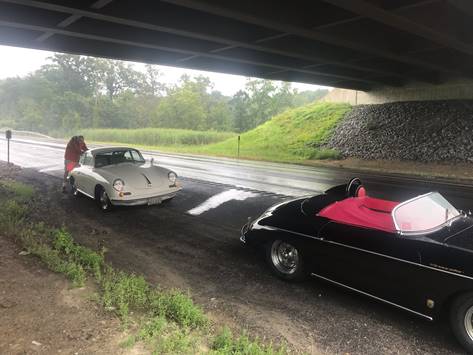
The weather forecast looked iffy the first travel day, but the following three days looked perfect, so Jeff Leeds and I took off on the Mass Pike after rush hour. There were only a few sprinkles until we got past the Lee exit, and then the sky opened. Thank goodness for overpasses. The first one available was filled with two large black Suburbans, but just a couple miles further, there was space.

The rain only lasted about 30 minutes and then it was only another hour to the resort. Bill and Bev had come in the day before, so the two Speedsters posed for a photo opportunity in front of the main building.

The resort includes breakfast, but unlike the big chains like Super 8 or Hampton Inn, they serve only sit down, and it starts at 8:30 am. Only. Did I mention it was a family-owned German resort? There are eggs any way you want them, bacon, sausage, and two kinds of cereal. A pitcher of orange juice, coffee, and milk was on each table. They also alternate French toast and pancakes, but they don’t serve both on the same day, so if you want pancakes, it better be the right day. Everyone working there seems to really like what they’re doing, and the place has a really nice family feel to it. The family owners can be seen clearing tables and serving food when needed.  Dinner is similar, and the menu is posted, so you know what to pick. It’s all served family-style with plenty of bread and butter on every table. 

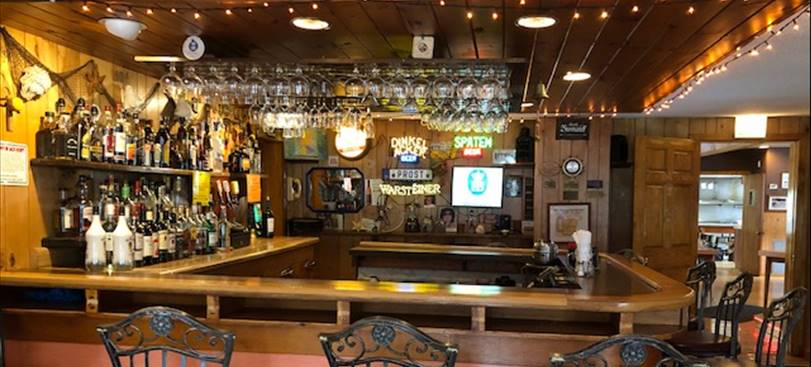
The bar has a great vibe with lots of German beer on tap, and Johnny and Jack are there too, our kind of place. There’s even a Juke Box that plays 45 rpm records, period-correct, of course.

We drove two of the tours that Bill had laid out, with the one on Sat ending at a small airfield with an airshow in the afternoon. The Old Rhinebeck Aerodrome has  8-9 operating biplanes that put on a great show. One of the oldest that was flying was a 1911 Curtiss Pusher Model D. 

Short rides are offered in an open cockpit biplane which Bill and I jumped into. It flew at a speed that our Tubs would’ve seen in third gear and went over the Hudson River, doing a couple of sharp turns to get back to the grassy runway.

The show lasted almost 2 hours, and they do it every weekend in the summer, both Sat and Sun. Big crowd, lots of kids, and great fun. They even had a separate parking spot for us near the runway so we could be part of the show.

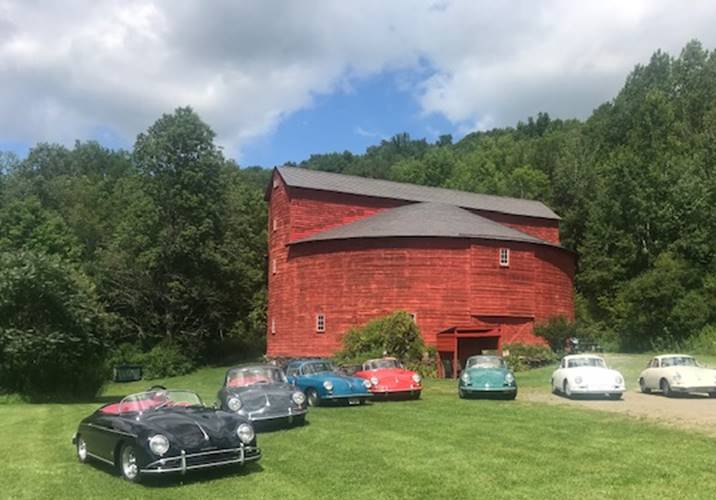
Another driving tour took us over some great Porsche roads and to the first round barn I’ve ever seen. We took a group shot to be used next year to promote the event, but when word gets out what a great area the Catskills are, I don’t think we’ll have a problem filling all the rooms.

Blackie ran great all weekend, made a lot of noise, and posed for photos when returning home on the Mass Pike. Somewhere around Exit 2 (now Exit 27? What?), one cylinder became part-time and only came to life under full throttle. I, of course, completely overthought the problem and had everything from a clogged main jet to an out-of-time distributor as the cause. I didn’t want to stop because it was running well enough to keep up with traffic, and stopping on the Pike has its own set of problems. It is classified as a restricted road and is not covered by AAA. If you must be towed, the State Police will send a tow truck that will tow you to the nearest exit, where you can then call AAA. The State Police contract says the nearest exit is $256 away. No wonder they show up so fast. Don’t ask me how I know that.

That ride gave me two hours to worry about what the problem could be. When I got home, it was lunchtime, so I let Blackie cool off, had a bite, and then jumped into the engine bay. I pulled the carb main jets first, they were clean, then checked the timing with a static light, and it was fine. I was going to pull the spark plugs to see if one was faulty, and the first one I reached for was number 3. The plug connector was just lying in the hole near the plug but not connected. I certainly don’t know how it came loose because nobody had been in the engine compartment except me, and it ran great all weekend. It also ran strong under full throttle, which doesn’t make sense if one plug wire was off.

I can only assume that Blackie was having such a great time in the Catskill Mountains playing with his friends that he didn’t want to go home.  These old cars are like that, trust me. The more you drive them, the better they run. Until it’s time to go home? – KTF

I remember being told that I was never going to find anything unless I kept looking. Like many of us in the car hobby, I am always looking.  I’m looking at parts, projects and cars but not to buy anything specific but to keep up to date on the value of things. Every now and then I’ll see something that peaks my interest enough to actually go look but it doesn’t happen often.

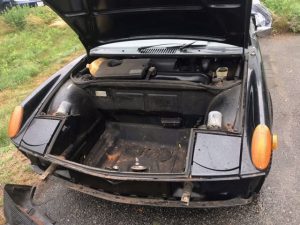
Last weekend I spotted a 914  for sale that wasn’t far away and the Facebook ad didn’t have much information but there were a couple of photos that didn’t look bad. There was no year given but because it had the large rubber bumpers on it I knew that it was a ’75 or ‘6. The hook for me was the statement that it was a running driving car and it was priced less than a 991 10k mile service.

I contacted the seller by text and got an address a couple of towns away so I set a time to go take a look. I drove to the address given to discover there was no house with the number I was given. I pulled over to text the seller who quickly responded with a house number of 141 not 41. Who doesn’t know their home address? Mistakes happen, right? Not a good sign. I was told later that it was the sellers uncle house so he didn’t know the number. OK, I’ll buy that.

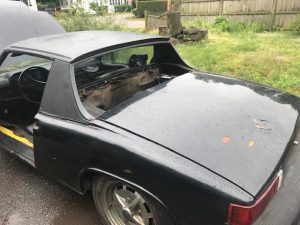
The car was black in the photos but close inspection (actually I didn’t have to be that close, maybe 50 feet?) revealed that the black was covering a car that started life in  yellow.  And the black was losing its grip in a lot of places.  Strike one.  A quick look at the rear panel not shown in the ad  told me that the car was a 1.8 l not the coveted 2.0 l  engine. Strike two.

After looking at the interior, that was rather tattered, I reached down to pull the engine cover release. It was seized and wouldn’t move. I’ve seen them hard to pull or broken and flapping but never frozen.  The seller, a nice clean cut young fellow, saw my problem and quickly stepped over to help. He just reached over the roll bar and grabbed the edge of the engine cover and lifted  the whole thing up and out of the way. It was just laying there, not bolted to anything.


The first thing that jumped out at me was the big four barrel carburetor sitting in the middle of the engine. Strike three. I said something about  the missing fuel injection system and the seller asked me when Porsche went to fuel injection on the 914. This seller was not alive when this car was built and this rat was probably the only one he had ever seen. All 914’s ever built used fuel injection and that was over 50 years ago. Think about that. Very advanced back in the day.  He did start it up and it actually  sounded decent  but this game was already over for me and I wished him well with the sale.   This car was not going to follow me home.

The fact is that the days of finding projects and putting them back together are long since gone for me. I never learned to weld, even after a 10 week welding class, but I had found a real craftsman who could fix anything. If he couldn’t fix it he could make another one. But he got married, closed his shop and traded his hobby in for a real job with benefits and coverage for his family. The wise thing to do.

My painting skills consisted of popping the top off a rattle can from Walmart and giving a hanging part a steady, even coat of paint.  But I found a fellow that was a real car guy and could have painted the Mona Lisa with a spray gun. He was the only guy I ever knew that loved painting a black car and really was a master at it. Everyone else complained from the start to prepare you for a poor result. But he retired after way too many years of breathing filler dust and paint fumes. I did recently check on two shops that I used years ago but one only does insurance work and the other is under new management. If I had a car that needed paint I’d have to sell it in primer, not the best way to raise the value of a project.

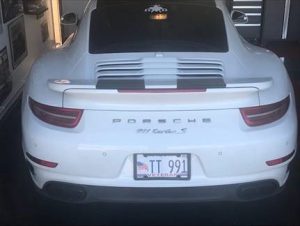
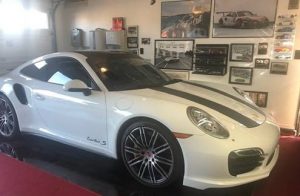
As my last few columns have indicated, I am attempting to move into the next century, with the help of son, Rob, and many younger club members. Rob located a 2015 991 Turbo S  in Las Vegas that checked all the right boxes. It was white with an expresso interior and had the glass sunroof that I preferred and center lock delete. It was very similar to the C4S in my garage except it is faster. So now he has my car in AZ and I have his car in MA.

I told him that  would meet him In St Louis to swap cars but so far no date. The kids threw a birthday party for me and a few friends at Lake Tahoe this month and that was the perfect time to test drive the Turbo. A sales job wasn’t needed to get one of the Grandsons to make the 8 hr drive up to the lake to deliver it and I got to do 4 days of test drives. The car is a rocket and really to my taste with a few stickers that Rob and the boys applied. The car is right at home following a line of traffic up a slow two lane road but show it a space and it can leap past campers and 18 wheelers with ease. The AC laughs at 110 degree temps and the satellite radio never skips a beat. The PDK gearbox is faster that any driver and my left foot stays planted on the floor. An amazing device for high speed travel that I never imagined the I would ride in, let alone own. Strange how things work out. It will be tough to leave it in AZ until transport can be set up.

There was another mission that I had while out west. Between Lake Tahoe and Las Vegas in the California Sierra mountains is the place where my father used to take us trout fishing in the ‘50’s. It was called Mammoth Mt. and that was before there were any ski lifts to be found. I always wanted to return to see if it was as I remembered when I was 10 years old. We stayed in the miners bunkhouses at a closed gold mine and each day hiked up the mountain to one of three lakes to fish.
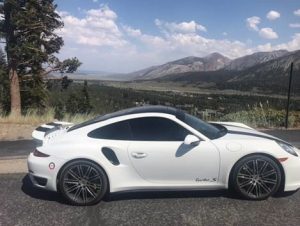
There are campsites on the one mile road off the highway now and the trailhead right is where the cabins still stand or at least pieces of them. The bunkhouses were a little smaller than I remembered and the hike was a lot harder that I recall but otherwise the smell of the pines and the view of the lake was exactly the same. It’s nice to know that even in the new century some things just never change.

KTF

I have owned a sim racing sim rig for two years now and raced actively for a year and a half. It takes a while to learn stuff at my advanced age, and I am deeply envious of the teenagers who join the leagues and outrace me in no time flat.

Several beginners I have observed, including me, tend to start with a relatively simplistic view of what it takes to win a race: Drive as fast as you dare! That is not only a simplistic view but also wrong! To win a race, the sum of your lap times must be less than the sum of your competitor’s lap times, and there is a lot to that.

So, let’s dive into how to have short lap times!

The single biggest issue is making mistakes and losing control. The typical lap time for road racetracks is more or less two minutes, and the usual number of laps for a race in the PCA league is around 20. If you spin, you will typically lose 15 seconds in the lap. It can be much longer if you have to wait for a gap in the other racers to re-enter the track. I have had to wait more than 20 seconds to get back on track, and then I have to accelerate to get up to race speed, which also costs time. So, what is the impact of that spin? Take the scenario that your error-free lap times are 1 second faster than your buddy Joe’s. If neither of you makes a mistake, you will be 20 seconds ahead of him at the end of the race. That is huge! But if you spin once and take more than 20 seconds in the lap you spun in, and that is very likely, then you will finish behind Joe! Spins are not the only mistakes and not the most common.

The worst mistakes are the ones that damage your car. Best case, you can recover and only lose a few seconds. But a lot of damage will affect your lap times. Losing a wing or a splitter may cost you 5 seconds a lap. So do the arithmetic again. If you scape a wall and damage your aero four laps before the end of the race, you will most likely lose the race to Joe. If you hurt the car so badly that you get the meatball flag requiring you to pit and repair, you are guaranteed to end up at the back. Even if the kind race organizer has allowed instant repairs, a pit stop typically takes between 20 and 30 seconds, and you probably had to drive at reduced speed to get to the pits. If your car is undrivable, you also have to be towed, which takes a relative eternity.

So how do you avoid mistakes? Experience is, of course, a factor, but the most significant issue to keep in mind is that the slower you drive, the better your control and the better the margins of error. The temptation is to go at ten 10ths of your ability. No margin of error, and every time something unexpected happens, you lose control. That gets even worse when other racers are on track, and it is not a race if there is only one driver!

Adrenaline is also pumping, and self-control is difficult when your adrenaline levels are high. They peak at the start of the race and when you are in a battle with another driver. You also have to remember that the other racer’s adrenaline also is high, and they are as likely to make mistakes precisely as you are. So, you have to leave some margin of error to minimize the impact of your mistakes and your competitors’ mistakes.

The start of the race is where more races are lost than any other time, and the first corner is where the most incidents happen. Everybody is bunched up, tires are cold, adrenaline is pumping, and drivers who had trouble qualifying are anxious to make up positions—a recipe for disaster. Even in Formula 1, you will see massive pileups, and those are the best drivers in the world! I am in the lowest class, and there if you survive the first five laps, you are likely to finish at least in the middle of the pack! So, these laps are all about survival.

If you survive the first laps without incidents, drivers will space out, and they will focus on advancing their position, passing other drivers. Passing and getting passed is a learned skill. The best strategy when someone catches up with you is to keep your cool and stay on pace. A better driver will get by, and if you try to increase your pace, you are more likely to make a mistake, making it even easier to get by you. If you are the faster driver, the best strategy is most likely to hang out close behind the slower car and wait for it to make a mistake. Feinting a passing maneuver puts more pressure on the driver and makes it more likely to make a mistake.

If you are fast enough to make sense to pass to avoid having my other competitors catch up with you, you need to do it in a safe place and observe the racing rules, written and unwritten.

You may have noticed that I have not talked about technique yet! Racing the racing line, optimizing speed out of corners before straights, braking early, and so on is what improves your pace, but it only wins races if you have learned the previous lessons!

So, if you have just joined the league and have no previous racing experience, my advice is to work on technique and always strive to avoid making mistakes. In both our local league and in the PCA National league, we emphasize welcoming and supporting new racers, so even if you have no experience, join the leagues, and start racing. It is OK to be a beginner, and we will treat you well!

See you on the (virtual) track!

Anker