Tag Archive for: Articles

Posts

Anker Berge-Sonne’s recent story regarding how he first learned to drive and eventually got his license got me to thinking. In some ways my experience is similar and yet certainly different. I was born way back in late November 1949… so not very long after World War II.

We lived in a nice 3 bedroom house in Johnston, RI. My folks had bought that house with the money they had saved up after my father (a licensed electrician) worked MANY long hours after the Hurricane of 38 pretty much devastated a lot of downtown Providence. My dad worked at the US Rubber plant (later called Uniroyal) and the plant sat right alongside the Woonasquatucket River. When the Hurricane blew up the east coast the storm serge was about 12 feet in the city. There are still markers on some of the downtown buildings showing how high the water rose.

With the US Rubber plant being right along the river… the water came up fast and pretty much took out the manufacturing capacity on ALL of the first floor buildings. For almost a year my dad worked from sun up to sun down, 6 and 7 days a week …repairing the damage. LOTS of overtime… and thus the money to eventually buy a house. One smart purchase my family made was to buy the extra lot next to our house. The lot was maybe 120 feet long and about 60 feet wide. This lot will soon be part of the story.

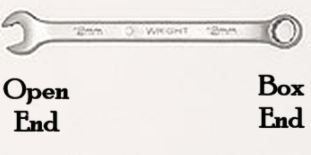
Cars (and motorcycles) were always a big part of my dad’s interest… and as a boy I would watch him (and help) as he worked either on his bike or his cars. “Hand me that 7/16-inch box wrench” …
“Ok… what’s a box wrench?”. I learned by doing. 
Dad followed racing…. Indy, Daytona, anything local like midgets and stock cars at Seekonk and Thompson. In fact, one of my early memories was going to Thompson (I was maybe 11 or 12) on the back of the Harley and ending up near the paddock of the second configuration of that track. We watched real “road racing” and I remember the Ferrari of Mike Gamino (of Providence) go head-to-head with a Jag and an early Corvette. I’m pretty sure this was an SCCA event and I think the Ferrari won.

So, about this time I am in my early teens and the “car bug” had bit. I wanted to learn to drive. We had a Hudson Hornet (anybody remember those beasts ??) that was “surplus to our needs” and was not registered. It sat in that extra lot. Eventually my mom gave me the keys and encouraged me to “drive it back and forth” in the lot. I did this for hours on end. Back and forth… back and forth. (note: I had never heard of the Hudson Hornet prior to posting this article – here is an example of Steve McQueen’s I found online – Luis)

My mom giving me encouragement will come into play in a moment.

After about a year of this (I think I was maybe 15) one day my mom leaves the house while a friend of mine was with me. I get the bright idea to take the Hudson out on the side roads for a little run. Remember this is suburbia… there are houses and people and other cars all around… we are NOT out in the country. My buddy and I are gone no more than 10 minutes…during which time I ALMOST crashed the car. As I am driving back into the yard… I realize my mom is HOME.

@$%&.. caught red handed. Mom has one comment. “Wait till your father gets home and hears about this!” How many times have we ALL heard that expression?

Well, I did not get smacked across the back of my head, but I did get a STERN talking to by my father. Needless to say, … I never took the Hudson out on the road again.

My mother basically taught me how to drive. She had a 64 Dodge Dart convertible with a small V-8 and automatic transmission. I got my learners permit and together we would go out and drive around and she would instruct me. But since I had spent so much time in the Hudson… there really was not a lot to lean.

In high school I went to LaSalle Academy in Providence, an all-boy’s Catholic school… rather strict. I was a sophomore when I turned 16. I took a day out of school and my mother takes me to the driving test. I had one demerit (did not turn on my flashers when pulling out of the slot at the beginning of the test) and passed with flying colors. We got my paper work and Mom takes me to the registry and I get my license. All in the same day.

So, the next morning … as I’m getting ready for school… I ask my mother for a “note” to give to the teacher… saying I was sick yesterday. My mother looks at me and says “you were not sick… I am not giving you a note”. “But mom” I protest… “I’ll get in trouble.” “Well, you should have thought of that beforehand”. Needless to say, I did NOT get a note!

At school, after the first class session, there is an announcement over the PA system. “Mr. Raymond Boyer, please come to the principal’s office”. Now you have to understand that up to this point I had NEVER missed a day of school at LaSalle.

I walk into the office and there is Brother Patrick… the principal. (I will have another run in with this authority figure later in the year… a story for another time).

“Mr. Boyer, you were not in school yesterday. What is your excuse. Do you have a note from home?”

“No Brother, I do not have a note.”

“Why not, you missed school yesterday?”

I paused before I answered, considering my options.
Finally, I just fessed up.

“Well Brother, yesterday was my birthday and I turned 16. I took the day off and my mother drove me to take the driving test, which I passed I might add. After that we went to the Registry and I filled out the paperwork and I got my license. Then my mother took me out for lunch to celebrate me getting my license.”


This is all BS… but hey… I might as well spin this yarn as far as I can and see what happens. In a final act of defiance, rather proudly I say …

“Would you like to see my license?”

Brother Patrick looks at me with a bit of shock and perhaps with just a bit of incredulity. He just stands there looking at me. It seemed like forever, but was probably no more that 10 seconds before he says.

“I have to commend both your mother and you for your honesty in this matter”

“Thank you, Brother,” I reply.

I figure I am home free. Patrick just stands there thinking, perhaps for another 5 seconds. Then the verdict comes down.

“Three Weeks Detention. Report to room 102 every day after class.”

So, for the next 3 weeks I go to room 102 after class and spend those 45 minutes each day with all the other “hooligans” of La Salle Academy.

But at least after detention I got to drive myself home. You see, my dad gave me that old Hudson Hornet as a birthday present.

Contribution by: NER Member Ray Boyer

Additional Info

Ray Boyer is a newer member of the Porsche community. He bought his first P car (a 2011 Carrera 911) in August of 2019 as a present to himself for his 70th. birthday. Raymond joined the New England Porsche club in January of 2021. He is also a member of the SCCA and has been racing Formula Fords for more than 30 years. He does most of the mechanical work on the car himself. He now knows the difference between a 7/16-inch box wrench and a screwdriver.
by Tom Tate

I have never been big on reading instructions. I always thought that instructions were something that you looked at if you got stuck when putting something together. If the picture on the box wasn’t enough to assemble the legs on a new stool or wheels on a cart then the instruction book was the fall back guide.

 I figured that written instructions were a modern device that lawyers wrote up with lots of disclaimers  to reduce the liability of the manufacturer.  Ladders always came with stickers all over them telling you how to unfold it, where to step, and how high you could go. Check any step ladder at the hardware store, they have a minimum of 8 stickers.  How about the instructions on the plastic bags from the cleaners? Does anyone really believe that the store sends you home with a toy along with your clean clothes? Really ? I know that it’s not a toy, they don’t have to print that on the bag 27 times.

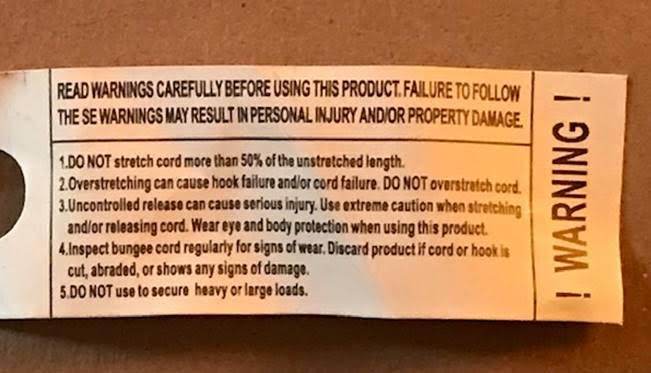
A handy gift that I got for Christmas last year was a handful of bungee cords. I have a bunch hanging in the garage, many are old and limp but I keep them around just in case. Some are from what we used to call the “supermarket of the highway” which is anything found on the side of the road. To this day I’ll pull over if I spot a discarded tool or hold down strap if it looks decent. The bright red bungee cords came in a nice clear plastic tube and had instructions attached. The instructions were actually warnings, a little list to keep them out of Court. The warnings made them sound like they would be dangerous to have around the house. It talked about personal injury and /or property damage.

The first thing it said was “DO NOT stretch the cord more than 50%”. That’s not even tight. We always doubled their length or else it wasn’t tight. The second line said the same thing but warned of hook or cord failure. Then a line about “uncontrolled release”. That’s when it snaps back and hits you in the back of your hand or in the face if you’re up too close. Been there, done that, don’t need to relive that. Line 4 says inspect regularly and discard if worn. What? Throw out a bungee cord? No chance, if it breaks just cut off the end, put it back through the hook, tie a knot back on, and it will be tighter next time. Last line: don’t use for heavy or large loads. If it wasn’t a large load I wouldn’t need a bungee cord. Who writes this stuff? Have they even used a bungee cord? I don’t think so.

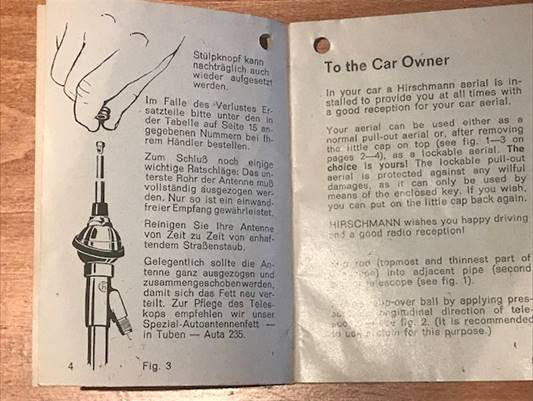
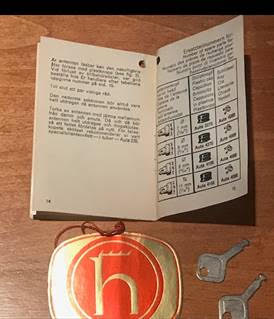
 Instructions like the above have been around longer than you think. I was going through some old files of Porsche literature and came across an instruction booklet that came with cars that were equipped with Hirschmann radio antennas. Tied to the booklet with a red string were two antenna keys since these early manual units could be locked down for safety.

The booklet was 8 pages, written in three languages, with many drawings showing exactly how it worked. With the plastic cap in place it could be compressed into the fender and then pulled up without the need for a key. In fairness, this was the ‘50’s and I would say this device was at the cutting edge of technology.

 If the owner was someone who wore suspenders and a belt and wanted to be safe when the car was parked, the plastic cap could be removed and the antenna pushed all the way down into the base and locked in place. Only the small key could catch the inside of the parked tip and pull it back into service. That was high tech in 1955.

 Simple instructions like those above got me thinking about the instructions that were given to new Porsche owners back in the ‘50’s as compared to todays new cars.

The owners manual from the 356 days was  96 pages and included a lengthy section on care and maintenance. The maintenance section explained how to change a tire, adjust carburetors, change a fan belt and do an oil and filter service. Brake and clutch adjustments were described in great detail along with many photos.  The manual was so complete that for many mechanics it was the only repair book that they needed.


Todays new cars are so full of technology  that the books that come with them all but fill what we used to call the glove compartment.  BTW, it’s now a Glove Box according to page 190 and there is a WARNING that says “An open glove box may cause injury during an accident. Keep the glove box closed while driving”.  

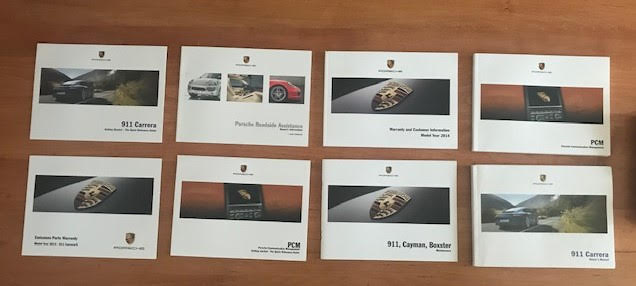
The owners books, I don’t think it’s fair to call them manuals, also include a PCM (Porsche Communication Management), a warranty book, and a maintenance book. The owners book looks familiar as it shows pictures of the dashboard, seat controls, things like that. It also has a section on settings, not unlike your phone. Do you want the outside mirrors to fold in when you lock the car? Do you want the seat to move back when you get out of the car to make your exit more graceful? What would you like to show up on the multi function display? G forces? Tire pressure ? Navigation? Map?  Engine / oil temps?  The choices seem endless.

The PCM is a descendant of the 4 page radio manual  that Blaupunkt used to include with their stereos back in the day. Now it includes forty pages on just the phone and accepting Bluetooth. Maps is in there somewhere with Navigation and takes up another 20 pages. It’s no wonder that people don’t read these books, besides there is a Quick Reference Guide for both the PCM and Owners Manual that is a fold out with only 9 pages each that will get the music on and the car moving.

There is a Warranty book that is waiting for the Dealer service stamps and maintenance records but it’s only 27 pages and easy to miss. Another labeled “Warranty Book and Customer Information” is bigger and has things like towing instructions and a notice from the state of CA that talks about arbitration and why you go there if you’re not a happy owner (not exactly in those words). Below are the totals:

                                                                                   2015   Porsche Macan S                            2015 Porsche Turbo S      
                      Owners Manual                                         352                                                                298
                      PCM                                                           200                                                                200
                      Warranty Book                                           84                                                                  84  
                      Maintenance Book                                      27                                                                27
                      Quick Start PCM                                          9                                                                  9  
                      Quick Start OM                                            9                                                                   9
                      Roadside Assistance folder                          7                                                                   7   
                      Emissions Parts Warranty                            4                                                                    4
                                                                                            ——-                                                             ——-   
                               Total                                                    692  pages                                                   638 pages


I don’t suppose that I need tell my readers that there are no sections on how to do any kind of maintenance on modern cars. Since there is no spare tire or jack you’re not going to be changing any flat tires on the side of the road but there is a page on how to use the tire sealant that is in the right hand box in the luggage compartment. Instruction number 7 is to get all passengers out of the vehicle. What ? That was when I stopped reading. I know that modern cars are a lot more complicated in 2022 than they were in 1958 (the year Blackie was built) but really, over 600 pages? Most of which are pages filled with red blocks labeled WARNING. See above.

 I believe that my original method of reading the instructions when I get into trouble has worked pretty well all these years so I will stay on that path. That and continuing to drive old cars every chance I get will keep a smile on my face.

 KTF  

I first started driving when I was 13, traveling cross country in my mother’s most disliked car ever: a flat 6-cylinder, rear engine Corvair station wagon.  We were on a two-lane road in Nevada heading home to Colorado and my mom was bored with driving in an endless straight line, so she pulled over and told me to drive.  Seemed logical to me.  It was an exciting experience, especially with semi-trucks passing in the opposite direction at 60+ miles per hour and only a few feet away.  All I remember her saying was “go faster, faster, faster.” 

Living in western Colorado, I could get my first driver’s license at age 14, but it was limited to operating a motorcycle.  I figured this was to benefit parents by eliminating the need to chauffeur kids over long distances, but what a gift to us!  It gave us independence, freedom, and adventure!  Needless to say, every boy who could got a motorcycle; the local pack of 14- to 16-year-old motorcyclists experienced a great deal of excitement, including many crashes.  Our house was at the end of a paved road going out of Grand Junction which turned into a Jeep trail across the desert leading to the then remote, rugged Book Cliffs.  Having motorcycles allowed us to spend a lot of time exploring the wilderness and doing what we wanted without parental oversight.

On my 16th birthday I went to the police department to take the automobile driver’s test.  My birthday was in early January during a blizzard, but I was determined to get my second license for driving cars legally as soon as possible.  I was driving my mother’s beloved Triumph TR-3, which was an especially rare vehicle in western Colorado.  The policeman who joined me in the car had seen it, loved the way it looked, and was thrilled to ride in it.  He was so thrilled that he made me drive for an hour and a half, on both town and rural roads, through the snow, on standard street tires that didn’t have much traction.

When he finally returned to the police station, he told me a required part of the test was to parallel park in front of the station.  I pointed out that a snowplow had created a large berm along the parking spaces; nevertheless, I was directed to parallel park.  The policeman cheerfully completed the paperwork and handed me my driving permit.  He then tried to open the little passenger door to get out, but found it pressed against the snow so he asked me to pull out of the parking space so he could get out.  Of course, the car was stuck, and the tires would only spin.  He then had to slide open the little plastic side curtain and yell to a couple of cops that were exiting the police station to push us out of the parking space, which they did.  They then gave my testing officer a lot of light-hearted grief and laughed as they told me to drive home as fast as I could before the snow got even deeper! 

TR-3 note: It was my mother’s daily driver to carry my two younger brothers and me.  As the oldest son, I got the passenger seat and my two younger brothers sat on top of the fuel tank behind the seats.  My mother drove up to 6 passengers in the little car (2 in the passenger seat, 2 on the fuel tank behind the seats, and 2 sitting on the trunk), and did get stopped by the police.  But when they saw it was not a teenager driving, they let her continue!

-Jeff Johnson

Most of my teen years were spent in Tanzania from 1963 to 1966, from age 14 to 18. As with all teens, these were transformational years for me, and what a great place to spend them. Tanzania had just gained independence. Actually, it was Tanganyika when we moved there; Zanzibar rebelled against their Arab rulers in 1964 and subsequently merged with Tanganyika and was renamed Tanzania.

My family moved there from Denmark because my father had taken a job with the Danish foreign aid agency, which was building a high school in Kibaha, about 25 miles from the capital, Dar-es-Salaam, in cooperation with Sweden, Norway, and Finland. The first year we lived in the Central Highlands in Iringa at a boarding school built by the British, called St. Michael’s and St. George’s School when we arrived, but quickly renamed Mkwawa High School after a chief who in the very late 1800s rebelled against their German colonialists. The rebellion failed, mainly because the magic potion, water, failed to protect the warriors against German bullets, and poor Mkwawa’s skull was kept in Berlin until it very recently was returned to his homeland. The school entirely transformed over the next two years from being extremely British: almost exclusively white students and teachers, and teachers wearing gowns and mortarboards daily, to still an almost exclusively white teacher body, but the student body being almost exclusively native Tanzanian.

At the end of the first two years, the rest of my family moved to Kibaha, 300 miles away. But I stayed on for a term as a boarder because the Scandinavian-built school in Kibaha wasn’t ready to accept students. Kids either really enjoy boarding school or hate it. I loved it. My younger brother went to a different boarding school in Nairobi, Kenya, and hated it. The only thing I wasn’t happy with was that as a white person and the son of a former teacher, the staff went to great lengths to not show any favoritism towards me, on the contrary.

Well, I digress and better start writing about cars. While I was a boarder in Iringa, I turned 16, the age at which I could get my driver’s license. I was able to talk the headmaster’s wife into letting me drive her car, a VW Beetle,  around the school grounds, with a big L sign on it. After a couple of weeks, my birthday came up, and since I was now confident in my driving skills, all done at 20 to 30 MPH, to make an appointment for my driving test on my actual birthday. For some reason, the headmaster’s wife’s Beetle wasn’t available, so I had to borrow another teacher’s car, fortunately also a Beetle. Driving tests were conducted by the police, and after I paid the fee, 5 shillings, approximately 80 cents in the US, a cop joined me in the passenger seat, had me drive around the block, and then parallel park. I passed!

To my surprise, the paperwork given to me authorized me to operate any land-based vehicle with wheels, including motorcycles, cars, trucks, and buses. I chose to have the actual license issued for motorcycles and cars. Much to my later regret, but because the truck and bus license required a picture, which I didn’t have. I could, however, use the original paperwork to upgrade my license later, which I didn’t, to my even greater regret.

My parents were blissfully unaware of my shenanigans, and when the term ended and I rejoined my family in Kibaha, I showed my license to them and asked if I could borrow the family car. To my huge surprise, my dad pulled out the keys, handed them to me, and said, “here!”

That 80 cent license got me a Danish driver’s license for almost nothing, and that, in turn, got me a US driver’s license for almost nothing! I did, however, have to take the written test, which the Danes hadn’t required.

The pictures are of my family taking a lunch break under a Baobab tree on one of our many vacation trips (I am the tallest kid), and of the lowest grade of road that we encountered!

I challenge all of you to write a better story about getting your driver’s license. To accept the challenge, write it up in a Word document and send it to [email protected]!

-Anker Berg Sonne

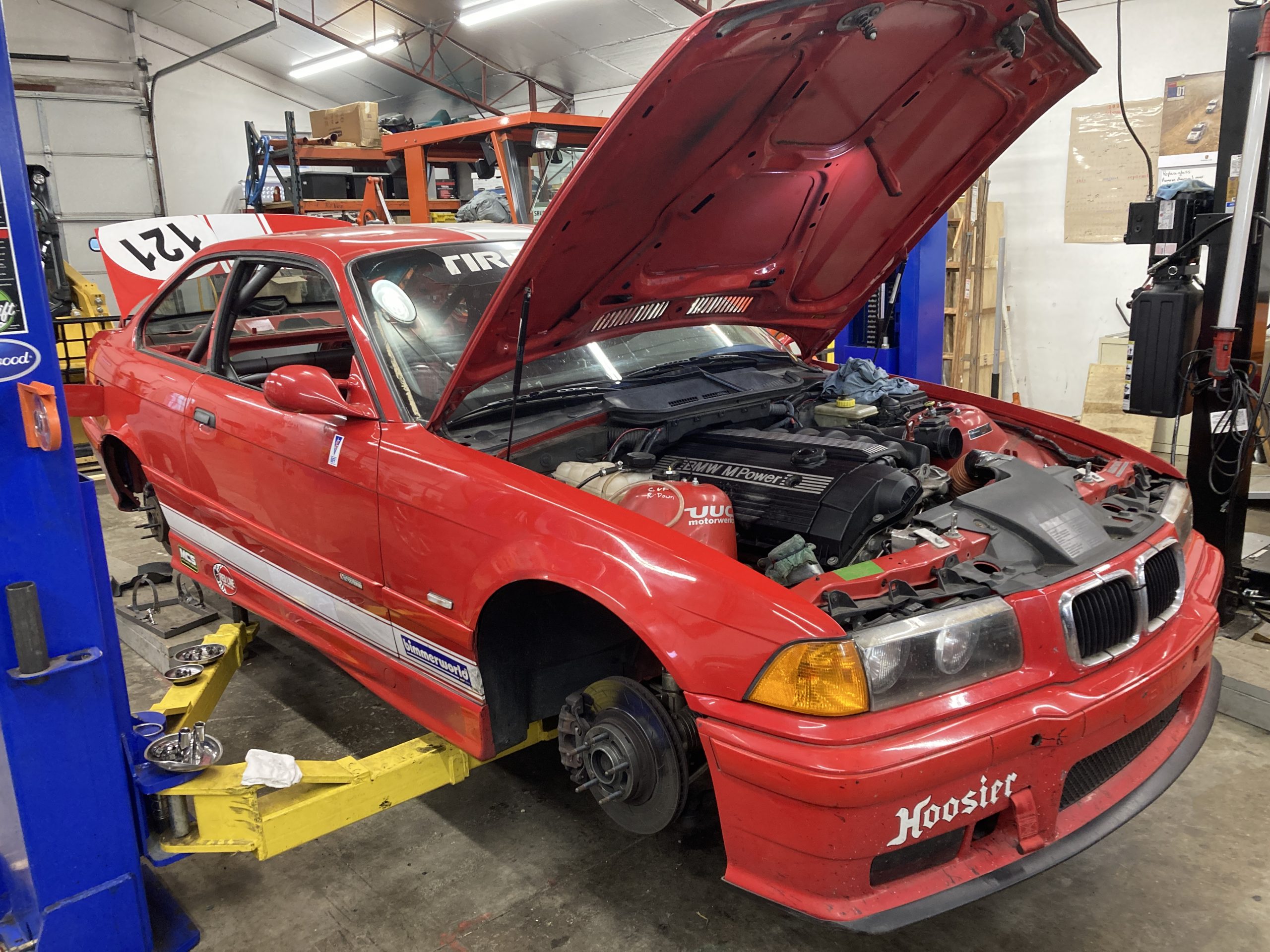
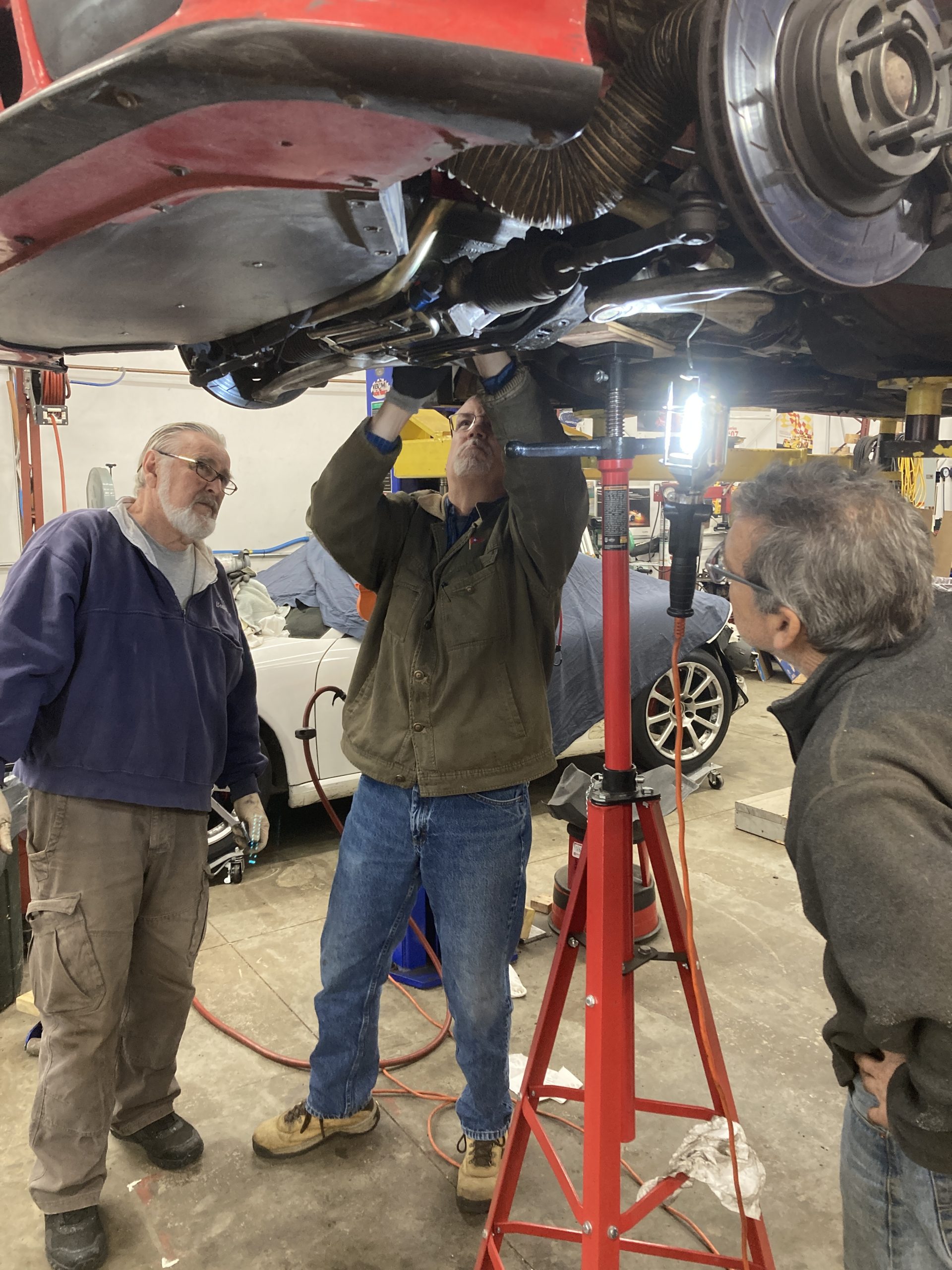
With the Mustang a no-go for the series we want to race in (American Endurance Racing and Champ Car), the Jamaican Bakin’ team bought an E36 BMW M3 race car as a replacement. The car was a successful BMW Club racer that was built out with the correct aftermarket parts. We took it out to the last Thompson member day for a trial, and it worked great – easy to drive, ran fine, good to go, nothing needed before next season, right? Well, no. Of course, there are a few things that need to be done – perhaps a day or two of work?

Let’s start with the obvious. To run successfully, we need to be able to go 90 minutes between stops. The stock fuel tank holds 17 gallons (perhaps 16 useful before it starves on corners) – not quite enough. So a pony tank will need to be installed in the spare tire wheel well. With a fuel pump to pump from the pony to the stock tank. With wiring, switches, etc. And while we are at it, we might as well replace the fuel lines, just to be safe. But with a pony tank in the trunk area, we now need to fabricate a firewall to separate that from the driver compartment.

We also need to move over the endurance racing stuff from the Mustang to the new ride. The cool-suit system and the telemetry system (don’t forget the antenna mounting) require some brackets to be fabricated and a fuse box added to deal with the additional electrical demands. Oh, and since we are messing with wires, we might as well take out some of the unnecessary original wiring and clean that up. Oh, and don’t forget the rain light (noting that AER mandates one type and Champ Car requires a different one.) Or the flagging system device and its wiring.

We were all reasonably comfortable doing short stints when we had the car at Thompson, but for long stints, the seating position wasn’t great for all of us. So we need a new seat which will require fabricating new brackets for the slider and the back brace. (Poor Chip is the one with the machine shop and thus gets more than his share of assignments.) And the steering wheel angle and location suited the previous owner but not us, so a little work to move the wheel down and away from the driver. Piece of cake! Plus, the mirror is too far back and needs to be moved.

The belts that came with the car are OK and have another year left, but the ones in the Mustang are better, so let’s swap those out. And, yes, there is a center net, but we don’t like the way it is fastened, so that will require some work. And the door net is a bit weird, so it will require some attention. While we are at it, for safety sake, let’s replace the original interior door handles with cables that are easier to find and pull in an emergency. Finally, on the safety side, the fire system is out of date and needs to be refreshed.

Oh, yeah. As an endurance car, we need to add a differential cooler (which needs to be powered plus a temperature sensor added – see wiring comments above), and it needs a NACA duct to draw in air. The easy solution is to replace the rear windows with Lexan and put in the duct – it lightens the car too! – and we need another duct to bring in cool air for the cool system anyway! And don’t forget that we need to do something to defrost the windshield since we might be doing long stints in bad weather.

While the car came to us as described, there were a couple of small problems. There was a crack in the windshield and a battery tie-down that would not get past an AER tech (but apparently got past BMW club racing). But, hey, we need a lighter battery anyway, so Chip has one more thing to fabricate. And there is a slight tear in the left ball joint boot. Now that we think about that, maybe there is a suspension upgrade that would require new front control arms anyway – we’ll look into that. And the clutch works fine but takes up very close to the floor. It would be more aesthetic with a higher catch point. And anyway, we should flush the system. Never mind, let’s just preemptively replace the clutch slave cylinder – it’s probably pretty old.

Let’s move on to the wear parts that could fail. Might as well do those now rather than just stockpile parts and wait for something bad to happen at a race! (Since I’m a lousy wrench, I get assigned to source the parts – made harder by my lack of knowledge, age of the car, and uncertainty of which are stock and which race aftermarket.) I’m looking at your bearings and half shafts! And perhaps the solid motor and transmission mounts are too stiff for the wear and tear of endurance racing? Let’s research and debate whether to go with OEM or poly. OK, poly it is.

OK, now we are almost ready to go racing. My final job (note the skill involved) is to remove the old number panels, work hours with acetone to get all the glue off, and then put on the shiny new “420” number panels and Jamaican Bakin’ Racing decals. Vroom. Vroom. Let’s hope we are ready.

P.S. One nice benefit of working on the E36 is that we have been reaching out to old NER friend Mark Schnoerr for advice. He and Sigrid send their regards from Texas.

-Bill Seymour

Another nicely run NCR event at Tamworth, this time with really nice weather and thus no excuses for my sorry driving.  My fastest session of the weekend was the first of the event – on a damp track – and I never improved from there. It seemed like I was pushing fairly hard, sliding around quite a bit, and I was quick to blame my tires.  Mr. Frugality believes he can go a whole season on one set of tires (the car is so light they don’t cord), but I thought perhaps they go off after a lot of heat cycles (I was up to 35 or so).  But data don’t lie. When I got home and compared that event to my previous better runs, there was no evidence of a lack of grip and a lot of evidence of not braking late enough or hard enough. I continue to struggle with not using braking markers, and I was giving up almost a second in Turn 1. You can’t teach an old dog new tricks, so I’m lucky that I’m just a pup and will obviously get better.

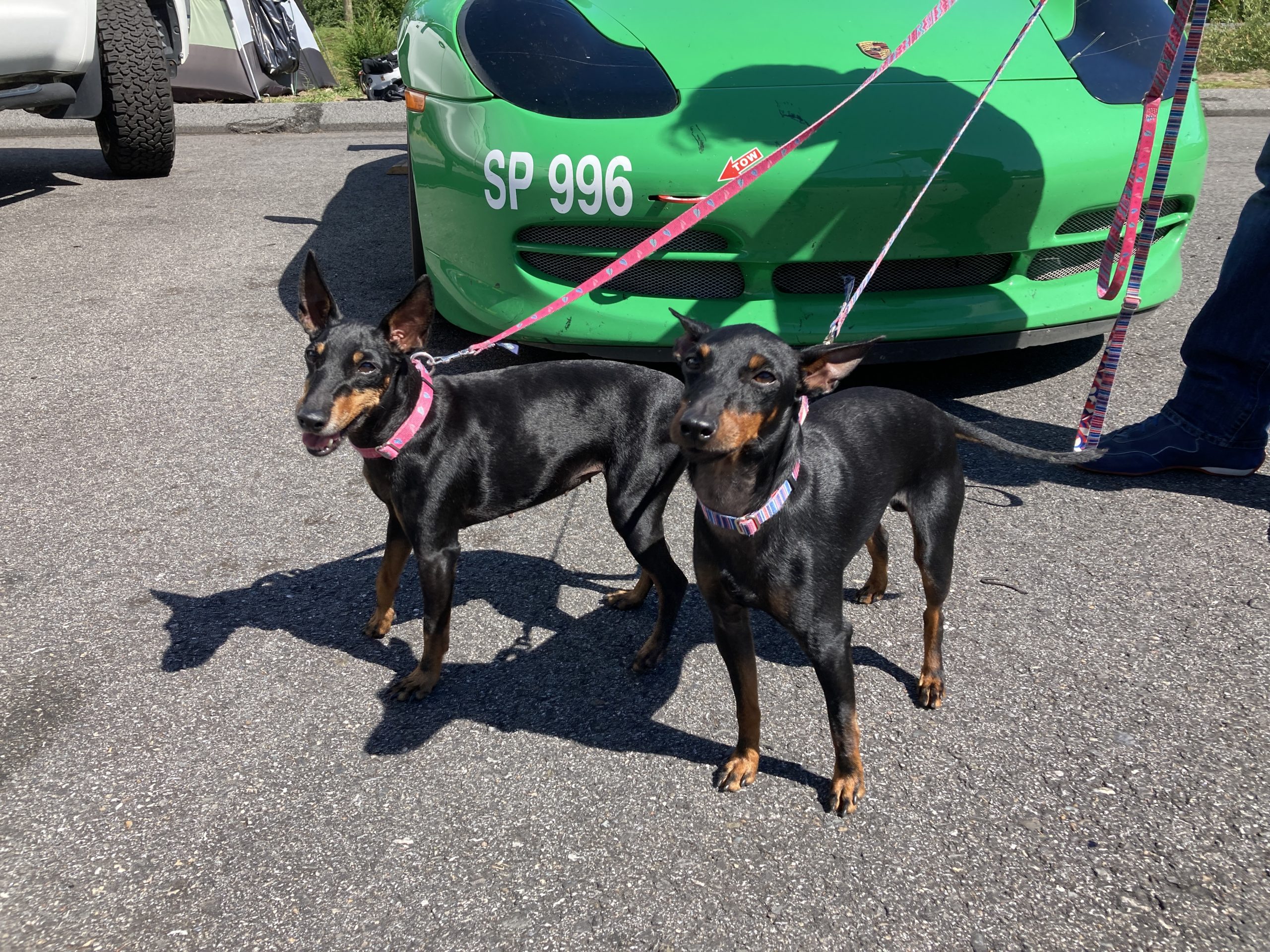
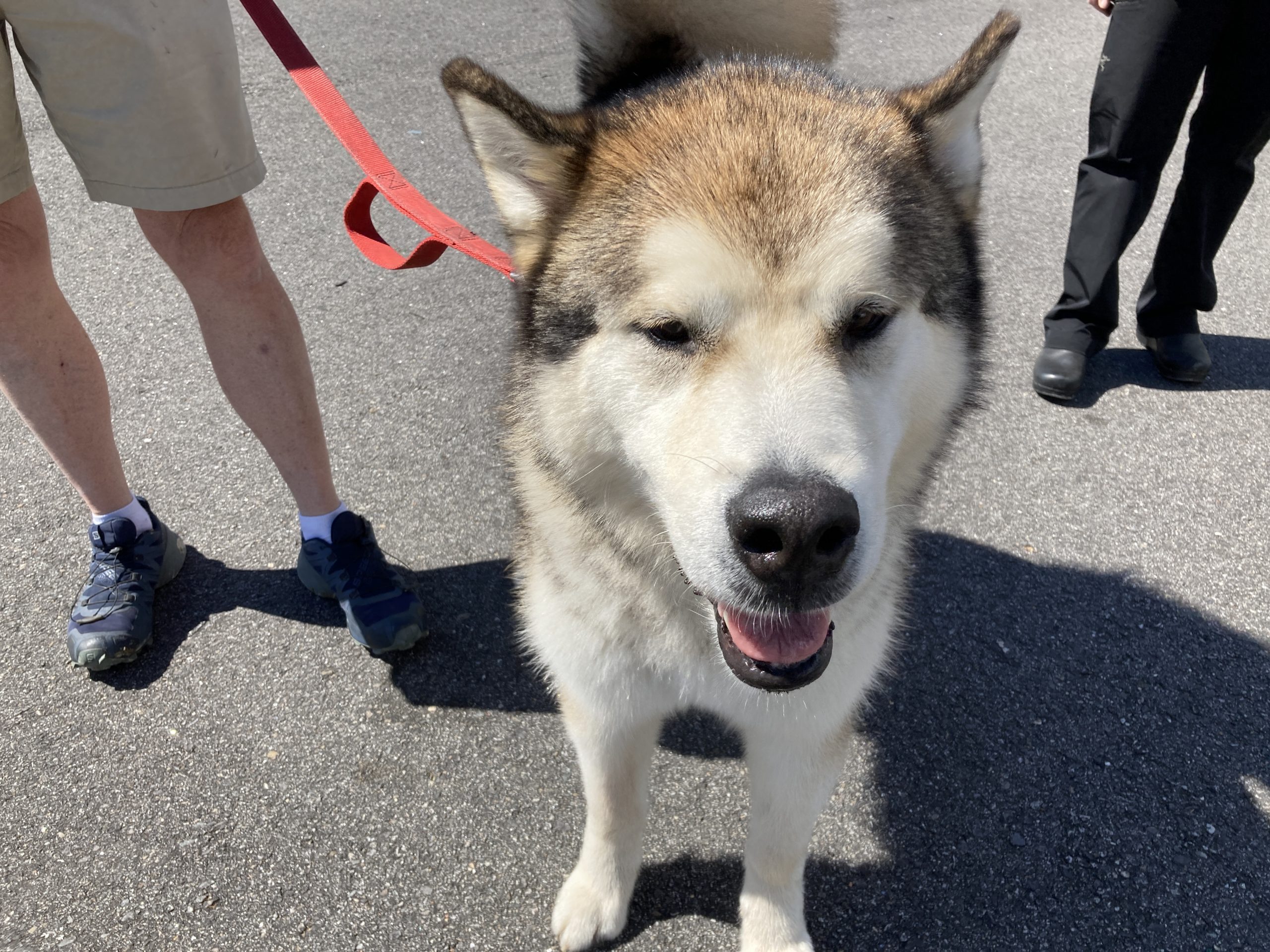
Speaking of pups, please enjoy Part Two of the Dogs of Tamworth.  I know that cute kitties might be better clickbait, but I couldn’t find any at the track.  Note in particular that Misty and Butzi are the pets of Kristin Larson’s Mom (and you know why Butzi is named Butzi!).

On to less happy tails (tales), let’s wander into the Jamaican Bakin’ Team garage and see how the Mustang is coming along.  In case you missed previous episodes, I’ll remind my reader that Sally’s motor blew up at the Watkins Glen American Endurance Racing event.  At considerable expense, we bought a replacement motor and have been slowly doing the swap (Nick is at race tracks all over America, and Chip has been struggling to relocate his machine shop).  Dave, in his role as Coroner, performed an autopsy on the victim and the picture shows the corpse.  Still not clear why the connecting rod let go, but the results are unattractive. The new Sally fired up right away, and so now we just need to get it to the dyno and put the snout back on. 

However, the bad news is that AER is changing their rules and for 2022 will not allow a car to run with a power to weight ratio below 9.  The Mustang, svelte thing that she is, weighs in at 3,200 pounds, and the old motor put out 400 hp at the rear wheels.  The new motor, with the fancy intake, is good for over 500 hp. Even the most math-challenged will agree that we’ve got a problem. We are advised that with a restrictor plate we can detune down to the necessary ~360 hp, but the car would then need to be short-shifted at around 4,000 rpm to stay in the torque band. This on a car that could put out over 500 hp and rev to close to 8,000 rpm.  What a waste!  And our experts pointed out that we would be better off driving a lighter car with less horsepower.  A zoom meeting was arranged to discuss options, and the decision was reached to move to a new car. Once the car is dyno’ed (we’ll have the specs to use in the sales brochure) and tested (at a Thompson club day) we’ll post it on Racing Junk and see what happens.  If anyone is interested in a roaring beast, just let me know!  (Use code “PCANER” for a 5% discount.  Buyers’ commissions are offered.  Driven on a closed track by a professional driver.  Do not try this at home.  Etc.)

So what is next?  Prior to the Mustang purchase, we had been looking at E36 or E46 BMW’s, and those certainly are candidates. Some of the JB team have a Boxster or Cayman that could be pressed into service, perhaps. Dave is a big fan of Acura Integras (front-wheel-drive car? C’mon!).  Or perhaps the answer is, as always, “Miata?” (With the Acura motor swap.)  Gives us something to do over the winter.

-Bill Seymour

As many of you know, we lost NER legend Steve Ross back in March.  He was a friend, a mentor, and a leader whose impact was unmatched.

Paying it Forward is a term that most of us have heard and probably used.  In fact, it has been around forever. It has been the subject of books, movies, YouTube videos, websites, and foundations.  There’s even a Pay it Forward Day.  An Australian started Pay it Forward Day, which is now celebrated on April 28th by eighty countries.   Defining it simply as “an expression for describing the beneficiary of a good deed repaying the kindness to others instead of to the original benefactor”.  Steve practiced Paying it Forward naturally.

If you are new to NER, Welcome!  If you are one of our more tenured members, try remembering your first day or NER experience.  What was your onboarding experience like?  This was mine:

When Betty and I joined NER we knew no one.  And I mean no one.  Soon after, we met Steve during lunch on a Fall Tour.  We quickly became friends and Steve launched into all things NER.  He summarized each event or program with his big smile and excitement.  And it was genuine. Steve had the natural ability to “sell” without selling. For some, it can be learned.  For others, it comes naturally.

Over the years, Steve was my “go-to” guy when I had any questions regarding the car, NER, Porsche, recommendations for events, introductions to fellow NER members and service providers.  Sometimes it was those classic conversations like storing the car or not.  One time, I talked to him about a rare 50-degree January day with no snow or salt on the road and my regret for storing it.  He looked me straight in the eye and said – “you bought the car to drive, drive it!”  I felt like I got hit over the head with a 2X4. 

At the end of each autocross, Steve would announce the upcoming NER events. Each of them with his Steve Ross smile.  At one AX (Autocross), Steve talked about a July DE (Driver’s Ed) event in Mont Tremblant Quebec.  Having skied there, I knew Mont Tremblant as a ski resort but did not know about a track.  Coincidently, the village of Mont Tremblant hosted the annual Canadian Blues Festival.  Steve’s pitch was, “If you are going to do one DE event, THIS IS the event that you need to do!”  Betty and I registered that day.

Steve told me about this event called “The Ramble”.  Maybe you are one of the 400 people who attend the annual event?  If you do not, you need to. Again, we registered late and got the absolute last two tickets.  And once again we were hooked.  Steve was spot on.  The Ramble remains my favorite NER event.

With me, and many others, Steve had the ability to look you directly in the eye and make you feel like you are the only person in the world, and what you were saying was more important than anything else. This is a gift.  His enthusiasm was genuine.  He was unpretentious, never arrogant, and never demanded something in return. His passion for all things Porsche could be infectious.  NER was more than a club to Steve, it was family.

Over the last few years, many of us watched Steve become more and more confused and forgetful.  Those of us with family members or friends with Alzheimer’s know these symptoms all too well.  When fellow NER member Alicia Kullas came to me in 2018 with Steve’s diagnosis, she suggested that we recognize his club contributions now, before it was too late.  I could not have agreed more.  I presented it to the board in June of 2018, and we unanimously agreed to move forward with it.

Why did I entitle this article Paying it Forward?  Because it was what Steve did.  He encouraged and paved the way for many of us.  He reached out to many new members welcoming and encouraging them to get involved. Whether you are new to NER or a tenured member, think about your first experience with the club.  What was it like?  What was your first impression? Did you feel welcome?

Whether you have been with the club for a short period of time or many years, reach out to new(er) members, give them a “hand up”.  Be a friend. Be a mentor.  Share your great club experiences.  Share your connections. Participate in one more event. Help produce a new or established event. Encourage new ideas.  Pay it Forward.

-Glenn Champagne

A Drive Down Memory Lane

I’m back from the Watkins Glen DE, and it’s column time.  After a very wet driving season (no, I don’t have rain tires because I have no interest in getting soaked and scaring myself), it was great to have decent weather.  Despite some clouds, I got in all 4 of my runs on Friday and Saturday, and Sunday saw perfect weather and five sessions as Adam combined the final Red, Black, and White run groups.  Plus, I drove a couple of student cars and had a session in Bob/Marcia Binder’s 2010 Cayman (almost identical to mine – the blip-shift is a great addition! – thanks!).  Congratulations to the NER DE team for a great event.

I love Watkins Glen – both the track and the area. I have very fond memories of my times there and probably have written about them in some previous column – if you can find it, you should read that one which is probably better than this will be.  But with talk of Porsche returning to F1, let’s have a little history lesson – some personal, some Porsche.

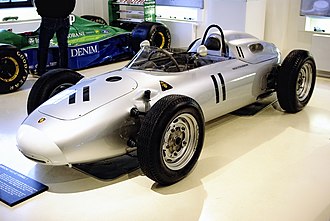
While early 356’s were successful in racing, the first pure Porsche racecar was the Typ 550 (well known as the James Dean car), which first appeared in 1953.  Like the 356, this had a flat-four air-cooled engine, but, unlike the 356, this had the 4-cam Fuhrmann engine (code 547) in a mid-engine location. It competed successfully in sports car racing, and an updated model raced in F2 races (initially as a two-seater, then as a single-seater).  When F1 changed to a 1.5-liter formula in 1961, the former F2 cars were now eligible.  Labeled Typ 718/2, these cars made 186hp @ 8,000 RPM and, weighing under 1,000 lbs, were capable of 150+ MPH (with drum brakes!).  For the 1961 season, “Porsche System Engineering” campaigned two cars in all 8 Grand Prix for Dan Gurney and Jo Bonnier.  Gurney (Car and Driver Magazine ran a campaign for him to be elected President in 1964) placed second in three races (including Watkins Glen) and finished the season fourth in the Driver Championship while Porsche was third in the Constructors Championship.  Ferraris were dominant, winning the Constructor Championship and Phil Hill winning the Driver Championship (after his teammate Wolfgang von Trips was killed in the next to last race).

For the 1962 season, Porsche introduced a new model, the Typ 804, which was similar in appearance to the Typ 718 but built to accommodate a flat-eight air-cooled engine (code 753).  Although slightly heavier and with no more power it was narrower, lower and smoother, which contributed to a higher top speed (167 MPH).  It was the first Porsche to use disc brakes and rack and pinion steering.

The 1962 F1 season saw a complete reversal from 1961:  the British constructors were ascendant with new V-8 engines, and Ferrari struggled with labor woes.  BRM won four races (Graham Hill), Lotus three (Jim Clark), and Cooper one (Bruce McLaren).  Porsche again campaigned two cars for Gurney and Bonnier, and Dan won the French Grand Prix – Porsche’s only F1 win (until 2025?).

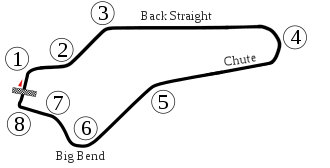
1962 was the fourth year that the U.S. hosted an F1 race:  Sebring in 1959 and Riverside CA in 1960.  But those events were unprofitable, and Watkins Glen got the race for 1961.  (Attendance was 60,000, and the race continued to be at Watkins Glen until 1980.)  The course was very different from what we drive.  While somewhat similar to the current NASCAR layout (which omits “the boot”), there was no front straight as we now know it.  It was 2.35 miles long. 

Since Ferrari was totally out of contention, they didn’t bother to come to the Glen in 1962 (they also skipped 1961 because they had already won the Championship).  With one race left after Watkins Glen (the South African Grand Prix), Hill could win the Championship if he finished ahead of rivals Clark and McLaren. 

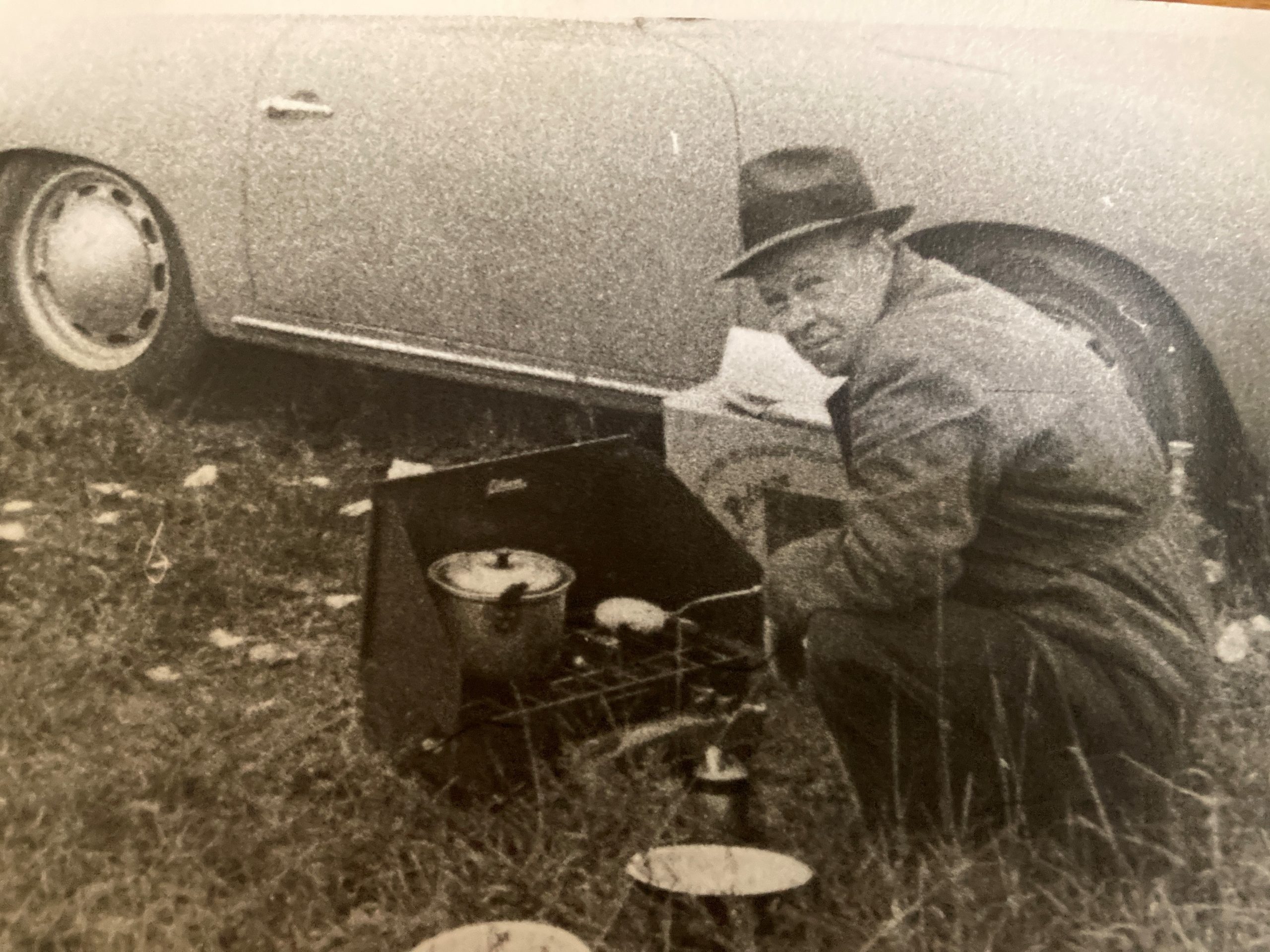
The race weather was dry but overcast. Ask me how I know.  My Dad and I had packed beer, a cookstove, and sleeping bags (no tent or anything useful like that – we were not a camping family) and headed to the race.  On the way out, I drove the 356 for the first time (underage, of course).  My Dad pulled over on the N.Y. Thruway and turned it over to me.  As I carefully matched the speed limit, he prodded, “if you are going to drive, then drive it,” and I was probably around 80 as we passed a State Cop in the median.  I saw my life flash before my eyes.  But he stayed put, and I pulled over as soon as we were out of sight.

We arrived the day before the race, parked in the infield, and set about cooking a steak.  After dinner, we wandered around and then attempted to sleep despite some fairly rowdy and drunken neighbors.  Although not cold by October Watkins Glen standards, it was pretty chilly on the ground in a crappy sleeping bag, so we retreated to the 356, reclined the seats, and spent an uncomfortable night.

Qualifying was different in 1962 than it is now:  practice and qualifying were combined, and there were sessions on Friday and Saturday afternoons.  Clark, in his Lotus-Climax, set a new course record of 1:15.8 (averaging 111 MPH with ~185 HP on skinny tires!) on Friday, and this held up due to rain on Saturday.  He started on the pole among a total of 18 cars.  Gurney qualified fourth.

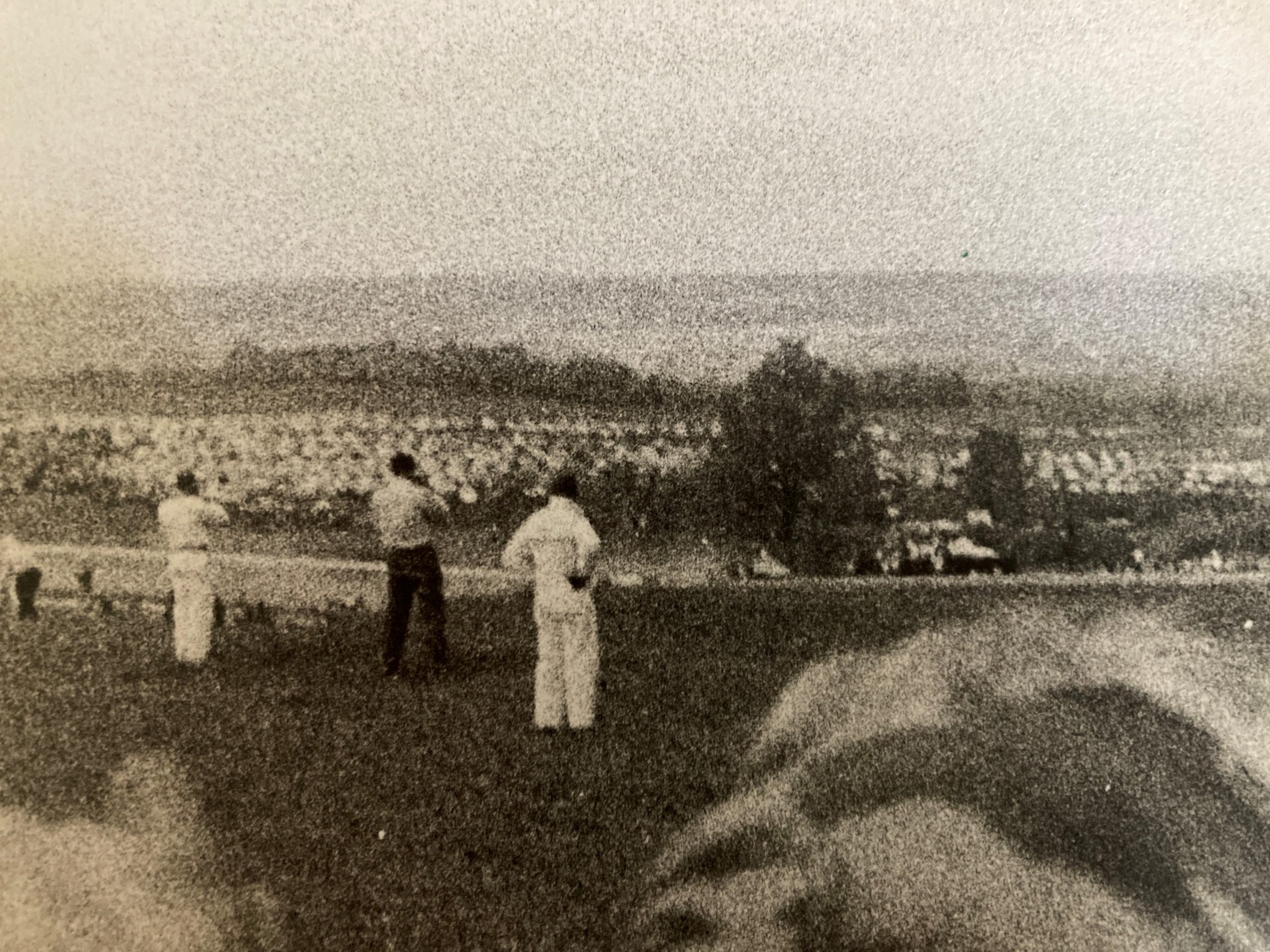
Without a cell phone and Race Hero or big scoreboards, it was pretty difficult to follow the race.  The report which follows is based on web research, not my teenage memory.  (And actually, I had always thought I went to the 1961 race.  It was only in researching for this column that I noticed the number on Gurney’s car, which meant it was 1962.)  Clark and Graham Hill ran away with the race, swapping the lead a couple of times, but Clark winning by 9 seconds.  No other cars were on the same lap, and only 13 cars were running at the end.  Gurney ran as high as third, but his car fell off at the end, and he finished fifth. 

In the final race of the 1962 season, two months later, Clark was leading easily before an oil leak ended his day. Graham Hill won the race and the Championship. 

Back to the Glen story, my Dad and I packed up and headed home.  He drove the whole way.  I later went to one other WGI F1 race with my Dad when I was in college.  That was the first time I ever had a beer in the morning to combat a hangover. 

Everyone needs to go to the Glen! And make sure you drive the old original road course.  Here is a nice article about the history of the courses used.

Interesting note: the really crappy pictures that I took were done with the camera that is shown in one of the pictures, which was a pretty weird little camera – not a common one. It was a half-frame 16mm thing, and the pictures always sucked. I don’t know why my father used it.


– Bill Seymour