NER opened its 2026 Autocross Season on Sunday May 17that Moore Airfield in Ayer – sponsored once again by our friends at Kachel Motor Company. Dave Seavey and Anthony Bitsoli from KMC were on hand to do some cone chasing – it was great to have them come and participate. Overall, we had 45 drivers for the event, allowing for a full course around the airfield which we always enjoy.
We had 11 novices registered including several who had just participated in the 2026 Autocross School on April 11. By the end of the day, it was Jeff Louie driving a 2022 911 C4S taking first place in the Porsche Novice class and Benjamin Do in his 2026 Toyota Supra taking first in the non-Porsche Novice class. Welcome to the big leagues, guys …
In Class 1, featuring the air-cooled cars, we saw Adam Small put up a 70.737 in his 1984 Carrera to take the top spot in Class 1 over Chris Darminio. In Class 2, Luis Rivera in a 2015 Panamera posted a time 82.334 to take the Class. In Class 3, Alan Donkin prevailed over Dan Wright (2nd) and Tony Miniscalco (3rd) with a 72.809. Mark Skala dominated Class 4 with a 66.727 handily beating Chris Ryan and Dan Gramm. Charles Comeau posted a 69.268 to take Class 5 with a win over Jeff Johnson and Ernie Grasso. Krishna Harpanahalli took Class 6 with a 66.375 over Dan Quaroni and Alan Davis. In the upset of the day, KMC driver Dave Seavey posted a 66.328 to take Class 7 and beat both Krishna and Mark Skala! Nice going Dave!
Ryan Cassillo was the winner of Non-Porsche SCCA Street Class 8 with a 66.918 in his2024 BMW M2 and Chris Lindquist topped SCCA Street Prepared Class 9 in his 2023 Toyota Supra with a 66.155.
Full results can be seen on our Live Timing/Archive site by going to https://porschenet.com/ax, scrolling down to the date of Autocross #1 (May 17, 2026), then selecting “Results”.
Thanks again to everyone for coming out to our kick off our 2026 Season and to our sponsor, Kachel Motor Company. Our next event will be on Sunday June 21st and registration is open on motorsportreg.com.
It’s time for the 37th Annual Zone 1 Autocross which will be held on August 27 and 28, 2022. Sign up now for this 2 day autocross at Moore Airfield at Fort Devens in Ayer, Massachusetts. There will be a different high speed course each day. In addition to the regular competition there will be a team challenge with trophies. Come on down to this great event and spend time with fellow Autocrossers from Zone 1. See your old friends and make new ones. Please see attached flyer for details on the host hotel as well as contact information. Sign up is on clubregistration.net.
Open your garage and experience the summer through the July NER events. There is something for everyone to enjoy whether it’s the adrenaline of autocross or relaxing at one of the cars and coffee events.
After a COVID-induced absence for a couple of years, NER held its Autocross School again this year on May 7th. The event was sponsored once again by Conway Autoworks in Hanover, MA. (Thank you, Kenny!)
This year’s event attracted 45 students, all eager to see what Autocross is all about and to learn more about what they can do with their cars. Twenty-eight of our veteran autocrossers came to instruct and help out with the event.
We held the usual chalk talk at the beginning of the event, and students had been advised (prior to the event) to watch the 3-part NER Autocross Video produced by Richard Viard to get some background for the day. Most of the students complied, and during the talk, Ed Moschella proceeded to describe the finer points of oversteer, understeer, the friction circle, driving lines, as well as the importance of looking ahead while driving, and how to work the course.
We modeled our school event on the setup used very successfully by our fellow autocrossers in the BMW and Miata Clubs. The key difference for us was to pre-assign instructors to students for the exercise portion of the event, which greatly eliminated some of the logistical issues we had had in the past with different people jumping in and out of cars and slowing down the whole process. Three exercises were set up consisting of a series of offset clamshell elements which helped with course-reading, getting a line, braking, and turning; a kidney-shaped exercise which provided more braking and turning practice; and a slalom exercise. There was only one person (starter) running each exercise.
The students were assigned to two different run groups, and each group was divided into three color-coded subgroups. The first run group cycled through the exercises with their assigned instructors, while the members of the second run group worked (shagged cones) along with each exercise. Then the run groups switched, and group 2 had their chance to cycle through the exercises. By the time we completed the exercises and broke for lunch, everyone was ready to try out their new skills on an actual timed course.
Students were driven around the course in their own cars by their instructor at a moderate pace to get familiarized with the course and a driving approach. Then, each student was given a chance to do four timed runs with their instructor riding along. For the fifth run, instructors drove the students again, but this time at a full autocross pace. This opened the students’ eyes as to what they and their cars could be expected to do. In hindsight, we probably should have done that after the second run, then let the students take their last two runs after having seen that. Something to consider for next year …
A look at the posted times for the day shows most of the students managed to improve their times considerably over the course of their four runs showing that they must have learned something during the day’s activities. Full results can be seen by going to NER’s Live Timing site at https://porschenet.com/ax, scrolling down to the date of the Autocross School (May 7th, 2022), then selecting “Results.”
We wrapped up the day by reading everyone’s posted times and awarding the students with a Rookie (“I Survived Autocross!”) trophy glass for everyone to remember the event by. We trust that they all had a lot of fun and learned something about their cars, what they are capable of, and what the sport of Autocross is all about. Based on feedback we’ve received, we expect to see a number of these students showing up for an autocross event soon – in fact – for our first event this year, 10 of the 23 Novices that registered had attended the school. We hope to welcome even more of them to one of our upcoming autocross events soon!
Do you remember the fable of the tortoise and the hare where the hare mocks the tortoise who challenges him to a race that the tortoise ultimately wins when the hare falls asleep when he takes a break!
This fable is very relevant to Sim racing. As a novice, most of us, including me, find it very hard to slow down in corners, and we tend to be overly anxious to pass slower drivers in spots where there is a high risk of messing up. What we haven’t realized is that a simple mistake like missing an apex can have a relatively huge cost. Spinning costs a lot more, and just one spin can set you more back than you can possibly recover. Hitting a wall and having to pit for repairs typically regulates you to being lapped at least once.
Grasping that you become faster by going slower is counterintuitive, and even when you understand that it is the case, It is insanely hard to do when someone is on your rear bumper, or you have just been given the green flag or light at the start. It took me two years of sim racing to do it.
Another thing that fascinates me is the differences in driving styles, brake points, and lines even pro-level drivers exhibit. What they do share is incredible consistency. They can hit exactly the same line plus throttle and brake application lap after lap. The lesson for me is that it doesn’t work to try to emulate your hero’s line, brake, and application inputs. What you need to do is figure out what works best for you and your current skill level and stick with it.
The Difference and Similarities Between Reality and Simulation in Racing
A common question regards how realistic Sim racing is. The short answer is that in some aspects, it isn’t and never will be, and in others, it is amazingly realistic.
Starting with where it is different, the sensory inputs that you use are something you have to learn. In a real car, you primarily use forces to tell you what is going on. You can feel your car rotate when you lose traction, your pedal pulses when ABS kicks in, and so on. In a simulator, it is impossible to replicate the forces that you experience in a real car. Not even a motion rig can come anywhere close. Brake and turning forces in a real race car can exceed one G. To replicate one G, a motion rig would have to be able to tilt you 90 degrees, and for more Gs than that, you would need to put the rig in a centrifuge. Even you did that, you can’t replicate the force transitions without having the simulator perform the exact same motions as the race car, which would require a track-sized simulator!
A motion rig does, however, help by adding physical forces to your body that can be extremely useful in spite of being unrealistic. I find exaggerated nose-diving helps me modulate my braking, especially when trail braking. Because my motion rig has a yaw actuator, I can feel a loss of rear traction in my butt.
So how do sim racers know what the car is doing? Force feedback steering wheels and pedals can replicate the motions and forces of the real race car.
Moving to the similarities, hearing, and vision can be replicated to the extent where they are totally immersive. A single monitor is too restrictive, but triple monitors or a Virtual Reality (VR) headset can be fully immersive. Auditory inputs benefit from being unrealistic. Tire noise is the most important, and it helps to dial down engine noise to make it easier to hear subtle changes.
To enhance realism, sim racing software takes great care to replicate the tracks as accurately as possible. The track and its surrounding are laser scanned and also videoed, so they look exactly the same. The physical properties of the race track are also replicated accurately down to traction, patches, grooves, and bumps.
I have driven Lime Rock Park both in a real race car and in the simulator, and I can testify that the track feels exactly the same in the two modalities.
The last area I will cover is the interaction between cars—turbulence, wind, and drafting work exactly the same. The one difference that can’t be replicated exactly is contact. Because of network delays, the simulation software uses a predictive algorithm to guess where cars will be relative to one another in spite of the delays, which usually are in the order of 9 to 10 milliseconds. What the software can’t predict is what the driver is going to do, so on occasion, the simulator will flag a car contact that actually didn’t happen. This is called a netcode in sim racing speak. Netcodes can be identified after the fact by looking at logs taken by the central server that runs the race.
I almost forgot pit crew simulation. The sim racing services and third parties provide simulated pit crews both for fueling and repairs but also for crew chief spotting for the racer plus lap and sector timing announcements. A particularly useful simulation is fuel calculations.
The final difference is in driver attitude. A crash in real life can cost you life, limb and serious damage to your wallet . A crash in the simulator has no financial cost, no risk to your and your co-racer’s health and at most causes a relatively brief pit stop in your race. This has a real effect on race attitude in sim racing drivers towards driving at 10/10ths or even 11/10ths. It makes races unfold differently. League races tend to have fewer incidents and crashes because the league organizers discourage aggressive racing; but in some uncontrolled sim racing environments there are an inordinate number of incidents and crashes.
To give you a feel for much of I have written here, including the tortoise and hare section, you can watch this broadcast video from a recent race in the PCA National league. In that race, I was able to successfully be the tortoise!
Bang!
At the very last Autocross of the season on October 3rd, it was pretty cool, in the 50s. In spite of the cool temperatures, I did mount the Toyo race tires on the Caterham. Not surprisingly, I had wheel spin every time I put down the throttle. I did manage to avoid any spins, but in the afternoon, I was going through the sweeper from the runway to the main runway pushing the car hard when I heard a loud bang from the rear, followed by a lot of ugly sounding clanking. I was able to coast to a position where I wouldn’t interfere with the course, and only Lev did a slowdown, mainly to hear whether I was OK. When I came to a stop, I tried to see if the car would move under its own power. No go, just the clanking noise. When the round was over the course workers around me helped push the car towards the pits, and Rob MxAlpine came out with his truck and a tow strap to get me the last part of the way.
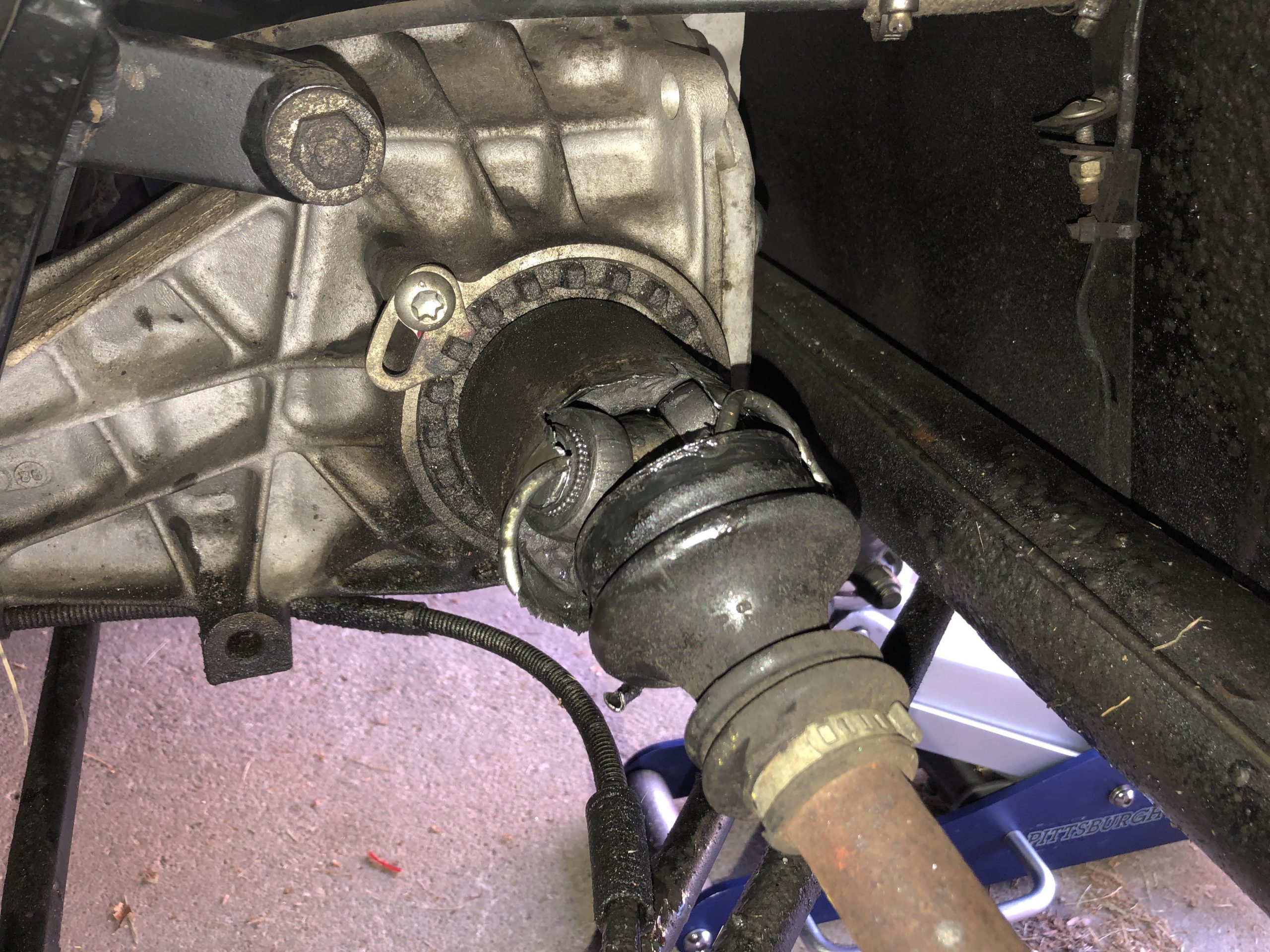
When I jacked the rear up it became very clear what had happened: the universal joint on the left half shaft at the differential end had shredded itself—lots of bent sheet metal. Ollie was extremely helpful by allowing me to load my car into his trailer and take it to my home while I led the way in his Boxster.
The next day I did some more investigating but was limited by my inability to find a 41 mm socket locally to remove the hub nut. Fortunately, I have all winter to get the car back into shape. I have ordered two half shafts, which only can be sourced from Caterham, plus two hub nuts. I will also have to send the left front damper back to Spax in the UK for a warranty repair, so the poor Caterham will spend the winter on jack stands in the garage.
The learning process
I have subscribed for a couple of years to Ross Bentley’s Speed Secrets emails and really enjoyed them. Several times I have replied to them, and he has always responded, which is unusual. For quite a while, I have kept suggesting that he set up a training service for sim racing, and a few weeks ago, he asked me to beta test exactly that. He was also looking for a few bodies to help him run the service, and I immediately stuck up my hand and yelled, “Me! Me!”. He took me up on the offer, and I am managing and moderating the Discord server. There are a couple of other team members that fill other roles, and it has been and looks to be a fun thing to do. Take a look at https://simraceracademy.com/
Ross is also really great at responding to musings. One I haven’t shared with him, but will very soon is about how people learn. Here it is:
Learning to drive a race car is like any other learning process. You start by having a goal, like learning to threshold braking and transitioning to trail braking. So you know what you want to. It sounds simple, but braking performance depends on a huge number of factors, some of which are track temperature, road surface, tire wear, corner shape, camber, slope, car weight distribution, brake bias, and more! If you don’t take all factors into consideration, bad things happen!
You can take two approaches. 1. Emulate precisely what the better drivers do on every corner of the track. The trouble is that you have to find an expert to emulate every time you get to a new track or car and that what you emulate only works if the conditions are exactly the same as when the expert ran it. 2. Learn what the expert learned to be able to figure out how to brake optimally in every condition. I call 1. the what and 2. the why or how. To become really good, I believe you have to take approach 2. But there is a lot more to it. Even if you know the theory, it is a different matter to put it into practice, so you have to also learn that. Initially, and possibly for a long time, you will have to focus your mind on doing that, but that may distract you from performing other tasks well, so eventually, you will have to apply the task unconsciously, just like you automatically hit the brake pedal when a kid runs out in front of you. You don’t think, “kid on the road, I may hit it, need to stop the car, do that by moving my foot from the accelerator to the brake pedal, push really hard.” No, your foot is hard on the brake pedal without any thought process. You may feel that you are plateauing as you go through the process of moving the application of theory from conscious to automatic, but in reality, you are progressing all the time, getting ready to go into the next phase of learning.
https://porschenet.com/wp-content/uploads/2021/11/PCA_NER_SIM_Racing.png10801920Luishttps://porschenet.com/wp-content/uploads/2017/03/NERegionVectorLogo-siteicon.pngLuis2021-11-08 21:22:392021-11-09 07:43:46Behind the Wheel with Anker
Saturday the 4th was a great day to be out at Devens engaging in cone-dodging … the skies were clear, the air was dry, and temps hovered in the 70’s all day. The timing tent sported a Kachel Motor Company banner, a new autocross sponsor this year. Brendon Miller and Dave Seavey were at the event representing KMC.
We had 70 people register for the event, but after several cancellations and a few no-shows, we ended up only fielding 58 drivers for another lightly attended autocross. But we saw a large novice contingent (20), which hopefully bodes well for the future if these folks get hooked.
Tom Tate represented Class 2 in his trusty 1972 911 with the Martini Racing stripes. Bob Canter finally got someone to race against in Class 3 when old friend Christine Skaubitis showed up with her cousin Lauren Firnstein driving her beautiful RS America 964. Neil Halbert finally had his car back and used it to beat Georges Rouhart in Class 4. Most of the other classes saw the usual winners take the prize, although Dave Seavey, co-driving Walter Lunsmann’s GT3 came close (within .2 seconds) to beating Walter in his own car – a definite no-no. Walter also had Porsche FTD posting a 68.863, while overall FTD was claimed by Frank Bayliss driving his Exocet with a small block V-8 coming in with a 65.951.
And speaking of KMC, in the Novice Class, Brendon Miller posted a 82.295 putting him in the top 50% of the class for the day – certainly a respectable showing for a relative newcomer. Nate Geyer took the Novice class overall with a 75.997, booting him out of the Novice class a moving him to Class 11 the next time he shows up.
The day was slightly marred for a couple of drivers when Anker Berg-Sonne’s Caterham started emitting smoke from a valve-cover leak and he had to stop running. And Rob MacAlpine’s trusty Miata had a ball joint let go jamming the wheel into the car in such a way as it could not be pushed off the course. I had to send Bob Canter to my house for a couple of wheel dollies so they could move it. Since it was lunchtime, we halted the event, had lunch while Rob took care of getting the car out of the way, then continued after lunch completing the day with 8 runs anyway and a good time was had by all.
Next up for NER is our final event of the season on October 23rd. Hope to see you out at Devens then!
NER held a special event geared to give novices a chance to come and try out autocross, meet some of the “regulars,” and see what it’s all about. The event was held instead of our normal “Autocross School,” which we usually do at the beginning of the season. As they have done with the school for years, Conway Motorsports sponsored the event.
We had 50 people sign up, and 27 of them were novices. We had a bunch of parent/child dual drivers, and one family brought four people (father, mother, son, and family friend), all sharing Dad’s Boxster. Now that they are all into autocross, they definitely need to get another Porsche! So, we achieved our goal of attracting the newbies … the trick was to give them a chance to try out autocross and come away with a good taste in their mouths for the sport.
We set up two separate courses and divided them into three run groups so that folks would end up spending most instead of half their time driving and less time out working the course. One course was timed and the other untimed. The untimed course was used as an exercise course allowing drivers to get a good feel for some of the basic autocross elements like slaloms, gates, clamshells through repetitive runs through the course. The timed course allowed everyone to gauge their own improvement throughout the day or against their favorite autocross buddy – regardless of class. The experienced drivers spent most of their time jumping in to instruct the novices, but they managed to get a few runs of their own in as well as give the novices some thrilling rides to give them an idea of what can be done with these cars.
Because we set up two courses in separate areas of the airfield, the courses were up and back arrangements like would be done if autocrossing in a parking lot. The timed course also featured two switchback elements which, in hindsight, may have proved to be a bit too complex for the novices – in fact, it proved to be tough for many of the experienced drivers as well! But it did teach people the importance of learning a complex course – a skill which will undoubtedly come in handy in the future.
The Club sprang for a Pizza lunch as we normally do at our Autocross School, and people had a chance to socialize while taking a break in the middle of the day. After lunch, it was back to the track(s) where people kept driving until after 4:30. Between the two courses, folks got a lot of seat time in, and even though it was all fun, many were ready to call it a day by then.
The timing results from the main course are posted below and will remain up on our live timing site at https://porschenet.com/autocross/results_live.htm until our next event on September 4th. Photos from the event taken by Anker Berg-Sonne have also been posted to the website and our Facebook page. Thanks to all the new people who came out to try AX and to the veterans who spent most, if not all their day instructing and helping the novices have fun.