Archive for category: Monthly Columns

NER’s Second DE of the Year – Palmer CW in June


A few days before the event the weather report didn’t look good but your faithful DE Crier called in a few favors and the weather was darn near perfect all three days.  You can thank me later.  As with Thompson, turnout was a bit on the low side – 95 drivers in total. The positive aspect of this was that run groups were combined which allowed longer run sessions.  Plenty of drive time and still not too much traffic.  Everyone behaved nicely and the only incident of the weekend was the idiot DE Crier crashing Kristin Larson’s electric scooter.  Ouch. Thanks for not laughing, Adam.

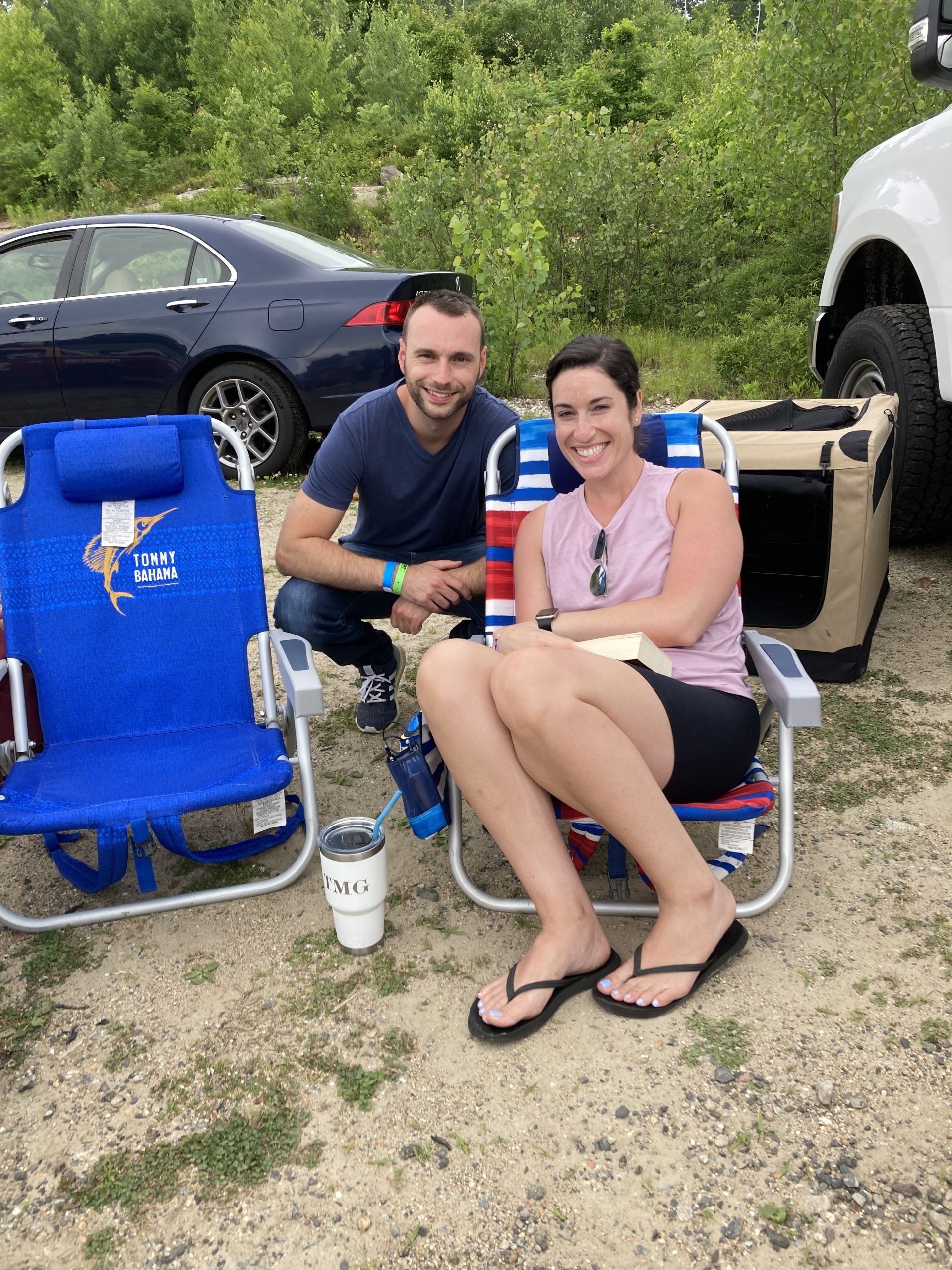
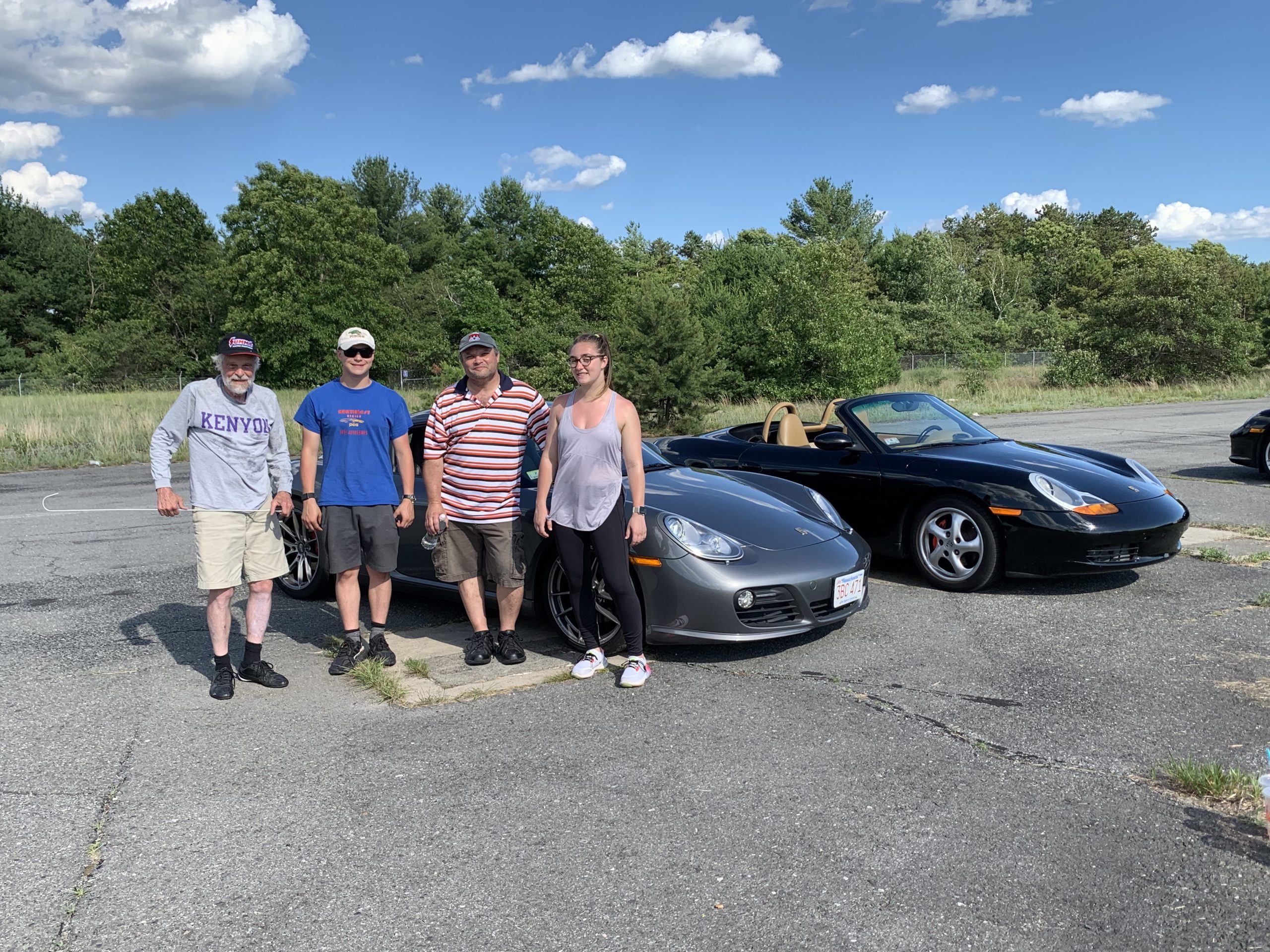
As is my usual practice I looked for a new driver and found a very good story.  Steven DiCato, a nice fellow who I had instructed last year at Tamworth (and whose dog was previously featured!), convinced his cousin Chris Costain to attend.  Chris, not wanting to abuse his street ride (an Acura I think – you can see it in the picture), rented one of the Palmer Miatas. (Note:  these are nicely prepared race cars with a full cage that are a blast to drive.  You can rent them and have an instructor provided with Palmer’s “Arrive and Drive” program.) Chris had a blast and was one of the fastest in the Green run group.  Steven immediately went to work on convincing him to buy a Miata that they could share.  But perhaps that will have to wait until Chris’ wedding in September to Tara Gambardella – she was in attendance and probably dismayed as she watched her husband-to-be start the slide down the slippery slope.

I had another nice conversation (at the Saturday night BBQ social) with Jeff Zern of the Riesentoter Region (that’s Eastern Pennsylvania and, yes, there is supposed to be an umlaut over the “o.” According to Google Translate that means “Giant Dead” but they claim it means “Giant Killer” in reference to Porsche slaying cars with greater displacement on the racetrack).  Anyway, Jeff had heard good things about Palmer and wanted to drive it in his Cayman.  He was exceptionally grateful for the help he got from Stan Corbett in registering, getting correctly placed in the White run group and even getting advice on hotels and routes. He also was very complimentary about the event organization and the driver etiquette on track. Nice to have some other region visitors!

As to the BBQ social, thanks to Judy Mansing and Pam Mascetta for setting it up and, once again, having a nice variety of beers to drink (and I presume wines but I can’t speak to that – I enjoyed some Lagunitas IPA and detect the influence of the NCR track chair in that selection).  Note to self:  talk less and line up sooner for BBQ so you get more than two ribs.

Here are the run groups advancements from the Palmer weekend…

Green to Yellow:  Stefan Vondran, Derrick Hedley

Yellow to Blue:  Jim Devol, Arun Ramamurthy, Ray Young, Prakash Iyer, Christopher Necchi, John Januszewski, Scott Stawas

Blue to White:  Thorsten Becker, Richard Pyatt, Todd Shilman

White to Black:  Michael Beers, Brian Nett, James Cooper, Torsten Gross (Note – this is a placement, not an advancement), Mark Hutker

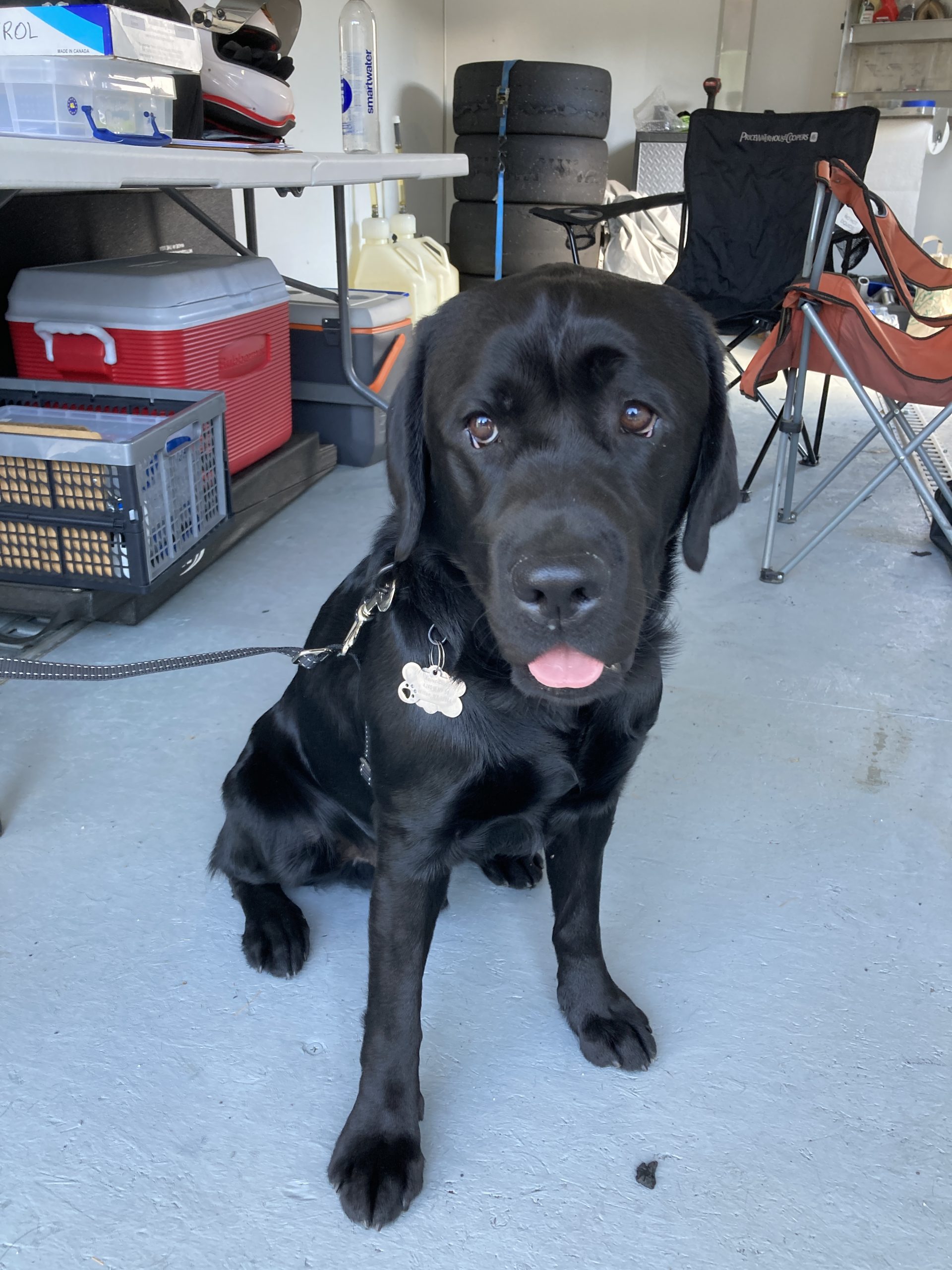
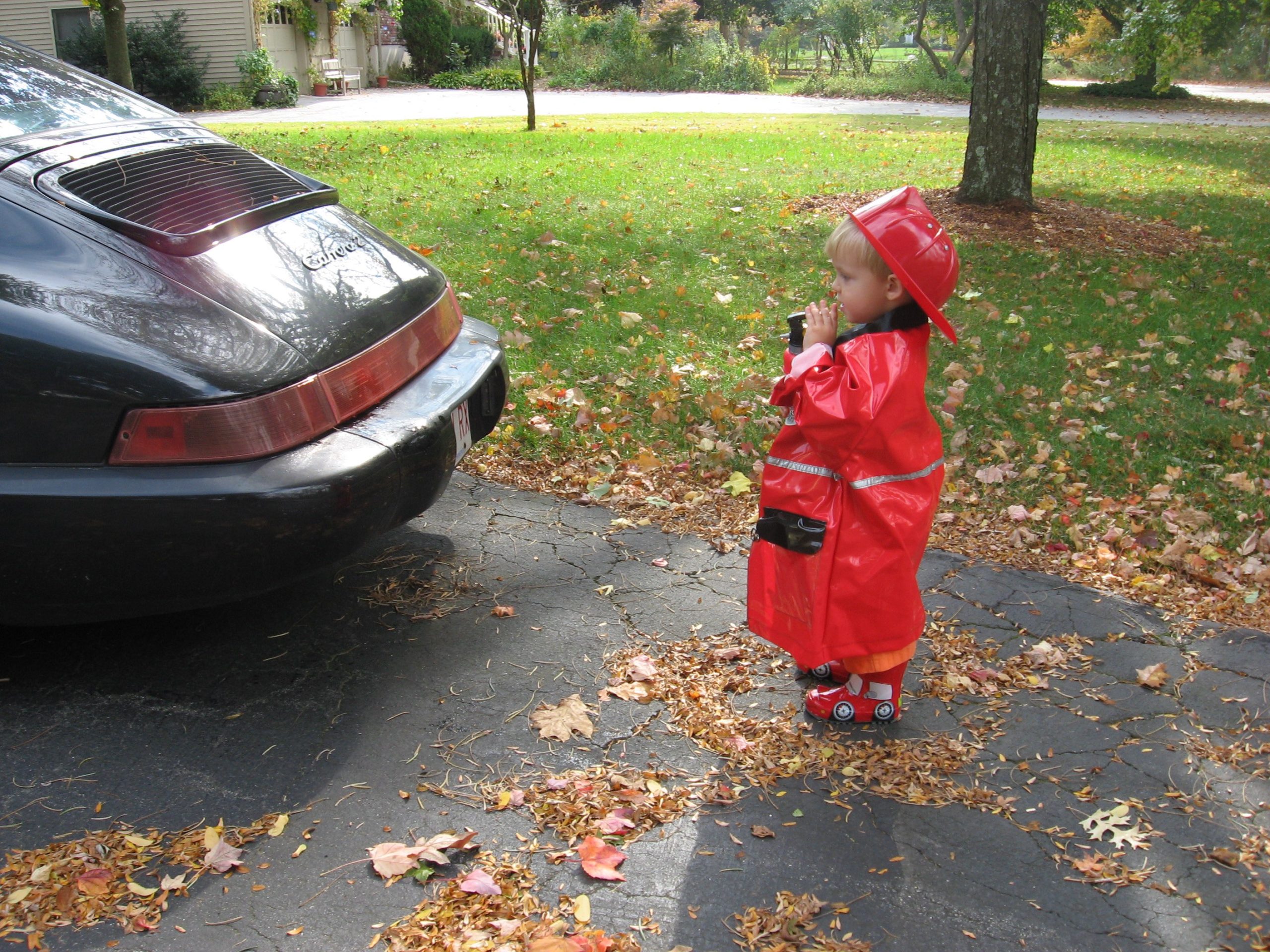
And finally, enjoy the pictures of some notable Palmer Pups!


-Bill Seymour


Human nature is to be quiet about embarrassing things one has done. But last week Tom Tate shared his latest embarrassing experience with all of the Northeast Region. Emboldened by his brave act I will share mine and encourage others to do the same.

Being used to modern cars, I have assumed that if my garage floor doesn’t show puddles of fluid, all must be fine in the fluid department. In my two years of Caterham ownership, the garage floor had been squeaky clean. So all appeared to be good!

At last year’s final NER autocross, I was driving the Caterham through a fast left-hand sweeper when a loud bang under my seat revealed something serious had happened. I coasted to a stop off track and engaging gear resulted in no forward movement but loud banging and clanking. After getting the car pushed and towed to the pits, it was revealed that the left half shaft had self-destructed spectacularly.

I will not bore you with the difficulty of sourcing the correct parts for a Caterham since they are built with parts from other manufacturers; you have to thoroughly research that the part that you order, when you find a source, is the correct one.

The final background information I need to share is that after an earlier autocross, the adjuster on the front left damper adjuster appeared to be frozen. I contacted the manufacturer, and they authorized a return for warranty repair.

On to the main topic: I first removed the “frozen” damper from the car, a non-trivial task. After removal, I discovered that I had been attempting to soften the damper beyond the softest setting. Softening an already fully softened damper is difficult, I would even say impossible. In my defense, I will say that it is stiff and that I was concerned about making the “problem” worse. On re-installing the damper, I ran into an issue I had when replacing the dampers less than a year before. It is challenging to align the top control arm bolt that goes through the chassis bushing. You have to compress the suspension just right with a jack and then manipulate the bolt blindly through 5 holes that have to be perfectly aligned.

But there is more: I had finally procured the correct half shafts and started dismantling the rear end this spring. My mechanic friend and a constant source of advice had warned me that oil would come spilling out of the differential when I pulled the half shaft out. Well, it didn’t! After installing the half shaft, I removed the fill plug in the differential. It is magnetic and had a beautiful crown of steel shavings sticking out from the magnet. I topped up the differential fluid and now have a new winter project: rebuilding the differential. Maybe an earlier project if it fails completely. There is no bearing noise and just a bit of backlash, so there is hope.

Given this experience, I thought it might be a good idea to also check the gearbox oil level. This is really hard because the fill plug is in less than a one-inch gap between the gearbox and the footwell. To remove it, you have to cut down an Allen wrench so you can get it into the fill plug, loosen it, unscrew it by hand, use a transfer pump to fill the transmission and then go through the painful process of starting the fill plug by hand and tightening it with the cut-down Allen wrench. The good news is that the gearbox fluid was low but not nearly as bad as the differential, and there were no shavings on the magnetic fill plug.

Believe it or not, there is more: When removing the brake and wheel carrier, I had spilled some brake fluid on the floor, and that had been mixed with some oil that had run down the fill tube when the differential had been topped up. I bled the brakes and filled up the brake reservoir. The puddle on the floor would be cleaned when I got the car off the jack stands. This happened a few days later and I was ready to do a quick test drive. Unfortunately, the brake pedal bottomed out with no resistance. There was a brake fluid leak somewhere. Non-functional brakes are a really bad problem. Believing I knew exactly where the issue was, I started unscrewing the flexible fluid line that I had compressed with a vice grip to ensure that only minimal brake fluid leaked out. When I got to the bottom of the line, where it connects with a T that connects the flexible line with the two metal tubes that lead to the wheels, I could see that the bottom of the T was clean, so the leak was causing the fluid to drip down from there. It turned out, however, that the leak was not the flexible line but the metal tube leading to the side where I had replaced the half shaft. Moving it out of the way so I could remove the broken half shaft had loosened the connection at the T. I tightened them all up, re-bled the brakes, and two days later, the brakes were still hard and the reservoir full.

This story could have been a lot longer if I also described the issues I had run into along the way that required head-scratching, analysis, and repeating the same job multiple times. Just one example: When I assembled the brakes and attached the wheel that the new half shaft was attached to, the brake drum rubbed against the backing plate. Rubbing is an understatement; it absolutely refused to rotate. Had I just installed the wrong half shaft? The pundits on the Interweb had described how the newer half shafts should work on older models despite not being the exact same length. After messing around more than you will have the patience to read, I realized that the new wheel bearings were thinner than the old ones, and I needed to install a shim to make up for the difference. Fortunately, I have an industrial lathe in my basement and was able to turn one that fit perfectly. That is after I had turned one that was too thin. I am going to turn one of the same thickness and save it for when I replace the other half shaft.

Ahhhh, the joys of working on old cars!

-Anker Berg-Sonne

 As many of my loyal readers know, this column tends to pass along stories that are upbeat; at least, that is my intent. Since I’m the writer I realize that I tend to also post tales that make me look good. Sometimes that is tough to do because I make some of the same mistakes that everyone else does. When an axle nut didn’t get tightened correctly, and the rear wheel came off the Speedster on the way home from an autocross, I just didn’t mention that in my next column. But when I want to change the oil in a C4S and save $450 off the dealer’s price, the description goes on forever. The underlying thread is that I’m a genius. Of course, we all know that isn’t true.

 I am the first to complain about the media and the biased reporting that we are all subjected to every day. I know that Walter Cronkite died years ago, and with him, the news reporting that I grew up with. A news story reported today could sound like two different events depending upon what station you are watching. No wonder the generation behind me doesn’t watch TV news. In the interest of full disclosure,  this month’s column will have some bad news in it. The good news is that I’m OK.

The race season is finally at full speed, and my first race was at Watkins Glen last month. It was an AER race, a two-day enduro that ran 8 hrs one day and 6 hrs the next. The cars were provided by Matt Connelly Motorsports. BMW 330’s that I have driven in the past. Terrific cars that can pretty much pass anything on the track at will.

 My co-driver, Rob, couldn’t make the trip, but I went up a couple of days early to get in some practice. The weather wasn’t great, but the ride out was great fun in the newest garage resident, a 2015 Turbo S.   I even had time to look around The Glen a bit and see some of the local attractions.


 Practice started with a wet track, but the car stuck pretty well even if the lap times weren’t that good. Matt brought two similar cars, and they were set up exactly the same. We had four drivers for each car, and everyone took a turn as the track began to dry out. My morning time was the slowest in the group, so I had to get serious in the afternoon; besides, I like driving in the rain. There is a nice data screen on the dash that shows the projected lap time as the course is being driven. If you brake too early or don’t carry enough speed through a turn, the projected lap time will be increased. In the same way, if you do the corner just right or hit the brakes later, the time on the screen will begin to fall. On my last practice lap, the racing line was finally dry, and my times were starting to fall, so I was determined to finish strong.

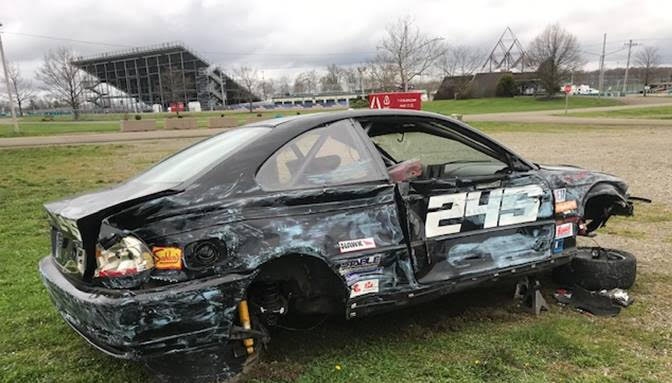
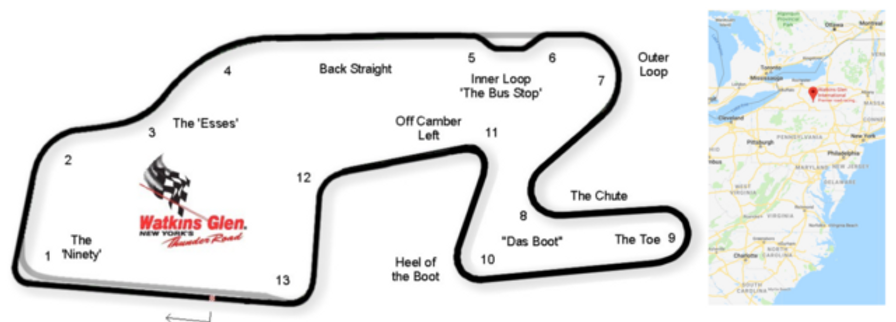
 With only two turns left and the timer looking good, I drove into turn ten flat out in 4th gear. Carrying just a bit more speed than the dry line could hold, I dropped two wheels onto the wet portion of the pavement and began to lose even more traction.  I have spun in turn ten before and always caught it, but this time was different. I remember thinking, keep my foot down, don’t lift, steer in the direction of the skid, you got this. But I didn’t.  The back of the car snapped around before I could react, and I was headed to the inside guard rail. I did get both feet down before impact, but it was close. The good news was that because this turn saw a lot of spins, there was a double row of tires up against the Armco barrier. That allowed a bit of a cushion before metal hit metal. The right front corner hit first as I was sliding backward, and that slammed the entire right side into the tire wall.

As the photos show, the left side still looks good, but the right side lost a lot of pieces. Tires, brakes, part of the front spoiler, and even a door handle got left on the track.

 I bounced around inside the car a bit, but the 5-point harness, along with the Hans device and race seat (which was displaced), kept me from any serious injury. I could hear the helmet tapping the roll cage as the Hans straps held my head on straight. The seat belts left their marks on my body, and my right arm suffered a good size bruise when it was restrained by the netting that did its job.  

The crash crew was there in less than a minute, and I had my arm out the window so that they knew that I was OK. I was certainly more embarrassed than hurt especially considering that this was practice. Nobody crashes in practice, a race, maybe but not while practicing. The fire extinguishers were at the ready but not needed, and the ambulance pulled up to offer me a ride a minute later. There were questions to answer (like: where are you?) and forms to fill out.

I have certainly crashed before; it happens when you race, but never bad enough to total a car. The front frame was pushed left when the right front tire hit the wall, but the engine and drivetrain were spared any damage. That became important when the other car suffered an engine failure due to a driver finding 3rd gear when he meant to go to 5th at speed. The engine swap was done on Sat night in less than 4 hrs, so the other drivers didn’t lose their racing seat time. That engine ran to the end on Sunday, proving I would’ve had a great race if I hadn’t crashed.

I was thankful that I didn’t break any bones, and I still knew what day it was when I was asked at the Care Center, but I sure felt like a jerk. The track insurance saved my bank account, and Matt was really good about the damage I did to his car. As he said, “you don’t really know where the limit is until you exceed it” sometimes it hurts, sometimes it doesn’t. This time it hurt, but I definitely know where the limit is, in turn, ten on a damp track.

 -KTF   

My loyal supporters will recall that I have lost a few readers upon discussing my position on noise, specifically engine noise. To set the stage for this latest discussion, let me remind everyone how this started, and then a decision can be made as to whether or not reading any further will be time well spent.

My first motor vehicle was a Lambretta motor scooter with a 125 cc two-cycle engine. Think, Putt, Putt, Putt. The year purchased, it had been used at Sebring as a communication link between corner stations at the track that we still race on. Since it burned a mixture of gas and oil (one Coke Bottle full of oil for every tank of gas) and had a muffler bigger than the gas tank, it was very quiet. The perfect vehicle for delivering the Orlando Sentinel early in the morning.  Not so perfect trying to be part of the biker crowd in rural Kissimmee, FL. In short order, I had two short pieces of plumbers pipe welded into the side of the muffler and plugged them with a screw-in metal cap. The first cutout on the street. Once the paper route was done and everyone was awake, the plugs came out, and the little scooter spoke with some authority. Not a lot, but some.

Next up was a ’58 VW beetle with a stock muffler. The second day I had it, another VW owner showed me how to take off the two chrome exhaust pipes, remove the fiberglass (probably asbestos) packing inside the pipe and make the 36hp engine sound like it had a lot more muscle. Like maybe 40hp. This was before any kind of nonstock exhaust was available. Extractor exhausts were still ten years away from the speed shops on the left coast. A couple of years into beetle ownership, the weld broke on the #4 exhaust pipe, and the one after the clamp had been loosened on the #3 pipe, the muffler could be pulled out just a little and it sounded like another ten hp appeared. Of course, it didn’t, but it sounded better

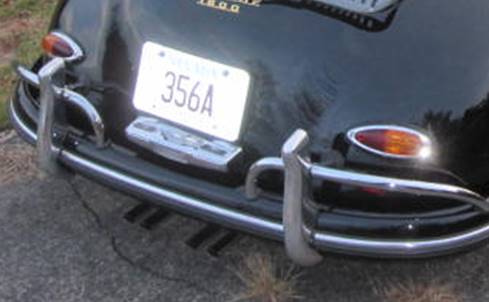
A  Porsche 356 was the next car I owned, and it came to me with an Abarth exhaust with four small chrome pipes coming out from under the rear bumper. That was perfect; no modification needed, nice deep exhaust tone, and very long-lasting.

 The 356 was getting expensive to service, and I needed a reliable ride for the last two years of college, so a Volvo 544 was the replacement. It had two mufflers, actually, one resonator in the center sitting longways and one muffler in the rear sitting crossways. Once the rear piece was removed and a straight pipe installed, it wasn’t that much louder, but it had a terrific growl to it when it was downshifted to a lower gear to slow down, just like a ’49 Flathead Ford coming down a grade in second gear.

There were lots of others. Once extractor exhausts were available, I had them on 356’s, 914’s, and even early 911s. Audis, like that old Volvo, always had more mufflers than I thought they needed, so more straight pipes were used. A  later Volvo 142 even got its system shortened to a side exhaust that dumped out in front of the rear wheel. On the driver’s side, of course.  Are we starting to see a pattern here?

There is only one car sitting in the garage with a stock exhaust system, and that is a Macan that I don’t drive and am not allowed to fool with.

 The Speedster has a Sebring exhaust                


 The Puddle Jumper has an original Abarth muffler                                                

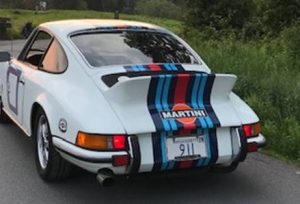
 The 72 911 has an Extractor Exhaust
The ’85 BMW has a stainless steel exhaust that Rick’s Custom built for me years ago that makes great noises, and Pearl, the Audi RS4, also benefited from Ricks’s handiwork before he retired with the installation of an electric cutout that can be opened at the touch of a button.  Even without the cutout, it is short a resonator that says it’s not your Grandfather’s Audi.

As the years rolled along, even the Porsche Factory got into the act. The current Big Dog in the garage (2015 991 Turbo S) has a system that changes tone with the touch of a switch, and it’s not quieter. The C4S that my son, Rob, loaned me for a while to inspire the Turbo S purchase has a Factory loud button as an option. Looking at the system, it is an electric cutout that redirects the exhaust to bypass two of the three mufflers. We both agreed that was a good start, but we have replaced the rear muffler on both cars to provide a little more character.

 Once the Turbo S and the C4S were tested at the track, and both passed the noise limit, that prompted me to take a look at what was on the books in the US that limited the noise on streetcars.

Of the 50 states, only 12 have an ordinance with an actual sound level number written into the regulations. It does make me wonder if Law Enforcement has a dB meter in each police car to actually measure the sound level in those states where an actual sound level applies. The states are :

CA – 95db                                   
CT- 82db                                       
HI-86db                          
MI-95db                       
MT-95db                         
NY-
82db                                 
OH-82db                                      
OR-92db                                       
RI-82db                           
WA-78db                          
DC-90db  

These are actually some pretty big numbers when you consider that the race noise limit at Lime Rock Park is 86db, and those are some loud cars. Of the New  England states, only RI has a measured limit, while others like MA and NH say things like “every motor vehicle shall be provided with a muffler or other suitable device to prevent unnecessary noise.”  I’m not sure what necessary noise really is, but it certainly doesn’t come with electric cars, which is probably why I can’t see owning one. NH has a rather strange rule that states “no person shall operate a motor vehicle with a straight pipe exhaust system,” whatever that is. Maybe that was written back in the ’50s when “Lakes pipes” were popular out west or more recently to address Corvette side pipes.  I did see a set of straight pipes on a Porsche when John Ames fashioned an exhaust system using a set of copper pipes on his Speedster when we were at Univ of MD back in the ’60s. As I recall, they didn’t last long as the brazed joints couldn’t take the exhaust heat. I’ll never forget the look of four pipes sticking out the back of that Tub flying up University Blvd on the way to class. Funny that snapshots of life never seem to go away.

 I really like the VT statute that only states: “A motor vehicle, operated on any highway shall be in good mechanical condition and shall be properly equipped.” MA law is as general as any as it uses the: “prevent unnecessary noise” line. It also goes on to say that motor vehicles need a bell or horn for signaling and a lock, key, or another device to prevent unauthorized use. That sounds like it could’ve been written back when quill pens were in use.

 There are 18 states that prohibit the use of “cutouts,” but only four states say that cars cannot have them mounted in the car. Those would be CA, NY, ME, and IL. Since MA is one of the states that only says that you can’t use it, I guess Pearl is in the clear as long as I don’t hit the switch. In case you are wondering if there are any states that really don’t care, there is one. That would be Alaska, where there are no state laws that address exhaust noise; they are regulated locally.

The research I did above prompted me to look at noise limits at some of the racetracks that I have run on in the past.

The track in NH where NASCAR runs, NHIS, really doesn’t have a noise limit. That seems reasonable as it is still out in the woods, and the deer don’t care. Civilization hasn’t gotten close enough to complain yet, but I’m sure that will happen. Another track with no noise restrictions is Watkins Glen. High above the town of Watkins Glen, I suppose that the residents are just glad to have folks stop by to spend a few bucks. There are a couple of sanctioning groups that do impose a limit, but those numbers are in the 102-105 range. Think jet plane takeoff volume as you’re standing on the runway.

Sebring is another race track without any concerns about noise. Another reason why I really like the world’s longest autocross track.

Speaking about autocrosses, we do have a sound limit when we run at Ft Devens. It is a little strange as it is set as a number over the ambient noise level. The rule says cars on the course cannot make more than 10db over the noise level when there is no noise. Of course, there is never “no noise.” I have a dB meter app on my phone (of course, doesn’t everyone?), and sitting in my office writing it tells me that the sound level is about 55db, and it’s quiet in here. That is about what it reads out on the runway at Ft Devens unless the wind is blowing, and then it can easily bounce up to 75-80db. Add a car out on the main road, and the meter will show 80-85. Take the reading far enough away from the course when a car goes past, and it adds less than 10db. It’s safe to say that a 90db limit is about right there. I don’t know that we have ever asked anyone to leave the event because their car was too loud.

 So, I conclude that noise is good. Even the stickers on the rear of a couple of my cars back that up, “Loud Pipes Save Lives.”

                 KTF



In my new (and evolving) role as DE Crier I received an email from Adam asking me to pen something that would get people excited for the upcoming DE season.  OK, fair enough.  There are a few ways we can go with this.  “Cooped up all winter, pandemic blues, blah, blah, blah but now the robin chirps, the tires squeal, etc.” would be one way. Or “Porsches are meant to be driven on the track, finally see what your car can do.”  But I’m going to take a more concrete approach and take you through the season, track by track, so you’ll have a sense of what is on tap.  Warning!  (Go ahead and wince, Adam.) This will be one man’s opinion and not every word will be positive. But before we get into that don’t forget about the DE Ground School at Palmer on April 24th. This is a class room introduction to DE pitched to those who have never done one (and includes the ability to do slow laps on the track). Even if you don’t think you want to do a DE why not go (and maybe have your mind changed)? Palmer is a cool place, see your other Porsche buddies, go for a nice ride in a rural part of the state.

All right, back to the task at hand.

The first event is NCR’s two day at Lime Rock. Paul Newman loved Lime Rock and I am a big fan – of Paul, but not Lime Rock. It’s a rare combination in that it is great for beginners and also very technical for the experienced.  But it’s short and there is only one left turn where I have managed to spin twice (which probably signals that I am a beginner so why don’t I like it more?). Also the downhill should be taken flat on the floor in my car but that hasn’t seemed to happen yet – so maybe I’m just a whiner. It is historic, in a very pretty part of CT, has good facilities and is a bucket list track. Stay in Great Barrington which is a cool town with nice restaurants.

Next up is Thompson which is also historic – the oval dates to 1940 and was one of the first paved tracks in the country.  The road course has gone through a number of versions.  Like Lime Rock it is pretty short at 1.6 miles but is much slower (60 seconds is a good lap at LRP, 80 seconds at Thompson) and has more turns. The haters call it a glorified autocross (hey! I was the AX chair for 6 or 7 seasons buster) but it has some nice subtleties and the facilities are excellent. Newer Porsches will see 130 on the straight, quit complaining. And, if you live in metro Boston, it is really close.

After that is the first of the two Palmer events (second one is in September). We run one event clockwise and the other counter clockwise (Anker says “anti-clockwise”). I prefer CCW but that’s just because I’ve done a million laps in that direction. This is a challenging track with elevation changes, off-camber turns and lots of opportunity to go wrong. But don’t because it is also the least forgiving of an “off.”  Facilities are good and getting better.  NER has a great relationship with Palmer and there will be good socials when the track goes cold.  An easy drive from Boston but no close hotels. At the Ware Diner they give you a choice of how you want your bacon cooked.

Back on our schedule after a multi-year break is Mont-Tremblant (use your French and call it LCMT).  This is another historic circuit that you have to get to at least once (it was called St. Jovite when F1 ran here). It is a very nice course with some interesting turns and a loooong straight, good runoff as well. I assume our event will be timed to coincide with the Blues Festival at the ski village which is fun. The geography is a little confusing:  at the north is Mont-Tremblant resort (the ski village), in the middle is the village of Mont-Tremblant (where the track is) and in the south is what was the village of St. Jovite – but now all are called Mont-Tremblant. I’m not fond of the ski village (too Disney-esque, drinks from an automated machine, but the kids will like it and the hotels are more modern) – better restaurants in St. Jovite. Consider camping at the track – a nice lake to swim in.  Pain in the neck to get to with the border crossing and maybe horrible traffic in Montreal (Adam thinks the bridge construction may be completed but I’d still brush up on my French swear vocabulary).

Also back on our schedule is Calabogie which is scheduled so that you do Mont-Tremblant then have a travel day to Calabogie – enjoy your week in Canada! Calabogie, like a martini, is an acquired taste (I really like martinis!). It is long and has many corners that look the same but (obviously) aren’t – after three days I was still struggling. And there is nothing to do nearby. But the hard core folks love it and there will be special programming to help advanced drivers improve (heavy training on interpreting data). I’ll be looking for a volunteer to help me write that one up from afar.

In July is the first of two NCR events at Tamworth.  Great track, gorgeous views – it’s too easy to screw up because you are admiring Mt. Chocorua off in the distance when you need to be hitting an apex. The facilities are not yet first class – no garages and not enough paved parking – but the quality of the track more than makes up for it.  The nearby hotels are weak – better ones a half hour away in North Conway – but have breakfast at Rosie’s and you’ll start your day off right.

Ah, Watkins Glen. What can I say?  The best, just go.  And take the husband – he’ll like the wineries, the Glen, the Corning Glass Museum.

The season ends with NCR’s New Hampshire Motor Speedway event in October (yes, it might be a little nippy). Before we had Palmer and Thompson we did tons of events at NHMS and everyone complained, instructors wouldn’t sign up. Yes, there are a couple of bumps that are hard on full-on track cars and, yes, it is pretty short.  But it’s a fun track, very safe for newbies and it is a hoot being in this huge sports complex where the NASCAR boys go to play (climb up in the stands between run sessions for a sense of it). Along with Thompson, Palmer and WGI it has garages. And there are lots of good lodging and eating choices nearby (have at least one meal at the Makris).

So there you have it:  29 days at 8 different tracks spread out over the season. If you have never done a track day then you need to, damn it!  And if you are a regular then welcome the newcomers into your fun club. One final enticement:  there are socials when the track goes cold and (thanks to the successful ministrations of Pam Mascetta and Judi Mansing) even the most snobby beer geeks will find something to their liking. See you there!

-Bill Seymour


Sim Racing may look really daunting from the outside looking in, but I definitely think it’s worth a try.  You’re finally able to drive the cars you watch on tv and read about online.  The only difference is you’re racing from the comfort of your own home and you don’t need to worry about the expense of crashing your GT3R 25 times in a row whenever Jeremy Mazzariello comes near you.  For people who have never done sim racing, the investment of time, equipment, and the steep learning curve are hurdles to consider before taking the leap into sim racing.

Before I get into what I believe the key to improving is, I’ll tell you a little about myself. I’m a 16 year old boy from Andover Massachusetts, and a competitive swimmer. I train with my club team 20-30 hours a week, while attending high school. In a mere 3 hours or so a week of practice in the sim I’ve been able to improve vastly.

This past June I started off by borrowing Anker’s extra sim rig, consisting of an Oculus Rift and g29 wheels and pedals. I invested in the software and started buzzing around Lime Rock Park in my little Miata. 

I sucked completely.  I found new ways to crash that no one else has managed to recreate. But with time and practice I came third overall in my class for the Zone Group Challenge Championship earlier this month. And yes, I achieved this before even having my actual drivers license.

My family and I were all enthralled with how lifelike Lime Rock Park was, or I’d assume it’s lifelike since I’ve never been. (working on that) It was so realistic it even had the Harpoon sign! 

Overall I think that the biggest thing for newcomers to understand is that there will be a steep learning curve. You need to adjust to the goggles/monitors, get used to the wheel and pedal setup you have, and in my case I had to learn how to drive a car.  It took a week of struggle before I could finish 2 laps in a row on Lime Rock.  Controlling your level of frustration is half the path to improving. 

Once you can finish laps, go to every PCA session you have time for.  In these sessions you need to ask one of the coaches to help you either through ride alongs or you hopping into their car. They are super helpful and will not judge you at all.  For me I was very fortunate that I knew Anker from going to autocrosses with my dad. Anker got me right into the car with Chris Braun (one of our NER coaches) who helped me right away on my first practice.  My first session was at Bathurst, which is a very hard track since there’s a lot of hills, hence the official name Mount Panorama.

That first lesson I had with Coach Braun was really difficult, he was using a lot of terms and concepts I was not familiar with yet.  By the end of the session I could finish laps on Mount Panorama, and if he can stay calm with a 16 year old who couldn’t even get out of the pits without binning the car 4 times, he can stay calm dealing with anyone.

After those first few sessions you will improve like I did.  After my first session I was about 15 seconds slower than the fastest people, second session I was about 10, then 7 and so on.  Today, about 8 months later, I am about 2 or 3 seconds off on most tracks.  So far in my sim racing journey the key to improvement has been to ask the coaches for help, it will pay off.

I hope that you reading this has helped influence your decision on whether or not to start sim racing. Sim racing has helped me immensely to learn car handling skills, which will be tested at Autocross next month. It also provides an awesome learning environment where you have nothing to lose. Iracing has allowed me to drive cars I likely will never be able to drive in real life, all on a lifeguard’s salary.

Please let your kids do sim racing. I’m lonely.

-Scott Kessel

Here’s another challenge to you, our readers, to recount your experience with the car purchase that got away for you. I’ll kick it off with my own, actually two cars that got away for me. (send your story to the Submissions Team!)

The first one was in 1975. We decided to sell our fairly new car, a Simca Ti and buy a new car. This was prompted by a rumor that Denmark would increase the tax on new cars from 200% to something higher. Our new car choice was a BMW 316, but unfortunately there was a long wait on that, so we ended up with the worst car we have ever owned, an Austin Princess. By the time we sold it two years later we had gone through a transmission and the paint had started peeling off the car. Other than those “minor” issues it was a great car, roomy, and with a fantastic air suspension. I have always regretted never owning a BMW.

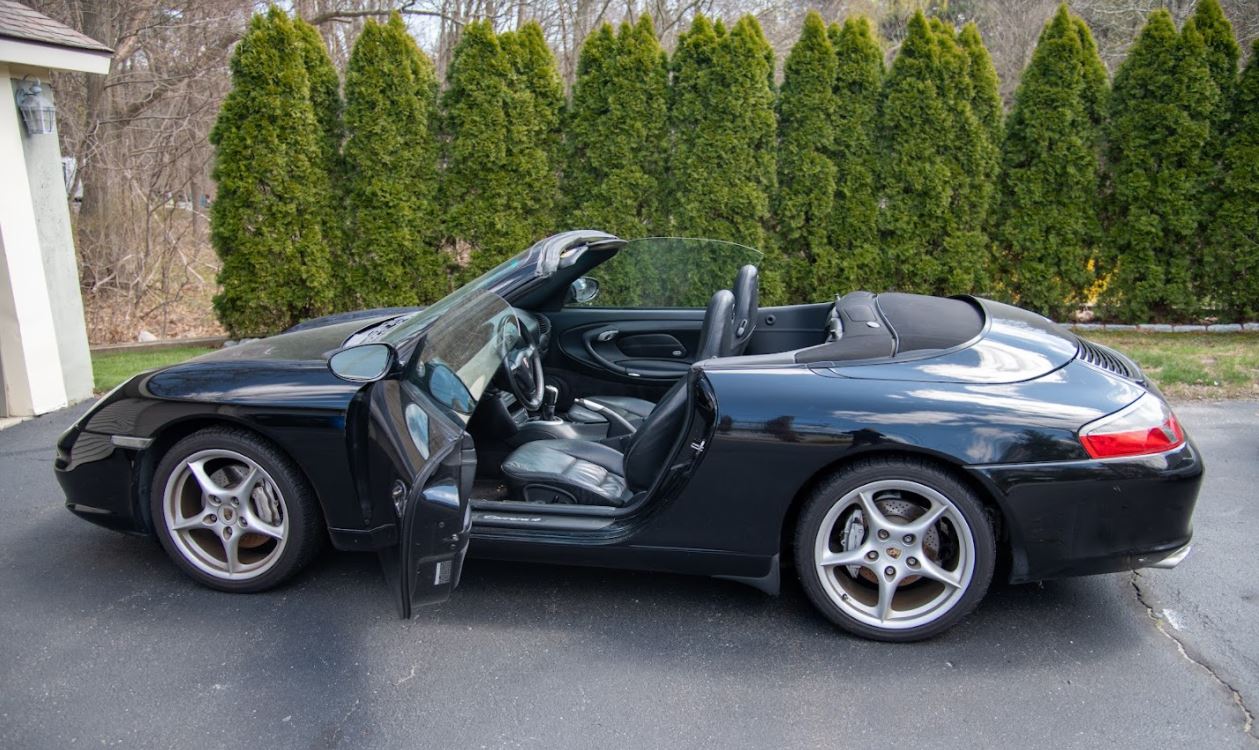
The second is much more recent. In January of 2020 we received an email addressed to the NER board from a woman whose brother had just passed way. She explained that he owned a Boxster that she needed to sell, and could we help her? She also explained that they had received an offer for $15,000 for it and had no idea whether it was reasonable. I responded that I was happy to do what I could and that the first step would for me to take a look at the car to determine exactly what it was. So I drove down to Wrentham where the car was parked, got the keys to the car and the garage and drove over to take a look at it. On opening the garage, I saw that it definitely wasn’t a Boxster, but rather a 996, a C4 convertible, black. I fired it up and pulled out of the garage. I don’t remember the exact mileage, but it was somewhere in the 70,000 mile range. The engine ran will with no smoke. Next, I examined it closely looking for any flaws. Then I opened and closed anything that should. The only one I could find was that the plastic around the passenger electric seat switches was missing.

I email the lady back and told her what the car actually was, and that the offer they had seemed very low. I offered to post the car on the NER Facebook group and see if anyone in the club was interested in making an offer.

Unfortunately, all I got was a couple of feelers from the NER membership and no one was interested enough to even look at the car, much to my surprise.

By now the lady and her brother’s executor were anxious to get rid of the car and they asked me if I would take it for $15,000. I asked my wife, and she wasn’t keen on the idea. She felt that going from owning 5 cars to 6, two of which were Porsches, and one a Caterham, was a bit too much, especially since we only have garage space for 4. It didn’t help either that the car was black, a color my wife isn’t keen on. Also,  this was early in the epidemic, and we had no idea what effect it would have on car prices, so I reluctantly declined.

As you all know I could have flipped the 911 and made a good profit or sold one of our Boxsters and kept the 911.


-Anker Berg-Sonne

After a year and a half driving Rob’s 2014 C4S it was time to give the car back. It wasn’t a bad deal for him either as he had my 2015 Turbo S in his garage in Arizona. There was a tire/rim swap to be done between the two cars so it was necessary to have them both in the same place at the same time , at least for a while. Since the driving season was at full speed in the valley of the sun we decided that it would be fun to run both cars at a PCA Driver Education event when they were both in the same garage.

I set about getting a shipping company to pick up his car in Medfield and buying plane tickets and he worked on getting us into the same Run Group at the DE so we could play on the track together. To level the playing field a bit we put the Hoosier race tires on his car to compensate for the extra 200 hp that the Turbo produced. That was after a few modifications, like exhaust, intake plenum, and Cobb ECU tune boosted the output from 520hp to around 650hp. While I was driving his car Rob and his crew were playing mechanic on mine. With four year old street tires on my car we figured they would lap at about the same times.

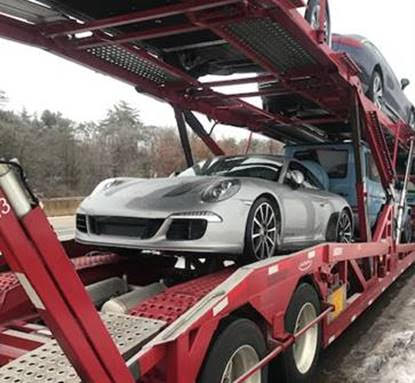
 The pick up went smoothly considering that it was in the middle of a snowstorm. It was pointed out to me that modern car carriers are now built so that the sides are open and the drivers door can be used for easy entry/exit. Apparently, in years past drivers had to get in and out of the car by climbing through the window.  For the 300lb driver that picked up this ride that would’ve been a nonstarter.

The trip out to Goodyear only took a week and the cars were finally together. Tires were swapped and the cleanup was done by Louie, Robbie and Tommy and they were rewarded with rides back and forth to school. Louie even ran errands with it after calling me to get permission. Great crew.

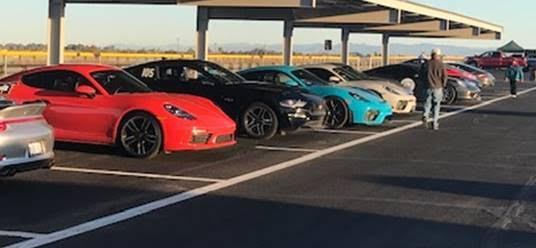
With the Arizona Motorsport Park less than a mile from the house the oil wasn’t even warmed up the morning that we drove both cars over to the track. It was chilly as the sun came up but turned into a great day for driving. Our shelf paper numbers looked great on the doors. The only panel done in metal anymore are the rear fenders so my old magnetic numbers have been retired to the back of the garage door. Rob made it easy by requesting numbers 31 and 311, all straight numbers in the Porsche font. Details are important.


Our advanced run group didn’t start until 9:30 so we had time to go back to the house for breakfast after dropping our gear in a premium parking spot.

The track is flat as a pancake, think big autocross, and over three miles long. With a couple of decent straights the C4S was going to have to be better in the turns to keep up with the Turbo S. The grippy race tires were definitely up to the task. There were to be four 20 minute sessions and they kept to the schedule down to the minute, very impressive.

The first session saw me finding my way, I didn’t want to be the guy who went off into the dirt and there was a lot of dirt. The video I had watched at home was helpful but it was tough to look ahead which what we tell every new student to do at a new track. If you know the track it’s easy to know when to keep your right foot down and when to tiptoe. As I was still learning, Rob was driving away. In the second session I had a better feel for the playing field and was able to keep up a little better. I chased him for a while but couldn’t get around him, he just went way too deep into the turns. He motioned me by to see if I could drive away but I couldn’t. We ran nose to tail the last ten minutes of the session, passing other cars like a train. Great fun.

By the third session it was catch me if you can. I had a better sense of the PCCB (Ceramic brakes) and could brake later that the C4S. Rob was still keeping up well but he ended the session early after his brakes began to fade. Turns out, he also corded a new Hoosier tire, a left front (we were running the track clockwise), so I know how hard he was trying. All in all, a terrific day at the track.

 The Big Dog is now back in Medfield having made the trip on the same truck with the same driver that took out the C4S. Strange how some things work out.

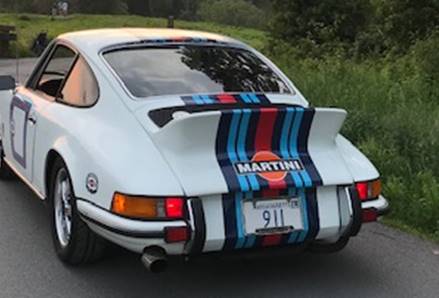
I may give the ’72 a rest this year and run the Turbo S in the Autocross series just to keep the young guys honest. I wonder how the Turbo S would look in a Martini suit? We’ll see.

Meanwhile, Summer is just around the corner.

KTF